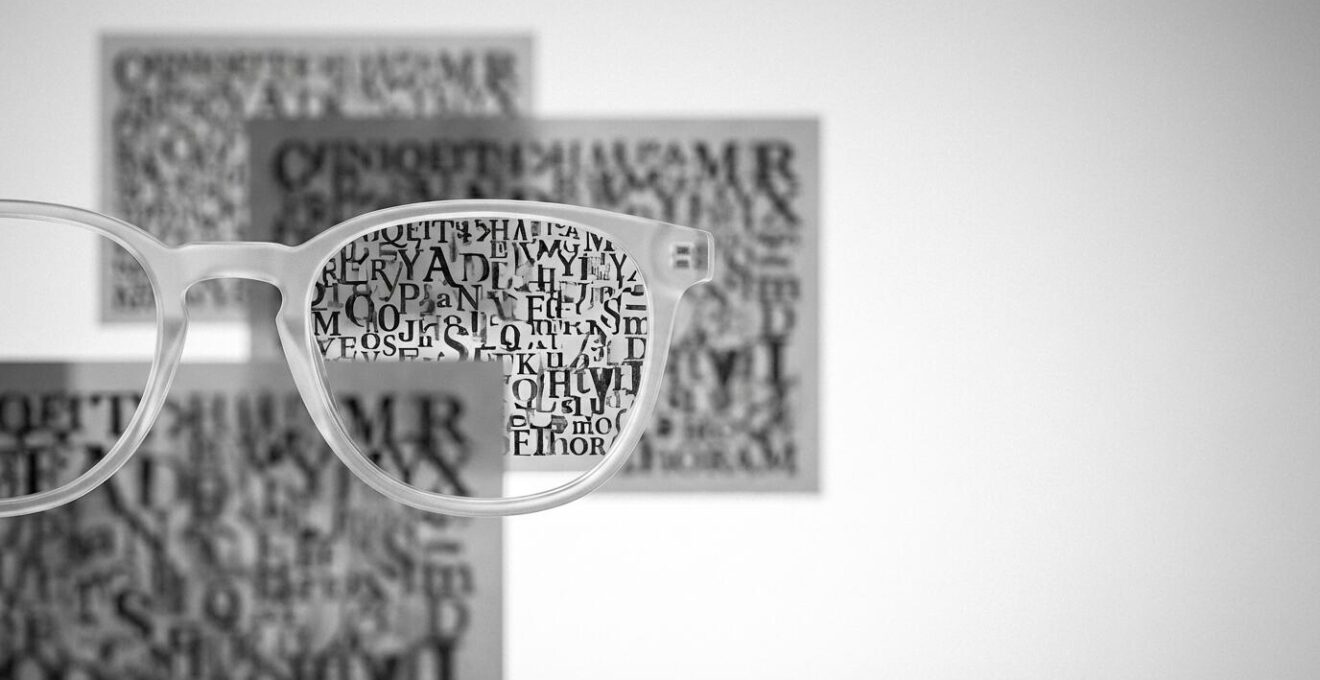
The frustration of blurry text is often caused by three distinct refractive errors, but the key to identifying yours lies in understanding *when* and *how* the blur appears.
- Blur that worsens with prolonged close work and causes headaches often signals underlying hyperopia (farsightedness).
- Consistent blur or distortion at all distances, like seeing halos around lights, is a classic sign of astigmatism.
- A gradual need to hold things further away to see them clearly after age 40 points directly to presbyopia.
Recommendation: Pay close attention to these “symptom signatures” to have a more informed conversation with your eye care professional.
That moment has arrived for many of us over 35. The text on your phone, a book, or a restaurant menu, once sharp and clear, now seems fuzzy and requires a conscious effort to read. You might find yourself squinting, holding your phone at arm’s length, or simply giving up on reading in dim light. It’s a common and often frustrating experience, leading to a cascade of questions. Is this just eye strain from too much screen time? Is it time for reading glasses? Or is it something more complex, like astigmatism?
The confusion is understandable because the primary symptom—blurry text—is shared across several conditions. Common advice often jumps straight to “see an eye doctor,” which, while essential, leaves you in the dark about what’s actually happening to your vision. You hear terms like hyperopia, presbyopia, and astigmatism, but they can feel like an interchangeable blur of clinical jargon. This leaves you unable to articulate your specific experience or understand the subtle clues your eyes are giving you.
But what if the key wasn’t just identifying the blur, but decoding its specific “symptom signature”? The true answer lies not in simply noting the blur, but in observing the context: when does it happen, for how long, and what makes it better or worse? This article moves beyond generic definitions to provide a clarifying framework. We will explore the distinct mechanical causes behind each type of blur, helping you differentiate between temporary strain and a true refractive error, understand why some conditions go unnoticed for years, and learn what you can do to manage the symptoms effectively. By the end, you won’t just know the names of these conditions; you’ll understand the story your eyes are telling you.
This guide will walk you through the distinct signs and underlying causes of each condition, providing the clarity needed to understand your vision. The following sections are designed to help you pinpoint the likely source of your blur.
Summary: Understanding the Source of Your Blurry Vision
- Why Hyperopia Often Goes Undiagnosed Until After Age 30?
- How to Spot the Difference Between Digital Strain and Refractive Error?
- Single Vision vs. Toric Lenses: Which Corrects Mixed Astigmatism Better?
- The Headache Cycle: What Happens When You Ignore +0.50 Hyperopia?
- Problem & Solution: Adjusting Font Sizes for Uncorrected Presbyopia
- Why Negative Diopters Shrink Eyes Appearance While Positive Ones Magnify?
- Why Being Under 21 Disqualifies You From Most Laser Surgeries?
- How to Read Your Eyeglass Prescription Before Ordering Online?
Why Hyperopia Often Goes Undiagnosed Until After Age 30?
Many people with hyperopia, or farsightedness, spend their childhood and young adult years with seemingly perfect 20/20 vision, only to find themselves struggling with blurry text and eye fatigue as they enter their 30s. This delayed onset can be confusing, but it’s rooted in the eye’s natural ability to compensate. In a hyperopic eye, the eyeball is slightly too short, causing light to focus behind the retina instead of directly on it. This makes near objects inherently blurry.
So, how does a young person see clearly? Through accommodative effort. The eye’s internal lens is flexible and controlled by the ciliary muscle. In a young hyperope, this muscle works overtime, flexing the lens to pull the focal point forward onto the retina, providing clear vision without conscious effort. This powerful compensation mechanism is highly effective, and research from StatPearls medical database shows that this ability to overcome hyperopia can mask the condition entirely for decades. The problem is, this constant muscle work isn’t free; it consumes energy and can lead to subtle, unexplained symptoms.
As we age, the lens naturally stiffens and the ciliary muscle’s focusing power weakens. Around age 30, the accommodative system starts to lose its reserve capacity. The muscle can no longer sustain the extra effort required to maintain clear near vision, especially during prolonged tasks like reading. This is when the previously hidden hyperopia is “unmasked.” The blur that was always being corrected now becomes noticeable, accompanied by symptoms of eye strain and headaches. It’s not that the hyperopia suddenly appeared; it’s that the eye’s ability to hide it has finally diminished, revealing the underlying refractive error that was there all along.
How to Spot the Difference Between Digital Strain and Refractive Error?
In today’s screen-centric world, it’s easy to blame any visual discomfort on “digital eye strain.” While this is a real condition, its symptoms can closely mimic those of an uncorrected refractive error, leading to confusion. Distinguishing between the two is crucial, as their solutions are very different. The National Eye Institute reports that over 150 million Americans have refractive errors, many of whom might mistakenly attribute their persistent blur to temporary screen fatigue.
The primary difference lies in duration and context. Digital eye strain is a temporary condition caused by the specific demands of screen use, such as reduced blink rates leading to dryness and prolonged focusing effort. Its symptoms, like surface irritation, grittiness, and temporary blur, typically improve significantly after you take a break from the screen. If your vision clears up after following the 20-20-20 rule (looking at something 20 feet away for 20 seconds every 20 minutes), you are likely experiencing digital strain.
A refractive error, on the other hand, is a structural issue with how your eye focuses light. This could be hyperopia, myopia, or astigmatism. The blur it causes is persistent and consistent, remaining even after you’ve rested your eyes. While screen use can exacerbate the symptoms and make you notice the blur more, the underlying problem exists regardless of the task. If you find that text is blurry not just on your computer but also on a printed page, or if distant signs are hard to read after a long day of office work, a refractive error is the more likely culprit. The following table helps clarify these distinctions.
| Characteristic | Digital Eye Strain | Refractive Error |
|---|---|---|
| Symptom Duration | Improves after 20-30 minute break | Persists even after rest |
| Symptom Type | Surface discomfort (dryness, grittiness) | Deep blur requiring squinting |
| Context Dependency | Task-dependent (during screen use) | Environment-dependent (all distances) |
| Relief Methods | Eye drops, breaks, 20-20-20 rule | Corrective lenses needed |
| Vision Quality | Clear vision returns after rest | Consistent blur pattern |
Single Vision vs. Toric Lenses: Which Corrects Mixed Astigmatism Better?
Astigmatism creates a unique type of blur. It occurs when the cornea or lens has an irregular, football-like shape instead of being perfectly round. This causes light to focus on multiple points in front of or behind the retina, resulting in distorted or blurry vision at all distances. However, it often coexists with other refractive errors like hyperopia (farsightedness) or myopia (nearsightedness), a condition known as mixed astigmatism. This is where choosing the right type of lens becomes critical.
A standard single vision lens has a uniform spherical curve designed to correct hyperopia or myopia. It can bend light equally in all directions. If you have only a very mild astigmatism, a single vision lens might provide adequate vision, but it cannot fully address the core problem. It corrects the general focus but leaves the distortion from the irregular shape unaddressed, which can still lead to eye strain and imperfect clarity.
This is where a toric lens excels. As the illustration below demonstrates, a toric lens is an engineering marvel with two different powers in two different orientations, perpendicular to each other. One power addresses the myopia or hyperopia, while the other addresses the astigmatism itself. This dual-power design creates a complex focal plane that precisely counteracts the eye’s irregular shape, bringing all light rays to a single, sharp focus on the retina. For anyone with moderate to significant astigmatism, a toric lens is not just better—it’s essential for achieving true visual clarity and comfort.

The choice between them often depends on the severity of the astigmatism and your daily activities. For tasks requiring high precision, like night driving or graphic design, the superior correction of a toric lens is non-negotiable. This table shows how uncorrected astigmatism impacts various activities and where each lens type is most effective.
| Activity | Impact of Uncorrected Astigmatism | Single Vision Adequacy | Toric Lens Benefit |
|---|---|---|---|
| Night Driving | High – Light halos and streaking | Partial correction | Full correction recommended |
| Computer Work | Moderate – Eye strain and blur | May suffice for low astigmatism | Better for prolonged use |
| Reading | Moderate – Letter distortion | Acceptable for casual reading | Essential for extended reading |
| Sports | Variable – Depth perception issues | Often adequate | Beneficial for precision sports |
| Graphic Design | High – Fine detail blur | Insufficient | Required for accuracy |
The Headache Cycle: What Happens When You Ignore +0.50 Hyperopia?
A prescription of +0.50 diopters seems almost negligible. Many people who receive such a diagnosis for hyperopia question whether it’s even worth getting glasses. They can often pass a vision test and see clearly, especially when they are young and well-rested. However, ignoring even a small amount of farsightedness can trigger a frustrating and chronic “headache cycle” that degrades quality of life. The problem isn’t the blur, which is often successfully compensated for, but the hidden effort required to achieve that clarity.
As we’ve discussed, a hyperopic eye must constantly use its ciliary muscle to accommodate, or refocus light, for clear near vision. With a +0.50 prescription, this effort is low-grade but persistent. During tasks like reading, computer work, or even focusing during a meeting, that muscle is in a state of constant tension. This prolonged, unacknowledged muscular strain is what leads to asthenopia—a clinical term for eye fatigue. According to medical research, asthenopia frequently manifests as a dull, frontal, or frontotemporal headache.
This creates a vicious cycle. You start a task, your eyes work overtime to compensate for the hyperopia, the ciliary muscle fatigues, and a headache begins. The headache reduces your ability to concentrate, making you strain even more, which in turn worsens the headache. You might not even connect the headache to your vision because your sight remains relatively clear. You might blame stress, dehydration, or lack of sleep. Yet, the root cause is the relentless, low-level effort of your focusing system. Correcting this small refractive error with glasses, even for part-time use during near tasks, breaks the cycle by letting the muscle relax. The glasses do the work, relieving the strain and preventing the headache before it starts.
Your action plan: Breaking the Hyperopia Headache Cycle
- Schedule a comprehensive eye exam and mention your headaches; a cycloplegic refraction can reveal hidden hyperopia.
- Consciously implement the 20-20-20 rule: Every 20 minutes, look at something 20 feet away for at least 20 seconds to relax the focusing muscle.
- Optimize your workstation with bright, ambient lighting to reduce the accommodative demand on your eyes.
- Seriously consider a prescription for even a small correction like +0.50D, especially for reading or computer glasses.
- Monitor your symptoms after getting correction. If headaches persist, it’s important to investigate other potential causes with a healthcare professional.
Problem & Solution: Adjusting Font Sizes for Uncorrected Presbyopia
Presbyopia is the one refractive error that is a universal and inevitable part of aging. Typically starting around age 40, it’s the gradual loss of the eye’s ability to focus on near objects. This happens because the natural lens inside the eye becomes less flexible. The most common first sign is the need to hold menus, books, or your phone further away to see the text clearly—the classic “trombone arm” effect. While the ultimate solution is corrective lenses like reading glasses or progressives, there are powerful environmental adjustments you can make to improve clarity in the meantime.
The most intuitive fix is increasing the font size on your digital devices. This is a great first step, as larger letters are easier to discern when your focusing system is compromised. However, simply making text bigger isn’t the only—or even the most effective—strategy. A more holistic approach involves optimizing the entire reading environment for maximum legibility. This means focusing on three key elements: contrast, spacing, and lighting.
High contrast is critical. Text that is gray on a light gray background, a common design choice, is incredibly difficult for a presbyopic eye to read. Switching to true black text on a pure white background makes the letterforms stand out. Similarly, adjusting letter and line spacing can work wonders. Slightly increased space between letters (kerning) and lines (leading) prevents the text from visually “crowding” together, allowing your brain to process it more easily. Finally, lighting is paramount. A presbyopic eye needs more light to see clearly up close. Reading in a dimly lit room is a recipe for frustration, while a well-lit space with a cool-toned (daylight) bulb can dramatically sharpen the appearance of text, as demonstrated in the optimized workspace below.

By combining these techniques, you can create a “clarity trio” that goes far beyond simply enlarging the font. Many of these options are available in the accessibility settings of your computer or smartphone. Actively managing these settings provides a powerful, non-prescription method for coping with the early stages of presbyopia and reducing daily visual strain.
Why Negative Diopters Shrink Eyes Appearance While Positive Ones Magnify?
One of the first things people notice after getting new glasses is how they change the appearance of their eyes. Wearers with prescriptions for myopia (nearsightedness) often feel their eyes look smaller and set back, while those with hyperopia (farsightedness) find their eyes appear larger and more magnified. This isn’t an illusion; it’s a direct consequence of the fundamental physics of light and the type of lens used for correction.
The effect is all about how the lenses bend light. As the Barraquer Ophthalmology Centre explains, a negative diopter lens used to correct myopia is a concave lens. It is thinner in the center and thicker at the edges. This shape causes light rays to diverge, or spread out, before they enter the eye, effectively pushing the focal point back onto the retina. When someone looks at the wearer, they are looking through a lens that creates a minification effect, making the eyes and the surrounding part of the face appear smaller.
Conversely, a positive diopter lens for correcting hyperopia is a convex lens—thicker in the center and thinner at the edges. It acts like a magnifying glass. This shape causes light rays to converge, or come together, helping the eye’s weak focusing system bring the focal point forward onto the retina. To an outside observer, this convergence creates a magnification effect, making the wearer’s eyes appear larger. The higher the prescription, the more pronounced this minification or magnification will be.
| Lens Type | Optical Effect | Eye Appearance | Minimization Strategy |
|---|---|---|---|
| Negative (Myopia) | Light divergence | Eyes appear smaller | High-index lenses, smaller frames |
| Positive (Hyperopia) | Light convergence | Eyes appear larger | Aspheric design, centered fitting |
| Contact Lenses | Direct corneal correction | Natural appearance | No visible effect |
| Progressive | Variable magnification | Changes by viewing zone | Digital lens technology |
Fortunately, modern lens technology offers ways to minimize these cosmetic effects. High-index materials allow lenses to be made thinner and lighter, reducing the distortion. Aspheric lens designs feature a more complex, flattened curvature that reduces the magnification effect of positive lenses. And, of course, contact lenses, which sit directly on the cornea, eliminate these optical distortions entirely, offering a completely natural appearance.
Why Being Under 21 Disqualifies You From Most Laser Surgeries?
For many young adults struggling with glasses or contacts, laser vision correction like LASIK seems like the ultimate solution. It can be disheartening to be told you are a perfect candidate in every way—except for your age. Most reputable surgeons will not perform laser surgery on patients under the age of 21, and often recommend waiting until 25. This isn’t an arbitrary rule; it’s a critical safety measure based on the principle of refractive stability.
Laser surgery works by permanently reshaping the cornea to correct a refractive error. For the procedure to have a lasting effect, the eye’s prescription must be stable. Throughout childhood and adolescence, the eye is still growing and changing. This means a person’s prescription for myopia or hyperopia can fluctuate significantly, a process that typically continues until the early twenties. Performing surgery on an eye that is still changing is like trying to hit a moving target. The correction might be perfect on the day of the surgery, but as the eye continues to evolve, the refractive error can return, requiring glasses or a risky secondary procedure.
The benchmark for surgery is demonstrating a stable prescription—meaning no significant change—for at least one to two years. As a 2024 report from the National Academies of Sciences confirms, the eye’s focusing system becomes far less dynamic and refractions tend to stabilize after approximately age 20. Waiting until the eye has reached its full adult size and the prescription has stopped changing ensures that the surgical correction will be accurate and permanent. This patience is a small price to pay for a lifetime of clear vision without the need for future interventions.
While waiting for refractive stability, young patients are not without excellent options. The International Myopia Institute emphasizes the use of advanced, non-permanent technologies. For example, Orthokeratology (Ortho-K) involves wearing special rigid contact lenses overnight that temporarily reshape the cornea, providing clear vision during the day without glasses or surgery. Modern daily disposable contact lenses also offer a safe, comfortable, and effective bridge until a patient is ready for a permanent surgical solution.
Key Takeaways
- The context of your visual blur (when and where it happens) is the most important clue to its cause.
- Temporary blur that improves with rest is often digital strain, while persistent blur at specific distances points to a refractive error.
- Even minor uncorrected hyperopia can cause chronic headaches due to constant, subconscious focusing effort.
How to Read Your Eyeglass Prescription Before Ordering Online?
Once you’ve had a comprehensive eye exam, you’ll be given a prescription. This small piece of paper holds all the information needed to correct your specific vision, but its grid of abbreviations and numbers can look like a foreign language. Understanding how to read it is empowering, especially if you plan to order glasses online. Decoding your prescription allows you to ensure accuracy and make informed choices about your lenses. Each component has a very specific meaning.
The prescription is typically laid out in a table with rows for your right eye (O.D. – oculus dexter) and left eye (O.S. – oculus sinister). The key columns you’ll need to understand are:
- SPH (Sphere): This is the main part of your prescription. A minus sign (-) indicates myopia (nearsightedness), while a plus sign (+) indicates hyperopia (farsightedness). The number represents the power in diopters.
- CYL (Cylinder) & AXIS: These two values always go together and indicate astigmatism. CYL is the amount of astigmatism, and AXIS is its orientation in degrees (from 1 to 180). If these fields are blank, you don’t have astigmatism.
- ADD (Addition): This value is only present on prescriptions for bifocals or progressive lenses. It represents the additional magnifying power needed for reading, used to correct presbyopia.
- PD (Pupillary Distance): This is the distance in millimeters between the centers of your pupils. It’s a critical measurement for ensuring the optical center of the lenses aligns with your eyes, but it’s often not included on the prescription itself. You may need to ask for it specifically or measure it yourself.
It’s crucial to enter these numbers precisely when ordering online, including the plus or minus signs. A small typo can result in glasses that are unwearable. While convenient, ordering online puts the responsibility of transcription on you. Always double-check your entries against the paper prescription before finalizing an order. Remember that a prescription is only valid for a limited time (usually 1-2 years) because your vision can change.
Frequently asked questions on Astigmatism, Hyperopia, or Presbyopia: What Causes Your Blurry Text?
Why is my PD (Pupillary Distance) not on my prescription?
PD is a fitting measurement, not a prescription value. Many eye doctors don’t include it as it’s typically measured when fitting frames. You can measure it yourself using a ruler and mirror, or ask your eye care provider specifically for this measurement.
What does it mean if my AXIS is 90° vs 180°?
AXIS indicates the orientation of your astigmatism correction. 90° corrects vertical astigmatism, 180° corrects horizontal, and any degree in between corrects oblique astigmatism. This must be precisely aligned for clear vision.
Can I use an expired prescription to order glasses online?
While technically possible, it’s not recommended. Prescriptions typically expire after 1-2 years because vision can change. Using an outdated prescription may result in eyestrain, headaches, or inadequate vision correction.