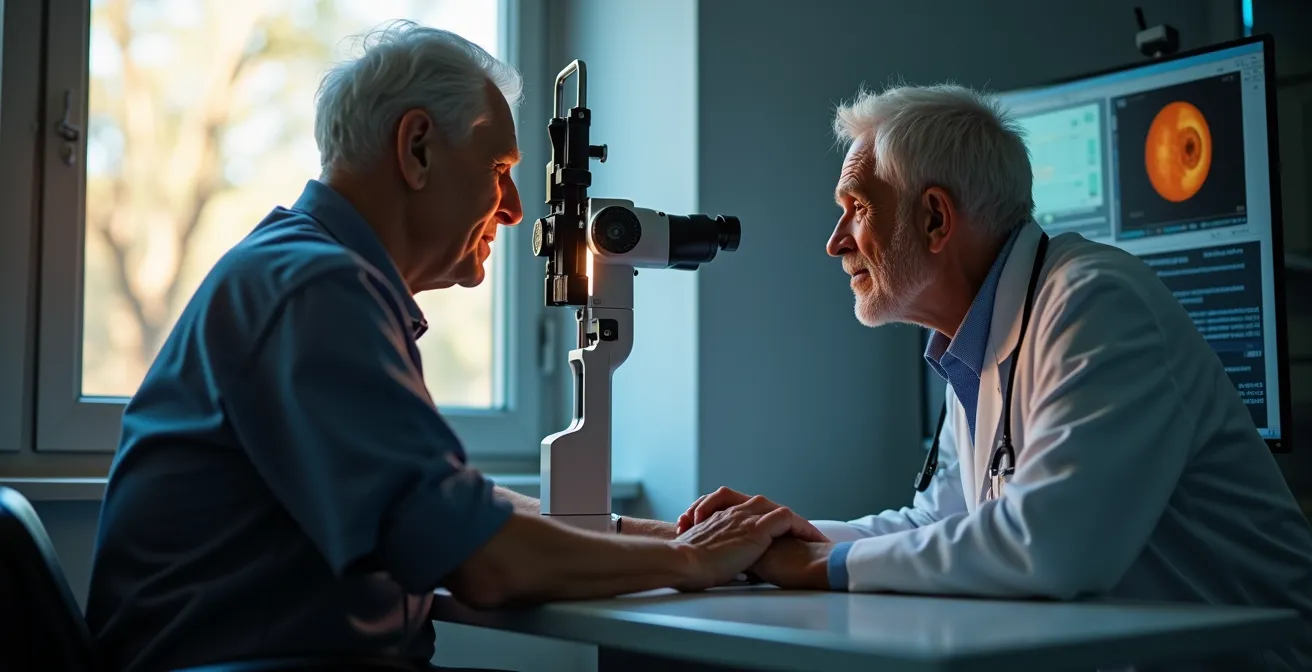
Despite aggressive marketing, there is no strong scientific evidence that blue light from digital devices causes macular degeneration or that filter glasses prevent it.
- The primary drivers of age-related macular degeneration (AMD) are well-established genetic and lifestyle factors, not screen use.
- True prevention involves managing proven risks like UV exposure, smoking, and poor nutrition, which have a far greater impact on eye health.
Recommendation: Prioritize evidence-based habits like a diet rich in antioxidants, consistent UV protection, and regular eye exams over investing in blue light filters for disease prevention.
If you’re an office worker, you’ve been bombarded with advertisements for blue light filtering glasses. The marketing is compelling, often hinting at dire consequences for your long-term vision and positioning these lenses as an essential shield against the purported dangers of screen time. The central claim often implies that by filtering blue light, you are actively preventing serious conditions like age-related macular degeneration (AMD). This has created a billion-dollar market built on a foundation of fear and the promise of a simple, technological fix.
But as a skeptical consumer, you’re right to question these claims. Is the blue light emanating from your monitor truly a long-term threat to your retina, or is this a case of a solution in search of a problem? The conversation around eye health has been disproportionately focused on this single, marketable issue, while far more significant, scientifically-backed risk factors are often relegated to the footnotes. What if the key to preserving your vision isn’t found in a special lens coating, but in understanding the fundamental, yet less glamorous, pillars of ocular health?
This evidence-based review will critically examine the science, or lack thereof, behind blue light filters and AMD. We will dismantle the marketing hype by contrasting it with the robust evidence for genuine risk factors. By shifting the focus from screen glare to the biological and environmental realities of eye aging, this article will provide you with a clear, actionable framework for what truly matters in protecting your sight for decades to come.
To navigate this complex topic, we will dissect the most critical, evidence-based factors that influence your long-term eye health. The following sections will provide a clear hierarchy of risks and protective measures, allowing you to make informed decisions based on science, not marketing.
Summary: A Critical Look at Long-Term Macular Health
- Why Quitting Smoking Reduces Your Risk of Cataracts by 40%?
- How to Incorporate Lutein and Zeaxanthin Into a Vegan Diet?
- AREDS2 Supplements or Kale Salad: Which Is Better for Early AMD?
- The UV Damage That Occurs Even When It Is Overcast
- When to Start Glaucoma Screenings if Your Parent Lost Vision?
- Blue Light Coatings or Anti-Fatigue Lenses: Which Helps Focus?
- Why Meibomian Glands Need High-Quality Fats to Function?
- Fish Oil or Flaxseed: Which Omega-3 Source Actually Helps Dry Eye?
Why Quitting Smoking Reduces Your Risk of Cataracts by 40%?
Before we even address the contested science of blue light, it’s essential to establish a baseline for what constitutes a proven, high-impact risk to eye health. Smoking is arguably one of the most destructive and well-documented lifestyle factors. The toxic chemicals in cigarette smoke are absorbed into the bloodstream and directly damage the delicate structures of the eye. This oxidative stress accelerates the aging process, particularly in the lens, leading to the formation of cataracts—a clouding that impairs vision.
The evidence linking smoking to eye disease is overwhelming and provides a stark contrast to the speculative nature of claims about screen-emitted blue light. For instance, recent ophthalmological studies confirm that heavy smokers (defined as 15 or more cigarettes daily) have up to three times the risk of developing cataracts compared to non-smokers. This isn’t a minor correlation; it’s a profound, dose-dependent relationship. The more you smoke, the more you poison your eyes’ natural defense and repair mechanisms.
The good news, however, is that this damage is not entirely irreversible. The body has a remarkable capacity for recovery. A landmark study published in JAMA Ophthalmology provided clear evidence of this. As the Physicians’ Health Study Research Team noted, former smokers who had quit for 20 years or more saw their risk decrease significantly. Specifically, their analysis found that compared with current smokers, past smokers showed relative risks of 0.74 after two decades of cessation. This demonstrates that quitting is one of the single most powerful proactive steps you can take to preserve your vision, with benefits that far outweigh any putative protection from blue light filters.
How to Incorporate Lutein and Zeaxanthin Into a Vegan Diet?
While external filters are marketed as a necessary shield, the eye possesses its own powerful, internal defense system. At the core of this system are two carotenoids: lutein and zeaxanthin. These compounds accumulate in the macula, the central part of the retina responsible for sharp, detailed vision. Here, they form the macular pigment, which acts as a natural filter for high-energy light, including the blue-violet spectrum. This internal shield is your first and most important line of defense against light-induced oxidative stress.
Research into this natural protection shows that a dense macular pigment can be remarkably effective. It is estimated that these macular pigments can block a significant portion of incoming blue light before it ever reaches the sensitive photoreceptor cells. This underscores a critical concept: building up your body’s innate defenses is a more biologically sound strategy than relying solely on external accessories. For those on a vegan diet, which excludes common sources like egg yolks, a targeted approach to plant-based nutrition is essential to maintain this protective layer.
The key is not just consuming these nutrients, but ensuring they are properly absorbed. Lutein and zeaxanthin are fat-soluble, meaning they require dietary fat to be transported from your gut into your bloodstream and ultimately to your eyes. Simply eating a plain salad of leafy greens will result in minimal absorption. Pairing these sources with healthy fats is a non-negotiable step for bioavailability.
Your Action Plan: Fortifying Your Macular Pigment on a Vegan Diet
- Prioritize dark leafy greens like kale, spinach, and collard greens as your primary sources of lutein.
- Always pair these greens with a source of healthy fat, such as avocado, a handful of nuts, or a dressing made with olive oil, to maximize absorption.
- Include orange and yellow vegetables like corn and orange bell peppers to ensure you are getting a good amount of zeaxanthin.
- Lightly steam or cook your greens; this can help break down cell walls and increase the bioavailability of the carotenoids.
- Aim for a consistent daily intake through food combinations, targeting around 6-10mg of lutein and 2mg of zeaxanthin for optimal macular health.
AREDS2 Supplements or Kale Salad: Which Is Better for Early AMD?
The conversation around nutrition for Age-Related Macular Degeneration (AMD) often pits whole foods against targeted supplements. This is a crucial distinction for anyone seeking evidence-based prevention. The Age-Related Eye Disease Studies (AREDS and AREDS2) were landmark clinical trials that established a specific formula of antioxidants, including lutein and zeaxanthin, as effective in slowing the progression of intermediate to advanced AMD. It is critical to understand that the AREDS2 formula is a high-dose therapeutic intervention, not a preventative measure for the general population or those with early AMD.
For individuals without a diagnosis of moderate AMD, the evidence overwhelmingly supports a dietary approach. A kale salad, rich not only in lutein but also in fiber, vitamins, and other anti-inflammatory compounds, offers holistic benefits that a pill cannot replicate. Epidemiological studies consistently show that populations with high intakes of leafy green vegetables have lower rates of AMD. This suggests that the synergistic effect of nutrients in whole foods plays a vital role in long-term prevention. The supplement is a targeted treatment; the salad is a foundational health strategy.
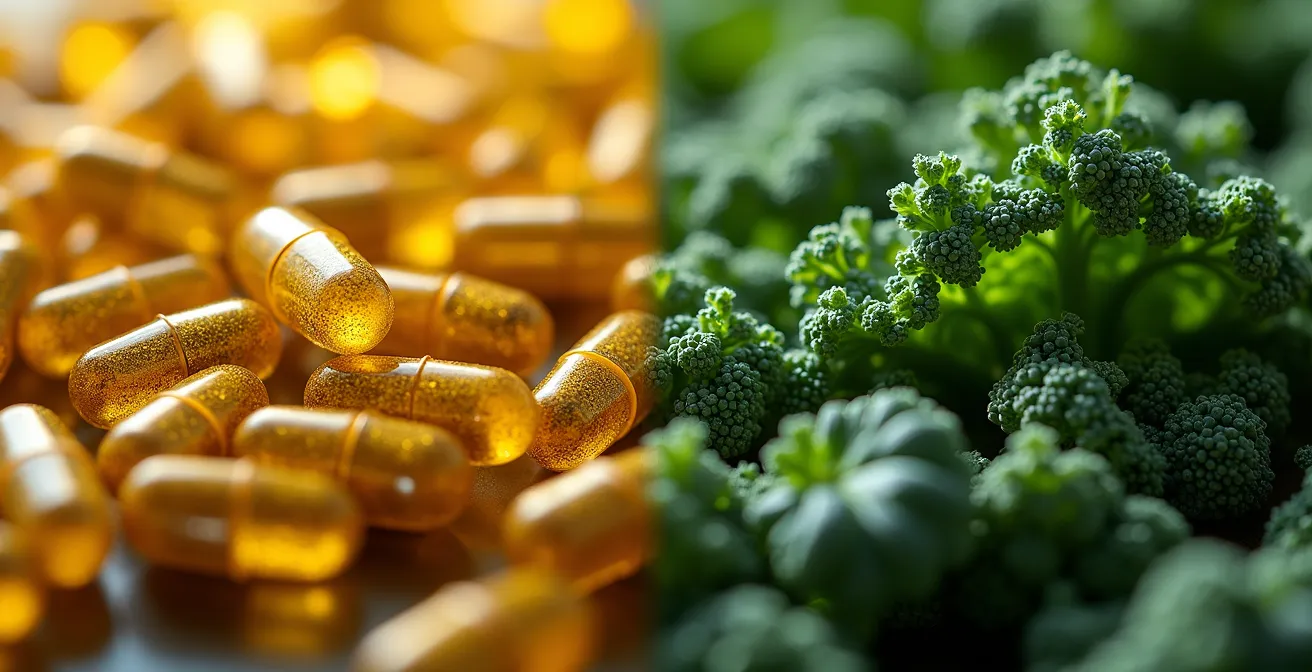
This image perfectly captures the core of the debate: the manufactured precision of a supplement versus the complex, natural matrix of a whole food. The choice between them depends entirely on your specific health profile and should be guided by an ophthalmologist. Relying on an AREDS2 supplement for general prevention is a misapplication of the evidence, akin to taking a potent medication “just in case.”
The following table breaks down the fundamental differences between these two approaches, clarifying their distinct purposes in the context of macular health.
| Aspect | AREDS2 Supplements | Kale Salad (Dietary) |
|---|---|---|
| Primary Purpose | Slow progression of intermediate to advanced AMD | Prevention and overall macular health |
| Dosage | High-dose therapeutic (10mg lutein, 2mg zeaxanthin) | Variable, typically 2-6mg lutein from 1 cup kale |
| Additional Benefits | Targeted AMD treatment only | Fiber, vitamins K/C/A, anti-inflammatory compounds |
| Recommended For | Diagnosed intermediate AMD patients | Everyone for prevention, especially high-risk individuals |
| Evidence Base | Proven to reduce progression by 25% in specific populations | Epidemiological studies show lower AMD rates with high vegetable intake |
The UV Damage That Occurs Even When It Is Overcast
The intense marketing focus on blue light from screens has created a significant blind spot regarding a far more potent and proven danger: ultraviolet (UV) radiation from the sun. Unlike the low-energy, diffuse blue light from your laptop, UV light is high-energy radiation with a long-established causal link to ocular diseases, including cataracts, pterygium, and certain forms of ocular cancer. It is a scientifically confirmed carcinogen for the eye.
A common and dangerous misconception is that UV protection is only necessary on bright, sunny days. This is fundamentally incorrect. Environmental research demonstrates that up to 80% of UV rays can penetrate clouds, haze, and fog. On an overcast day, the diffuse light can scatter, meaning your eyes are bombarded with UV radiation from multiple angles, not just from directly overhead. This incidental, cumulative exposure over a lifetime is a primary driver of long-term ocular damage.
The damage from UV light is insidious and cumulative. Each moment of unprotected exposure contributes to the slow degradation of the eye’s structures. This is a proven versus postulated risk. While the debate over screen-emitted blue light continues, the verdict on UV radiation is in and has been for decades. Prioritizing the purchase of blue light filters while neglecting to wear high-quality, 100% UV-blocking sunglasses outdoors is a critical misallocation of resources and attention. A wide-brimmed hat and proper sunglasses are not just accessories for comfort; they are essential medical devices for preserving long-term vision, effective on both sunny and cloudy days.
When to Start Glaucoma Screenings if Your Parent Lost Vision?
While environmental factors like smoking and UV exposure are significant, we cannot ignore the powerful role of genetics in long-term eye health. For many sight-threatening conditions, family history is the single most important non-modifiable risk factor. This is particularly true for glaucoma, a disease characterized by progressive damage to the optic nerve, often without symptoms in its early stages. It is a leading cause of irreversible blindness, and its risk is strongly inherited.
If you have a first-degree relative—a parent or sibling—with glaucoma, your personal risk skyrockets. The hierarchy of evidence is clear on this point. Ophthalmological genetics research confirms that individuals with a first-degree relative with glaucoma have a 3 to 9 times higher risk of developing the disease themselves. This genetic predisposition means that standard screening guidelines for the general population do not apply to you. Proactive, early screening is not optional; it is essential.

This scenario illustrates the critical importance of intergenerational health awareness. Understanding your family’s ocular history is as crucial as any lifestyle choice you make. For high-risk individuals, the key is to begin comprehensive dilated eye exams much earlier and more frequently than low-risk peers. A general rule of thumb is to start screenings 10 years prior to the age at which your parent was diagnosed, but no later than age 40. Waiting for symptoms to appear is a failing strategy, as significant and permanent vision loss has already occurred by that point.
Blue Light Coatings or Anti-Fatigue Lenses: Which Helps Focus?
Now we arrive at the heart of the marketing claims. Many office workers who experience discomfort after long hours at the computer—often labeled “digital eye strain”—are led to believe that blue light is the culprit. In response, they purchase blue light filtering lenses. However, it’s crucial to dissect the symptoms. Is the issue truly the wavelength of light, or is it the act of focusing at a fixed, near distance for prolonged periods? This is where the distinction between blue light coatings and anti-fatigue lenses becomes critical.
These two technologies are designed to solve entirely different problems. A blue light coating is a filter that selectively blocks a portion of the high-energy visible (HEV) light spectrum. Its primary proposed function is to reduce potential circadian rhythm disruption from evening device use. An anti-fatigue lens, on the other hand, is a feat of optical engineering. It incorporates a small, almost imperceptible power boost in the lower portion of the lens, which provides accommodative support. This subtly reduces the focusing effort your eyes must exert for near tasks, directly addressing the muscular strain that leads to focusing fatigue and blur.
For a worker struggling with blurry vision or difficulty refocusing after hours of screen time, an anti-fatigue lens directly targets the physiological cause of the problem. A blue light filter does not. Furthermore, the central premise that blue light from devices is harmful to the retina has been widely refuted by major health institutions. As stated in an article from Harvard Medical School, the evidence is simply not there. They conclude, ” The amount of blue light from electronic devices is not harmful to the retina or any other part of the eye. Blue light from electronic devices is not going to increase the risk of macular degeneration.” This expert consensus deals a fatal blow to the primary marketing claim used to sell these lenses for disease prevention.
To clarify, here is a direct comparison of the two lens technologies:
| Feature | Blue Light Coatings | Anti-Fatigue Lenses |
|---|---|---|
| Primary Function | Filter high-energy blue light (380-500nm) | Provide accommodative support for near vision |
| Problem Addressed | Perceived digital eye strain, potential circadian rhythm disruption | Focusing fatigue, blurred near vision |
| Mechanism | Selective wavelength filtering | Progressive power addition in lower lens |
| Best For | Extended screen time, particularly evening device use | Frequent focus shifts and prolonged near work |
| Symptom Relief | May reduce ‘tired and wired’ feeling, unproven for strain | Directly relieves blurry vision and focusing difficulty |
Why Meibomian Glands Need High-Quality Fats to Function?
Many symptoms attributed to “blue light sensitivity,” such as burning, irritation, and light sensitivity, are often classic signs of dry eye disease. A primary cause of this condition is Meibomian Gland Dysfunction (MGD). These tiny glands lining your eyelids are responsible for secreting the oily layer (meibum) of your tear film. This oil is crucial; it prevents your tears from evaporating too quickly, keeping the eye’s surface smooth and comfortable. The quality of this oil is directly influenced by the quality of fats in your diet.
Think of the meibum as needing to have the consistency of olive oil to flow freely from the glands. When your diet is high in unhealthy saturated fats, the meibum can become thick and viscous, more like butter or lard. This thick oil can easily clog the gland openings, leading to inflammation, gland atrophy, and a deficient tear film. This instability causes evaporative dry eye, which in turn makes the eyes feel gritty, tired, and hypersensitive to all light, not just blue light.
This connection highlights another facet of the body’s “internal defense mechanisms.” A healthy tear film is the eye’s first optical surface. When it’s compromised, light scatters improperly, and discomfort ensues. The solution isn’t to filter a specific color of light but to restore the health of the ocular surface. This is achieved not through glasses, but through nutrition.
Clinical Observations on Dietary Fat and Meibum Quality
Clinical observations show that patients consuming diets high in omega-3 fatty acids from marine sources demonstrate improved meibum quality with lower melting points, similar to olive oil consistency. This allows for better tear film stability and reduced evaporative dry eye symptoms. Conversely, diets high in saturated fats produce thicker, more viscous meibum that clogs gland openings, leading to dysfunction and increased light sensitivity often mistaken for blue light intolerance.
This demonstrates a direct, biological link between dietary choices and ocular comfort. Addressing the root cause of dry eye through high-quality fat intake is a far more effective strategy than attempting to manage a single symptom with a lens filter.
Key Takeaways
- There is no robust scientific evidence linking blue light from screens to the development of AMD.
- Proven, high-impact risks for eye disease include smoking, cumulative UV exposure, and poor nutrition.
- The body’s internal defenses, like macular pigment from lutein/zeaxanthin and a healthy tear film from omega-3s, are more critical than external filters.
Fish Oil or Flaxseed: Which Omega-3 Source Actually Helps Dry Eye?
Understanding that dietary fats are crucial for managing dry eye brings us to a practical and often debated question: which source of omega-3 fatty acids is most effective? The market is flooded with options, but the biochemical reality is that not all omega-3s are created equal. The key difference lies in their form and bioavailability.
Plant-based sources like flaxseed, chia seeds, and walnuts are rich in alpha-linolenic acid (ALA). ALA is a precursor omega-3, meaning the body must convert it into the long-chain fatty acids eicosapentaenoic acid (EPA) and docosahexaenoic acid (DHA) to be used for its anti-inflammatory functions. Marine sources like fish oil and algae oil, however, provide EPA and DHA directly. This distinction is critical because the human body is notoriously inefficient at this conversion process. Nutritional biochemistry research confirms that, in most individuals, less than 5% of ALA converts to usable EPA/DHA. This means you would need to consume a massive amount of flaxseed oil to achieve the same anti-inflammatory benefit as a modest dose of fish or algae oil.
For treating the inflammation associated with Meibomian Gland Dysfunction, the direct, potent anti-inflammatory effects of EPA and DHA are what matter. This makes marine-sourced omega-3s the clear winner from an evidence-based perspective. For vegans or those who do not consume fish, algae oil is an excellent alternative, as it is a primary plant-based source of direct EPA and DHA.
This table compares the efficacy of the most common omega-3 sources for managing dry eye.
| Source | Active Compounds | Bioavailability | Dry Eye Efficacy |
|---|---|---|---|
| Fish Oil | EPA & DHA (direct) | High – immediately usable | Proven anti-inflammatory effect on glands |
| Flaxseed Oil | ALA (precursor) | Low – <5% conversion rate | Limited evidence for direct benefit |
| Algae Oil | EPA & DHA (direct) | High – plant-based alternative | Comparable to fish oil effectiveness |
Ultimately, the overwhelming focus on blue light filters is a distraction from the actionable, evidence-based strategies that truly protect your vision. The path to long-term ocular health is not paved with specialized coatings, but with conscious lifestyle choices. By quitting smoking, consistently wearing UV protection, maintaining a diet rich in antioxidants and high-quality fats, and adhering to a proactive screening schedule based on your genetic risk, you are addressing the factors that scientific consensus has proven to matter. For a customized plan, consulting with an eye care professional to discuss your specific risks and needs is the most logical next step.
Frequently asked questions about Light Exposure and Eye Protection
Why is UV protection necessary on cloudy days?
UV radiation penetrates cloud cover effectively, with up to 80% of harmful rays reaching ground level even on overcast days. The diffuse light can sometimes increase exposure from multiple angles.
How does UV damage differ from blue light exposure?
UV light is proven high-energy radiation causing cataracts and surface damage, while blue light from screens is lower energy with unproven retinal damage links in typical exposure scenarios.
What protection methods work beyond sunglasses?
Wide-brimmed hats reduce overhead UV by 50%, UV-blocking contact lenses provide additional protection, and seeking shade during peak hours (10am-4pm) significantly reduces cumulative exposure.