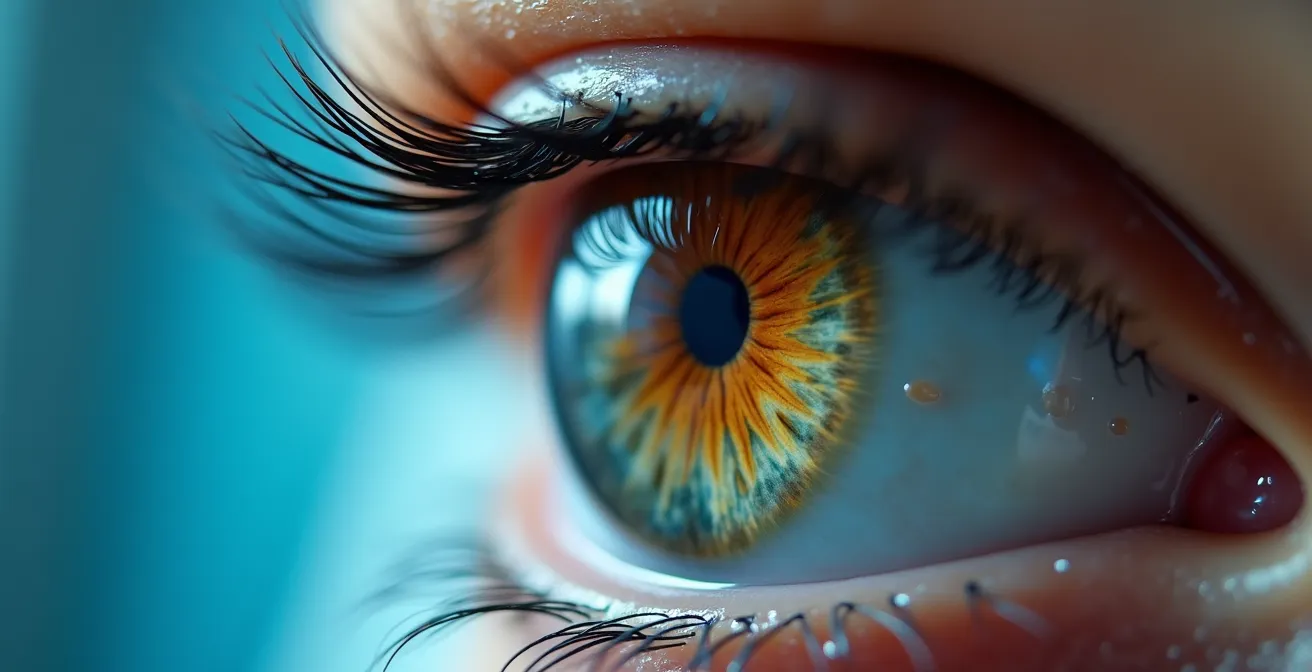
Chronic dry eye that doesn’t respond to standard drops is often a sign of a mechanical failure in your tear system, not just a lack of moisture.
- Evaporative Dry Eye (EDE), accounting for 86% of cases, is a plumbing issue (clogged oil glands), not a supply issue.
- Aqueous Deficient Dry Eye (ADDE) is a tear supply issue (low production from lacrimal glands).
Recommendation: Identify your specific type using the symptom guide within and switch from simply rewetting your eyes to implementing targeted, clinical-grade treatments like therapeutic heat and preservative-free formulas.
If you find yourself in a relentless cycle of applying artificial tears, feeling fleeting relief, and then reaching for the bottle again within the hour, you are not alone. This constant, frustrating battle is the reality for millions who believe their eyes are simply “dry.” The conventional wisdom is to add more moisture, yet for many, this approach provides no lasting comfort. This experience is a primary indicator that the root of your problem is not a simple lack of tears, but a more complex mechanical failure within your ocular system.
The dry eye landscape is dominated by two distinct conditions that require fundamentally different treatment strategies: Evaporative Dry Eye (EDE) and Aqueous Deficient Dry Eye (ADDE). Think of it as a plumbing problem versus a water supply problem. Simply pouring more water onto the floor won’t fix a leaky pipe. In the same way, endlessly adding artificial tears is often futile if your eye’s natural oil-retaining layer is compromised. The key to breaking the cycle of dependency on drops is to move beyond generic rewetting and embrace a diagnostic approach.
This guide is designed to function as a clinical tool. It will help you understand the mechanical failures behind your symptoms, differentiate between the two primary types of dry eye, and identify the specific, targeted interventions that address the underlying cause of your discomfort. We will deconstruct the function of your tear film, explore the environmental and behavioral triggers that sabotage it, and outline a clear path toward restoring your eye’s natural, healthy equilibrium.
By understanding the precise nature of your condition, you can finally move from temporary fixes to effective, long-term management. The following sections provide the diagnostic framework to help you and your eye care professional determine the true source of your dryness and the most effective therapeutic path forward.
Summary: Evaporative Dry Eye or Aqueous Deficiency: Which One Do You Have?
- Why You Blink 60% Less When Looking at a Smartphone?
- How to Perform a “Hard Blink” to Reset Your Tear Film?
- Oil Glands or Tear Ducts: Which Is the Root of Your Dryness?
- The Drying Effect of Sleeping With a Ceiling Fan on High
- Problem & Solution: Unclogging Oil Glands With Warm Compresses at Home
- The Dry Eye Mistake That Ruins Contact Lens Comfort for 60% of Users
- Scleral Lenses or Standard Gas Permeable: Which Heals Severe Dry Eye?
- Preservative-Free or Bottle: Which Artificial Tear is Safe for Hourly Use?
Why You Blink 60% Less When Looking at a Smartphone?
The human eye is engineered to blink approximately 15 to 20 times per minute. This reflex is not random; it is a critical mechanical process that spreads a fresh, three-layer tear film across the ocular surface, nourishing the cornea and providing a smooth refractive surface for clear vision. However, when engaged in tasks that demand high concentration, particularly looking at digital screens, a phenomenon known as “task-induced blink suppression” occurs. The intense focus required to process information on a screen overrides the natural blink reflex.
Clinically, this leads to a dramatic decrease in blink frequency. In fact, studies have shown that focused screen use causes a 60% reduction in blink rate. This reduction has profound consequences. With fewer blinks, the tear film is not replenished. The aqueous (water) layer evaporates more quickly, and the crucial outer lipid (oil) layer thins out, leading to instability and the rapid onset of evaporative dry eye symptoms like burning and fluctuating vision. Furthermore, the blinks that do occur are often incomplete, failing to fully “wipe” the cornea and express the essential oils from the meibomian glands.
This is a primary reason why symptoms often worsen after long periods of reading or computer work. The eye’s maintenance system is effectively shut down by sustained concentration. To counteract this, it is essential to consciously reintroduce full, complete blinks and take structured breaks. A simple, effective strategy is the 20-20-20 rule: every 20 minutes, you must look away from your screen at an object at least 20 feet away for a full 20 seconds. This simple action breaks the concentration-induced stare, allowing your blink rate to reset and your tear film to recover.
How to Perform a “Hard Blink” to Reset Your Tear Film?
For individuals with evaporative dry eye, the issue is often not the blink rate itself, but the *quality* of the blink. Many people, especially during screen use, perform rapid, incomplete “flicker blinks” where the upper and lower eyelids never make full contact. This is a significant mechanical failure. A complete blink is necessary for two reasons: it spreads the tear film evenly, and, more importantly, the gentle pressure of the closed lids acts as a pump, expressing the protective oil (meibum) from the meibomian glands located in the eyelids.
When blinks are incomplete, this oil expression fails to occur. The meibum becomes stagnant, thickens, and clogs the glands, exacerbating evaporative dry eye. A “hard blink,” or more accurately, a therapeutic blink, is a conscious exercise designed to counteract this. It is a deliberate, two-step motion: first, gently close your eyes as if going to sleep, ensuring the lids touch. Second, pause for a moment and then give a firm, but not forceful, squeeze for two seconds before relaxing and opening. This sustained pressure is highly effective at expressing the meibum and re-establishing a healthy lipid layer on your tear film.
This technique should be practiced consciously throughout the day, especially during screen use. Performing a set of five therapeutic blinks every 20 minutes can dramatically improve tear film stability and reduce symptoms. It effectively re-engages the natural mechanics of the eye that have been suppressed by modern visual demands. The goal is to retrain your blinking pattern so that full, complete blinks become reflexive once again.

As you can see in the demonstration, the emphasis is on full closure and a deliberate squeeze. This is not about blinking harder or faster, but about performing the action completely and with intention. This simple exercise can serve as a powerful reset button for your tear film, providing immediate relief and contributing to the long-term health of your oil glands.
Oil Glands or Tear Ducts: Which Is the Root of Your Dryness?
Understanding the source of your dry eye is the most critical step toward finding effective relief. The two primary categories, Aqueous Deficient Dry Eye (ADDE) and Evaporative Dry Eye (EDE), have distinct underlying causes and symptom patterns. ADDE is a “supply” problem where the lacrimal glands fail to produce enough of the watery component of tears. In contrast, EDE is a “plumbing” problem, where the eye produces enough water, but it evaporates too quickly due to a deficient or unstable oil layer produced by the meibomian glands. This distinction is crucial, as EDE accounts for an overwhelming 86% of all dry eye cases.
Many patients mistakenly assume they have ADDE because their eyes feel “dry,” leading them to use standard artificial tears that only supplement the aqueous layer. This provides minimal relief for EDE because the added water simply evaporates just as quickly as their natural tears. Identifying your subtype is possible by observing your symptom patterns. The following table outlines the key clinical differences and can serve as a diagnostic starting point for your discussion with a specialist.
This table highlights the key diagnostic indicators that help differentiate between evaporative and aqueous-deficient conditions. Pay close attention to when your symptoms are at their worst.
| Characteristic | Evaporative (EDE) | Aqueous Deficient (ADDE) |
|---|---|---|
| Worst Time | Upon awakening | Worsens throughout day |
| Primary Cause | Meibomian gland dysfunction | Lacrimal gland dysfunction |
| Prevalence | 86% of dry eye cases | 10-14% of cases |
| Response to Blinking | Temporary relief | Little to no relief |
| Morning Symptoms | Crusty, gritty eyes | Less pronounced |
If your symptoms are worst upon waking, with a gritty or crusty feeling, it strongly suggests EDE. This occurs because stagnant, unhealthy oils have accumulated overnight. Conversely, if your eyes feel relatively fine in the morning but become progressively worse as the day goes on, this points toward ADDE, as your limited tear supply is depleted over time. Blinking can also be a clue; in EDE, a hard blink can provide temporary relief by expressing some oil, whereas in ADDE, it has little effect.
The Drying Effect of Sleeping With a Ceiling Fan on High
The eight hours spent sleeping represent a significant period where the ocular surface is vulnerable. The environment of your bedroom can either be a sanctuary for healing or a catalyst for severe morning dry eye. A primary antagonist in the sleep environment is moving air. A ceiling fan on high, or even a poorly directed air conditioning vent, creates a constant airflow across the face. This airflow dramatically accelerates the evaporation of the tear film, even through closed eyelids.
This is particularly problematic for individuals with nocturnal lagophthalmos, a condition where the eyelids do not close completely during sleep, leaving a portion of the ocular surface exposed. According to Dr. Robert W. Weisenthal of SUNY Upstate Medical University, this condition has a surprisingly high prevalence. As he notes in a foundational study, “Nocturnal lagophthalmos affects up to 20% of the population and significantly worsens overnight dryness when combined with air movement.” For these individuals, sleeping under a fan is the equivalent of leaving their eyes in a wind tunnel all night, leading to severe inflammation, pain, and grittiness upon waking.
Creating a protective sleep environment is a non-negotiable therapeutic intervention. The goal is to minimize air movement and maximize humidity around the eyes. This can be achieved through several practical steps:
- Position a humidifier on the nightstand to create a localized high-humidity zone (aim for 40-50% humidity).
- Apply thick, preservative-free gel drops or ointment 30 minutes before sleep to create a lubricating barrier.
- Use moisture chamber goggles or specialized sleep masks like Eyeseals 4.0 to create a sealed, humid environment around the eyes.
- Redirect any ceiling fan away from the face or use the lowest setting with an oscillating function to disrupt direct airflow.
- If diagnosed with nocturnal lagophthalmos by a doctor, medical-grade eyelid tape may be recommended to ensure full closure.
By transforming your bedroom into a high-humidity, still-air “safe zone,” you allow your ocular surface the chance to heal and rehydrate overnight, rather than endure further damage. This single change can result in a dramatic improvement in morning comfort.
Problem & Solution: Unclogging Oil Glands With Warm Compresses at Home
For the 86% of dry eye sufferers with Meibomian Gland Dysfunction (MGD), the root cause is a plumbing blockage. The meibum, or oil, that should be thin and clear like olive oil becomes thick and viscous, like toothpaste. This clogged oil cannot be expressed by natural blinking, leading to a deficient lipid layer and rapid tear evaporation. The most effective at-home therapy to address this is the application of targeted, sustained heat.
The goal of a warm compress is not simply comfort; it is a therapeutic procedure to melt the solidified meibum. To be effective, the compress must reach and maintain a specific temperature range. According to extensive research, clinical studies demonstrate that maintaining a temperature of 40-42°C (104-108°F) for 8-10 minutes is required to effectively liquefy the obstructed meibum. This is a critical detail that is often missed. A simple wet washcloth, a common recommendation, fails this standard. It feels warm initially but loses its therapeutic heat within one to two minutes, rendering it ineffective.

To achieve consistent therapeutic heat, specialized microwavable eye masks (such as Bruder or MGDRx masks) are the clinical standard for home use. They are designed with materials that absorb moisture from the air and hold a consistent temperature for the required duration. The difference in outcomes is not trivial, as validated by recent evidence.
Case Study: Comparison of DIY vs. Commercial Warm Compress Methods
A 2024 evidence-based review of 20 studies found a significant difference in efficacy between methods. Microwavable eye masks maintained the therapeutic temperature (>40°C) for the full 10-minute duration. In stark contrast, wet washcloths dropped below the therapeutic range within 2 minutes. The clinical impact was clear: study participants who used consistent-heat devices showed 45% better meibomian gland scores after just 4 weeks compared to those who used simple washcloths. This confirms that the method of heat delivery is as important as the heat itself.
Immediately following the 8-10 minute heat application, it is beneficial to perform gentle eyelid massage and a series of therapeutic blinks to help express the newly liquefied oil. This combination of melting and expressing is the most powerful at-home intervention for managing MGD.
The Dry Eye Mistake That Ruins Contact Lens Comfort for 60% of Users
For contact lens wearers with dry eye, lens selection is fraught with counterintuitive pitfalls. A common and costly mistake is choosing a lens based on the belief that a “high water content” is better for a dry eye. On the surface, it seems logical: a dry eye needs more water, so a lens with more water should be more comfortable. In reality, the opposite is often true, particularly for those with aqueous deficiency.
High water content (typically 50% or more) soft lenses are hydrophilic, meaning they are “water-loving.” To maintain their shape, flexibility, and oxygen permeability, they must remain fully hydrated. In a healthy eye with an abundant tear film, this is not an issue. However, in an aqueous-deficient eye, the lens cannot draw enough moisture from the tear film. As Dr. Cynthia Matossian, a leading dry eye specialist, explains, “High-water content lenses can actually act like a sponge, drawing tears from an already dry eye to maintain their own hydration.” This process actively desiccates the cornea, leading to increased friction, inflammation, and end-of-day discomfort that makes continued wear impossible.
For this reason, many modern contact lenses designed for dry eye, especially those made from silicone hydrogel materials, have a lower water content. They rely on the superior oxygen permeability of the silicone material itself, rather than water, to keep the cornea healthy. This makes them less dependent on the patient’s tear film for their own structural integrity. Understanding which material works best for your specific type of dry eye is paramount.
| Lens Type | Water Content | Best For | Avoid If |
|---|---|---|---|
| Silicone Hydrogel | 24-46% | Evaporative dry eye (EDE) | Silicone sensitivity |
| High Water Content | 50-80% | Mild cases only | Aqueous deficiency (ADDE) |
| Scleral GP | 0% (fluid reservoir) | Severe ADDE | Mild cases (overkill) |
| Daily Disposables | Variable | All dry eye types | Cost concerns |
Choosing a daily disposable lens is often the best overall strategy, as it eliminates the problem of protein and lipid deposits that build up on monthly or bi-weekly lenses. These deposits can destabilize the tear film and increase irritation. A fresh, clean lens every day provides the best possible wearing experience for a compromised ocular surface.
Scleral Lenses or Standard Gas Permeable: Which Heals Severe Dry Eye?
When standard soft contact lenses and aggressive lubrication fail to provide relief for severe dry eye, it is time to consider specialty lenses. These are not merely vision-correcting devices; they are therapeutic prosthetics designed to protect and heal the ocular surface. The two primary options are standard corneal Gas Permeable (GP) lenses and larger scleral lenses. While both are made from rigid, oxygen-permeable materials, their mechanism of action is fundamentally different.
A corneal GP lens rests directly on the cornea, vaulting over its central part. Its small diameter allows for good tear exchange around the edges. This design can be effective for individuals with mild to moderate evaporative dry eye, as the smooth lens surface can provide a better refractive plane than an unstable tear film. However, for a severely compromised cornea, particularly in cases of aqueous deficiency, direct contact with any lens can be intolerable.
This is where scleral lenses offer a revolutionary solution. A scleral lens is a large-diameter GP lens that completely vaults over the entire cornea and rests on the sclera (the white part of the eye). This design creates a space between the back of the lens and the front of the cornea. Before insertion, this space is filled with a preservative-free saline solution, creating a liquid reservoir or “fluid bandage” that continuously bathes the cornea in moisture throughout the day. This provides profound relief from dryness and protects the sensitive corneal nerves from the environment and the friction of the eyelids. For patients with severe ADDE, Stevens-Johnson syndrome, or other ocular surface diseases, scleral lenses are often a life-changing intervention that restores both vision and comfort.
Your Action Plan: Determining Your Best Specialty Lens Option
- Assess Severity and Type: Consider scleral lenses if you have a diagnosis of severe Aqueous Deficient Dry Eye (ADDE), corneal irregularities (like keratoconus), or have failed all other treatments.
- Evaluate Tear Volume and Cost: Try a corneal GP lens first if you have mild to moderate Evaporative Dry Eye (EDE), good tear volume, and are more cost-conscious, as they are typically less expensive.
- Consider Hybrid Options: Hybrid lenses, which feature a rigid GP center and a soft outer “skirt,” can be an intermediate step for those who need the crisp vision of a GP lens but the comfort of a soft lens.
- Perform Daily Monitoring: Regardless of the type, you must monitor daily for signs of lens fogging, protein deposits, or changes in comfort, which may indicate a need for fit or solution adjustments.
- Prioritize a Professional Fitting: The success of any specialty lens is entirely dependent on a precise, expert fitting. An improper fit can create suction, limit oxygen, and significantly worsen your dry eye symptoms.
The choice between these advanced options is a clinical decision that depends heavily on the specific diagnosis, corneal anatomy, and severity of the condition. It requires a consultation with an eye care professional specializing in specialty contact lenses.
Key Takeaways
- Dry eye is a mechanical problem: EDE is a plumbing issue (clogged glands), while ADDE is a supply issue (low tear production).
- Therapeutic heat for EDE requires a sustained temperature of 40-42°C (104-108°F) for 8-10 minutes; a wet washcloth is ineffective.
- Frequent artificial tear use (more than 4 times daily) necessitates a preservative-free formula to avoid the toxic effects of preservatives like BAK.
Preservative-Free or Bottle: Which Artificial Tear is Safe for Hourly Use?
For patients with moderate to severe dry eye, particularly those with aqueous deficiency, the frequent application of artificial tears is a necessity. However, a critical and often overlooked danger lies within the bottle itself: preservatives. The most common preservative used in multi-dose bottles is benzalkonium chloride (BAK). While effective at preventing bacterial growth in the bottle, BAK is a known ocular surface toxin.
As Dr. Vatinee Bunya, a researcher at the University of Pennsylvania’s Scheie Eye Institute, states, the mechanism of this toxicity is directly counterproductive for many dry eye patients. “Benzalkonium chloride acts as a detergent that disrupts the lipid layer, making evaporative dry eye worse with each application.” It also causes direct damage to the epithelial cells of the cornea and conjunctiva, leading to inflammation, increased cell death, and a worsening of dry eye symptoms over time. The very “solution” a patient is using to find relief can be perpetuating the problem, especially with frequent use.
Because of this cumulative toxicity, a clear clinical guideline has been established. Official ophthalmology guidelines recommend that more than 4 times daily use requires preservative-free artificial tears. If you need to use drops every hour or two, using a bottled drop containing BAK is actively harming your eyes. Preservative-free (PF) tears are packaged in single-use sterile vials, eliminating the need for preservatives and ensuring each drop is safe for the delicate ocular surface. While more expensive, they are a medical necessity for frequent users.
| Preservative Type | Example Brands | Safety for Frequent Use | Best For |
|---|---|---|---|
| None (PF vials) | Refresh Plus, Systane Ultra PF | Unlimited | Severe dry eye, >4x daily |
| Disappearing (Purite) | Refresh Tears | Up to 6x daily | Moderate use, convenience |
| Soft (Polyquad) | Systane Balance | Up to 4x daily | Mild dry eye |
| BAK | Visine, Clear Eyes | Not recommended | Emergency use only |
Some multi-dose bottles use “soft” or “disappearing” preservatives (like Purite or Polyquad) that are less toxic than BAK. These are generally considered safe for use up to 4-6 times per day. However, for the chronic sufferer who relies on hourly application, single-use, preservative-free vials are the only truly safe and therapeutic option.
Armed with this diagnostic knowledge, your next step is to discuss these specific interventions—therapeutic heat, preservative-free options, and specialty lenses—with your eye care professional. This will allow you to build a targeted treatment plan that goes beyond simple rewetting drops and finally addresses the true mechanical root of your condition.