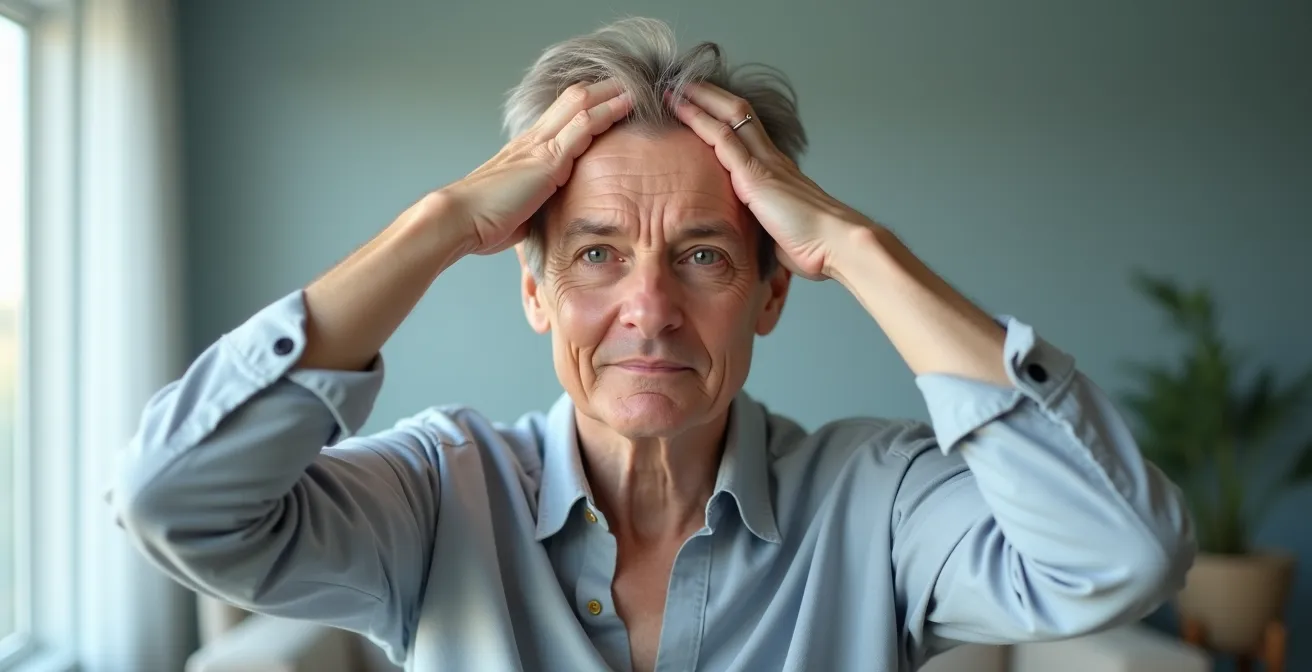
That predictable frontal headache hitting at 4 PM isn’t random fatigue; it’s a critical diagnostic clue. Contrary to the belief that it’s just a “long day,” this specific pattern often signals the depletion of your daily “accommodative budget”—the focusing power of your eyes—caused by a small, uncorrected vision problem. This guide decodes the timeline from morning clarity to afternoon pain, distinguishing it from a true migraine and revealing the underlying cause.
The sensation is maddeningly predictable. The morning starts clear, focused, and pain-free. But as the clock ticks past 3 PM, a dull, persistent ache begins to build behind your forehead. By 4 PM, it’s a full-blown frontal headache, making it difficult to concentrate on your screen or the drive home. You might dismiss it as stress or dehydration, or even wonder if it’s the start of a migraine. While common advice suggests simply resting your eyes or taking a painkiller, these solutions often miss the point entirely.
The timing and location of your headache are not incidental symptoms; they are the primary data points in a diagnostic puzzle. A headache that consistently appears at the same time late in the workday points less toward a classic neurological migraine and more toward a physiological limit being reached. The real culprit is often a minor, uncorrected refractive error, such as a +0.50 hyperopia, that forces your eye’s focusing muscles into a day-long marathon. This drains your “focusing budget” until it’s bankrupt by late afternoon.
This article will function as a diagnostic liaison, guiding you through the subtle but crucial differences between a headache born from visual fatigue and a primary migraine. We will dissect the timeline of your pain, explore the mechanical triggers related to your glasses, and explain why being honest during your eye exam is the ultimate preventative measure. Understanding this cycle is the first step to breaking it and ending those debilitating afternoon headaches for good.
To navigate this complex topic, this article breaks down the problem into distinct, diagnostic components. The following summary provides a roadmap to understanding the root cause of your pain and the steps you can take to find lasting relief.
Summary: Differentiating Eye Strain Headaches from Migraines
- Why Farsighted People Get Headaches When They Read Without Glasses?
- How to Massage Pressure Points to Relieve Eye Strain Headaches?
- New Glasses Headache or Adjustment Period: Which Is It?
- The Danger of Taking Ibuprofen Daily Instead of Checking Your Eyes
- When Does It Hurt: Why Morning Headaches Indicate a Different Problem?
- The Headache Cycle: What Happens When You Ignore +0.50 Hyperopia?
- The Migraine Caused by Frames That Sit Too Low on Your Face
- Why Being Honest About “Option 1 or 2” Prevents Headaches Later?
Why Farsighted People Get Headaches When They Read Without Glasses?
To understand the 4 PM frontal headache, you must first understand the concept of an “accommodative budget.” Every person, especially those with hyperopia (farsightedness), starts the day with a finite amount of focusing energy supplied by the ciliary muscle in the eye. A person with perfect distance vision uses 0% of this budget to see far away. However, a person with even a slight +0.50 farsightedness is already spending a portion of their budget just to keep distant objects clear. This creates a constant, low-level strain that goes unnoticed in the morning when reserves are full.
When this individual engages in near-work like reading or using a computer, the demand on the ciliary muscle skyrockets. The muscle must contract even more forcefully to bring the text into focus. This accelerated spending of the accommodative budget is what leads to the predictable timeline of pain. The headache isn’t a random event; it’s the refractive tipping point where accommodative demand finally outstrips the muscle’s remaining capacity. The frontal location is characteristic because the strain is concentrated in the muscles responsible for focusing and maintaining binocular vision.
The progression of symptoms throughout the day is a clear indicator of this accommodative reserve depletion. What begins as a full tank of focusing power in the morning systematically drains, leading to identifiable stages of visual fatigue.
- Stage 1 (Morning): A full accommodative reserve is available. You experience no symptoms and have clear vision at all distances.
- Stage 2 (Midday): The reserve depletes. You may feel mild eye tiredness or notice an occasional need to blink more frequently when reading.
- Stage 3 (Late afternoon): The reserve is critically low. A frontal headache begins, and you may find it difficult to switch focus between near and far objects.
- Stage 4 (Evening): The reserve is exhausted. This can manifest as bilateral frontal/temporal pain, blurred near vision, and even sensitivity to light (photophobia), mimicking a migraine.
How to Massage Pressure Points to Relieve Eye Strain Headaches?
While identifying the root cause is crucial, immediate relief from a tension-type headache is also necessary. When the ciliary muscle is overworked, the strain often refers to adjacent muscle groups, including those in the temples, brow, and neck. Targeted massage of specific pressure points can provide temporary but significant relief by increasing blood flow and releasing tension in these satellite muscles. This is not a cure, but a tactical intervention to manage the acute symptom of pain.
The key is to apply firm, sustained pressure rather than a light rubbing. This technique, often used in acupressure and physical therapy, helps to interrupt the pain signals being sent to the brain. For pain located directly between the eyebrows—often mistaken for sinus pressure—targeting the procerus muscle at the bridge of the nose can be particularly effective. The goal is to address the specific location of the pain with a corresponding massage technique, offering a more precise approach than simply rubbing your temples.
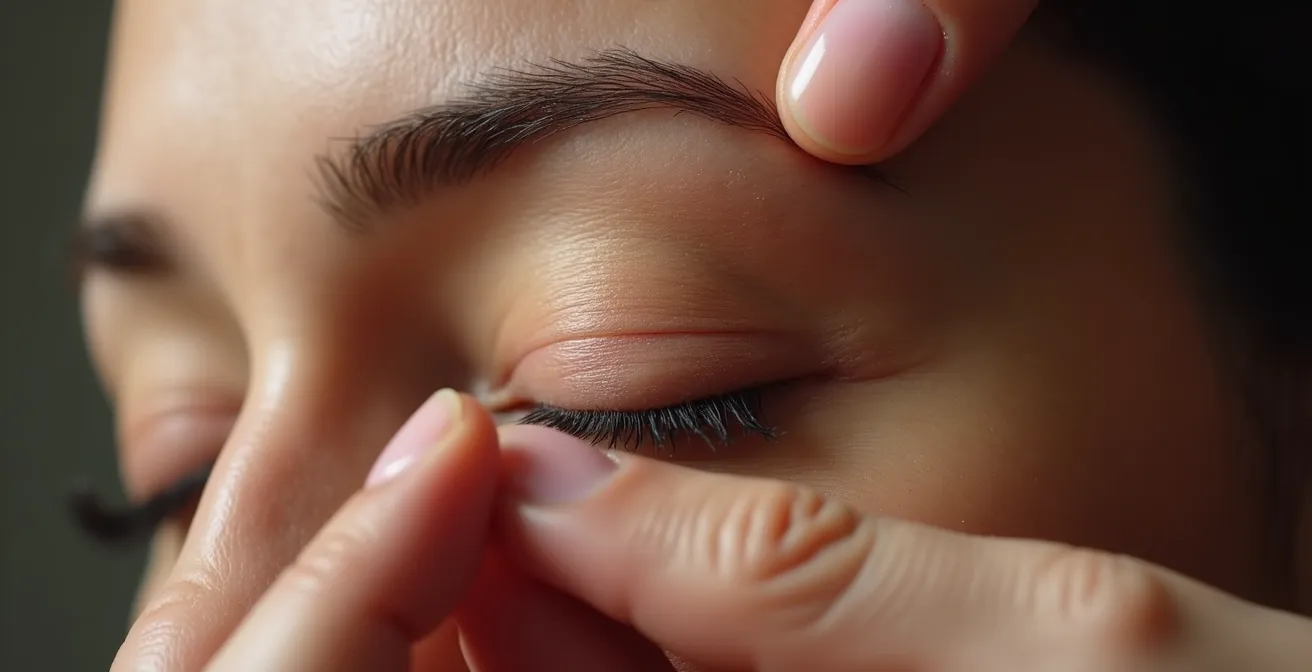
This hands-on approach directly addresses the physical manifestation of visual fatigue. By following a symptom-specific protocol, you can more effectively manage the discomfort as it arises.
- For pain between the brows: Apply firm, circular pressure to the procerus muscle (at the bridge of the nose) for 30 seconds, and repeat this 3 times.
- For temple pain from squinting: Using your fingertips, massage the temporalis muscle in slow circles, moving from your hairline down towards your jaw. Continue for 2 minutes on each side.
- For an ache behind the eyes: Press gently on the supraorbital notch (the center of your eyebrow ridge) with your thumb. Hold the pressure for 20 seconds, then release slowly.
- For neck-referred pain: Apply pressure to the suboccipital muscles at the base of your skull using a tennis ball against a wall. Hold the position for 1 minute.
New Glasses Headache or Adjustment Period: Which Is It?
A common diagnostic challenge arises when a headache begins after getting new glasses. Is the pain a sign of a prescription error, or is it just the normal neural adaptation period? Differentiating between the two is critical. A normal adjustment period involves your brain learning to process visual information through a new lens. This can cause a mild, transient “swim” effect or a general sense of eye fatigue that improves each day and typically resolves within 72 hours. This is your brain recalibrating.
In contrast, a headache from a prescription or fitting error feels fundamentally different. The pain is often sharper, more localized (e.g., intense pain behind one eye), and, most importantly, it worsens with wear time. If your headache is more severe at the end of the day than it was in the morning, it’s a significant red flag. This can be caused by an incorrect prescription, an inaccurate pupillary distance measurement, or poor frame alignment, such as the wrong pantoscopic tilt. A clinical review of adaptation symptoms shows that persistent nausea or a severe “fishbowl” effect are strong indicators of an error, not just adaptation.
The following table provides a clear framework for distinguishing normal symptoms from those that require a return visit to your optometrist. Paying attention to the type, location, and timing of your symptoms provides clear diagnostic evidence.
| Symptom Type | Normal Adaptation (Days 1-3) | Prescription/Fit Issue (Persists beyond 3 days) |
|---|---|---|
| Pain Location | Mild temple pressure, general eye fatigue | Sharp pain behind eyes, severe neck/ear pain from frames |
| Visual Symptoms | Slight swim effect, mild peripheral distortion | Persistent double vision, extreme fishbowl effect, nausea |
| Timing Pattern | Improves throughout the day | Worsens with wear time |
| Frame Issues | Initial awareness of frame edges | Pressure marks, sliding frames, uneven lens height |
The Danger of Taking Ibuprofen Daily Instead of Checking Your Eyes
When faced with a daily 4 PM headache, the most convenient response is to reach for an over-the-counter painkiller like ibuprofen. While this may temporarily dull the pain, it’s a dangerous form of symptom masking. It silences the body’s warning signal without addressing the underlying cause—the depleted accommodative budget. This creates a hazardous feedback loop: the visual problem persists, the headache returns tomorrow, and you take another pill. This pattern can lead to a more sinister condition known as Medication Overuse Headache (MOH).
MOH is a secondary headache disorder where the medication itself becomes the trigger. As Dr. Gerard Meskill states in the Merck Manual Professional Edition, “Regular overuse of NSAIDs for 15 or more days per month creates a self-perpetuating cycle where the medication itself becomes the cause of daily headaches.” This is a crucial distinction. The character of the pain changes from a predictable, end-of-day ache to a persistent, low-grade, daily headache that is often present upon waking. Medical references confirm the scale of this issue, noting that taking NSAIDs 15+ days per month for over three months can trigger MOH in up to 2% of the general population.

This cycle of masking the symptom not only fails to solve the root problem but actively creates a new, more complex one. The initial eye strain headache becomes complicated by a medication-induced one, making diagnosis and treatment far more difficult. It’s a trap that turns a simple refractive issue into a chronic pain condition.
Medication overuse headache must be differentiated from the primary headache disorder. Regular overuse of NSAIDs for 15 or more days per month creates a self-perpetuating cycle where the medication itself becomes the cause of daily headaches.
– Dr. Gerard Meskill, Merck Manual Professional Edition
When Does It Hurt: Why Morning Headaches Indicate a Different Problem?
The timing of your headache is the most powerful diagnostic clue. If your pain is consistently worst in the late afternoon, it strongly points to accommodative fatigue. Conversely, if you frequently wake up with a headache, the cause is almost certainly unrelated to visual strain from the previous day. Morning headaches open up an entirely different set of potential diagnoses, as the visual system has had a full night to rest and replenish its “focusing budget.”
A headache present upon waking signals a problem that occurred during sleep. The most common culprits are conditions that affect breathing, muscle tension, or blood pressure overnight. For instance, the bilateral, pressing headache associated with sleep apnea is caused by a drop in oxygen levels during the night. Similarly, a headache radiating from the jaw to the temples upon waking is a classic sign of bruxism (teeth grinding), where the temporomandibular joint (TMJ) and surrounding muscles are under intense strain for hours.
By using a process of elimination, the timing of your pain helps narrow the field of possibilities. If you never wake up with a headache, but it reliably appears as your workday progresses, you can more confidently focus your investigation on visual causes. This checklist helps differentiate the potential sources of morning headaches, highlighting how different their profiles are from a classic eye strain headache.
- Sleep Apnea: Check for snoring, gasping for air during sleep, and significant daytime fatigue. The headache is typically pressing and bilateral.
- Bruxism: Look for jaw pain, audible grinding, worn-down teeth, or TMJ clicking. Pain often radiates from the jaw to the temples.
- Dehydration: Note other signs like dry mouth, dark urine, and dizziness. The headache is often throbbing and improves after drinking fluids.
- Hypertension: Monitor your blood pressure upon waking. A pulsating, occipital (back of the head) headache can be a sign of high blood pressure.
- Caffeine Withdrawal: Track your coffee or tea consumption. A dull, diffuse ache that starts 12-24 hours after your last dose is a classic withdrawal symptom.
The Headache Cycle: What Happens When You Ignore +0.50 Hyperopia?
A small amount of uncorrected hyperopia, like +0.50D, may seem insignificant. In youth, the eye’s powerful accommodative system can easily compensate for it, rendering the person completely asymptomatic. This is why many people believe they have “perfect vision” for years. However, this compensation comes at a cost, relentlessly draining the daily “focusing budget.” As documented in a long-term study on the progression of untreated hyperopia, this hidden strain eventually leads to a predictable decline. By the age of 30-35, the accommodative reserve begins to wane, and the first symptoms emerge: afternoon headaches during near work.
The problem is not the work itself; it’s the fact that the hyperopic individual starts their focusing tasks with a handicap. Every single activity, even looking across the room, requires a baseline level of accommodative effort that a person with emmetropia (perfect vision) doesn’t need to exert. This creates a dramatically different daily expenditure of focusing energy. When presbyopia begins around age 40, this compounds the problem, leading to constant blur and daily, debilitating headaches.
This table, based on accommodation demand data, clearly illustrates how a small +0.50D refractive error dramatically increases the percentage of the daily focusing budget used for common activities, pushing the individual toward the 4 PM headache tipping point much faster.
| Activity | Accommodation Demand | % of Daily Budget Used (+0.50D Hyperope) | % Budget for Emmetrope |
|---|---|---|---|
| Distance viewing (TV) | 0.50D constant | 15% | 0% |
| Computer work (60cm) | 2.17D | 45% | 30% |
| Reading (40cm) | 3.00D | 65% | 50% |
| Phone use (30cm) | 3.83D | 85% | 70% |
This data, from an analysis of accommodative effort, provides the quantitative proof. The 4 PM headache isn’t a mystery; it’s simple math. The constant, low-level effort required by uncorrected hyperopia accelerates the depletion of a finite daily resource.
The Migraine Caused by Frames That Sit Too Low on Your Face
Sometimes the headache culprit isn’t the prescription itself, but the physical placement of the lenses in front of your eyes. Every prescription lens has an optical center (OC), the single point that provides the truest vision with no prismatic effect. Your optometrist measures your pupillary distance to ensure your pupil aligns perfectly with this OC. When frames are fitted correctly, your eye looks directly through this sweet spot for distance vision.
However, if your glasses constantly slide down your nose, your pupils will be positioned above the optical center. To see clearly, your eyes are forced to look downward through a part of the lens that induces a “base-up” prismatic effect. Your eye muscles must then fight this artificial prism all day long to maintain single, binocular vision. This induces severe eye strain and can trigger not just a tension headache, but a full-blown migraine with nausea and disorientation. This is especially true for patients with higher prescriptions or progressive lenses, where precise alignment is even more critical.
This is a mechanical problem, not a neurological one. Sufferers may not realize they are constantly making micro-corrections, like tucking their chin to look through the proper part of the lens. This leads to both eye strain and neck pain. Performing a simple self-check in a mirror can reveal if your frames are the source of your pain.
Your Action Plan: Optical Center Self-Check Protocol
- Stand approximately 3 feet from a mirror. Close one eye and look straight ahead into your open eye.
- Check if your pupil aligns perfectly with the optical center of the lens. New glasses sometimes have a small ink mark indicating the OC.
- If your pupil is sitting noticeably above the center of the lens, your frames are positioned too low. This is a primary cause of prismatic effect and strain.
- For progressive lenses, ensure your pupil aligns with the upper “distance zone” when you are looking straight ahead.
- Pay attention to your posture during the day. Document any habitual chin-tucking or head-tilting you do to see clearly at various distances; this is a key sign of poor fit.
Key Takeaways
- Your daily 4 PM frontal headache is a key diagnostic clue, often signaling a depleted “accommodative budget” from uncorrected vision issues, not a random migraine.
- Using painkillers like ibuprofen for a recurring eye strain headache masks the symptom and can lead to Medication Overuse Headache (MOH), a more complex chronic condition.
- The fit of your glasses is as critical as the prescription; frames that sit too low force your eyes to fight a prismatic effect, which can trigger severe headaches and migraines.
Why Being Honest About “Option 1 or 2” Prevents Headaches Later?
The entire diagnostic and corrective process begins in one place: the optometrist’s exam chair. The moment the doctor asks, “Which is better, option one or option two?” is the most critical juncture in preventing future headaches. Many patients, wanting to be “correct” or quick, will guess if the difference is subtle. This is a fundamental mistake. That tiny, seemingly negligible 0.25 diopter difference between the two choices can be the exact amount of strain that accumulates over an 8-hour workday to trigger your 4 PM headache.
As one expert notes, the choice isn’t just about sharpness; it’s about comfort. One option might appear slightly clearer, but if it requires more accommodative effort to maintain, it will be the one that bankrupts your focusing budget by the end of the day. Your honest, subjective feedback is the most valuable data you can provide. Voicing uncertainty or describing a feeling of “pulling” or “strain” is far more useful to the optometrist than a hasty guess.
The tiny 0.25D difference between ‘1 and 2’ might seem negligible in the exam chair, but your visual system may have to work slightly harder to maintain focus with one of them. Over 10-12 hours of wear, this tiny extra effort accumulates into significant eye strain and headaches.
– Dr. Olivia Begasse De Dhaem, American Headache Society Clinical Guidelines
You are not being tested; you are providing crucial feedback for a custom-fit medical device. Being an active, honest participant in your eye exam is the primary preventative measure against eye strain headaches. Instead of guessing, use clear, descriptive language to help your doctor find the prescription that is not only sharp but also the most relaxed for your visual system. The following scripts can help you communicate more effectively.
- Instead of guessing: “They both look about the same to me.”
- For comfort feedback: “Option 1 is sharper, but Option 2 feels more relaxed.”
- When unsure: “Can you show me those again? I need more time to decide.”
- For strain indication: “I feel a slight pulling sensation with Option 2.”
- Honest uncertainty: “Neither feels completely comfortable – is there another option?”
Your journey to a pain-free afternoon begins with recognizing your headache not as a random affliction, but as a data point. The next logical step is to bring this data to a professional who can perform a comprehensive eye health and refractive examination to confirm the diagnosis and provide the correct prescription.