
In summary:
- Your prescription is a precise map of your eye’s unique needs, not just a list of numbers. Understanding the “why” behind SPH, CYL, and AXIS is key.
- Factors like the time of day can affect your exam results, and an outdated prescription actively causes cognitive strain, not just blurry vision.
- Distinguishing between normal adjustment symptoms (mild, fading “fishbowl” effect) and a true prescription error (sharp, persistent headaches) is crucial after purchase.
- For stronger prescriptions, choosing the right lens index (e.g., 1.67 vs. 1.74) is a critical balance between aesthetics, comfort, and cost.
That small slip of paper from your optometrist can feel like a barrier. It sits between you and a new pair of glasses, filled with cryptic abbreviations like SPH, CYL, and AXIS. For anyone trying to buy glasses online, this document can be a source of major anxiety. What if you enter a number in the wrong box? What does an “Axis” of 90 even mean, and what happens if it’s off by a single degree? This confusion is the single biggest hurdle to unlocking the convenience and savings of online eyewear retailers.
Many guides simply act as a dictionary, defining each term in isolation. But this approach misses the point. Your prescription isn’t just a set of disconnected numbers; it’s a holistic blueprint of your personal vision landscape. True confidence comes not from memorizing definitions, but from understanding how these elements work together to create clear, comfortable vision. It’s about grasping the implications of each value so you can make informed decisions—not just on the numbers themselves, but on lens materials, frame choices, and what to expect when your new glasses arrive.
This guide will demystify that document. We will move beyond simple definitions to explore the ‘why’ behind the ‘what’. You will learn to see your prescription as a powerful tool, a map that empowers you to navigate the world of online glasses with complete confidence. We’ll explore why your vision can change throughout the day, how to tell if your new glasses are actually correct, and what choices you need to make for frames and lenses based on your specific numbers.
The following sections break down every critical aspect of your prescription and the choices that follow, turning confusion into clarity. Use this table of contents to navigate to the answers you need most.
Summary: Your Guide to Prescription and Eyewear Choices
- Why Your Vision Prescription Might Vary if Measured at 5 PM?
- How to Check if Your New Glasses Match Your Prescription at Home?
- 1.67 or 1.74 Index: Which Is Necessary for a -6.00 Prescription?
- The Hidden Strain Caused by Wearing a 2-Year-Old Prescription
- When to Ask for a Remake: 3 Signs Your Prescription Power Is Too Strong
- How to Read Your Eye Chart Results Beyond the Bottom Line?
- Glasses Rx vs. Contact Rx: Why the Powers Are Never the Same?
- Plastic or Metal Frames: Which Is Better for Oily Skin and High Humidity?
Why Your Vision Prescription Might Vary if Measured at 5 PM?
One of the most surprising factors influencing your prescription is timing. If you’ve ever felt your vision is sharper in the morning and fuzzier after a long day of screen time, you’re not imagining it. This phenomenon, known as accommodation fatigue, can have a real impact on your eye exam results. Your eyes contain tiny muscles that work all day to focus, and just like any other muscle, they get tired.
When these muscles are fatigued, they can go into a state of “accommodative spasm,” making it harder for them to relax. This can lead to a temporary shift in your vision, making you seem slightly more nearsighted than you actually are. In fact, eyes measured at the end of the day can show a temporary myopic shift, potentially leading to an inaccurate or overly strong prescription. This is a key example of “measurement context”—the conditions under which your vision is measured directly affect the integrity of the data.
To ensure your prescription is as accurate as possible, the goal is to have your eyes examined when they are well-rested. This gives the optometrist the clearest picture of your baseline vision needs. Consider scheduling your appointment in the mid-morning and avoid heavy computer or phone use for at least an hour beforehand. This simple step helps ensure the numbers on your prescription truly reflect your “vision landscape” rather than just a moment of eye fatigue.
How to Check if Your New Glasses Match Your Prescription at Home?
The moment of truth arrives with your new glasses. But what if they feel… off? It’s a common fear for online buyers. The key is to distinguish between the normal adjustment period and a genuine manufacturing or prescription error. Your brain needs time to adapt to seeing the world through a new “lens,” which can take anywhere from a few days to two weeks.
During a normal adjustment, you might experience a mild “fishbowl” effect, where straight lines at the periphery of your vision appear slightly curved. Your depth perception may also feel slightly off. However, these symptoms should be mild and decrease each day. A true error, on the other hand, often presents with immediate and more severe symptoms. Sharp, persistent headaches, significant visual warping that doesn’t improve, or constant eye strain are red flags.
This distinction is critical, as outlined in the following comparison.
| Symptom | Normal Adaptation (1-2 weeks) | Prescription Error (Immediate) |
|---|---|---|
| Headaches | Mild, decreasing daily | Sharp, persistent |
| Vision distortion | Slight fishbowl effect fading | Severe warping not improving |
| Eye strain | Temporary during adjustment | Constant and worsening |
| Depth perception | Slightly off but improving | Significantly impaired |
A simple home check is the Door Frame Test. Stand in a doorway and look at the straight vertical and horizontal lines of the frame. With a correct prescription, the lines should appear perfectly straight. If they look significantly bowed or wavy, and this effect doesn’t diminish after a day or two, it could indicate an issue with the lens or the prescription itself.
1.67 or 1.74 Index: Which Is Necessary for a -6.00 Prescription?
Once you have your prescription, especially if it includes a Sphere (SPH) value of -4.00 or higher, you’ll be faced with a choice: lens index. This number (1.50, 1.61, 1.67, 1.74) refers to how efficiently the lens material bends light. A higher index bends light more effectively, meaning less material is needed to achieve the same corrective power. The result is a thinner, lighter, and more cosmetically appealing lens.
For a prescription around -6.00, standard 1.50 index lenses would be noticeably thick and heavy, creating the “coke bottle” effect. Moving to a high-index material is no longer just an add-on; it’s a necessity for visual comfort and aesthetics. The primary choice is often between a 1.67 and a 1.74 index. While 1.74 is the thinnest and lightest option available, the difference may not always justify the significant price jump. The 1.67 index often represents the sweet spot, offering a dramatic reduction in thickness and weight at a more moderate cost.
Your decision should be a balance of four factors: lens thickness, weight, optical clarity (Abbe value), and budget. A lower Abbe value, common in higher-index lenses, can sometimes lead to more chromatic aberration (color fringing) in your peripheral vision, though many wearers don’t notice it.
| Factor | 1.67 Index | 1.74 Index |
|---|---|---|
| Edge thickness reduction | 30% thinner than standard | 35% thinner than standard |
| Cost increase | Moderate ($50-100 more) | High ($100-200 more) |
| Weight difference | 20% lighter | 25% lighter |
| Abbe Value (clarity) | 32 (better color accuracy) | 28 (more chromatic aberration) |
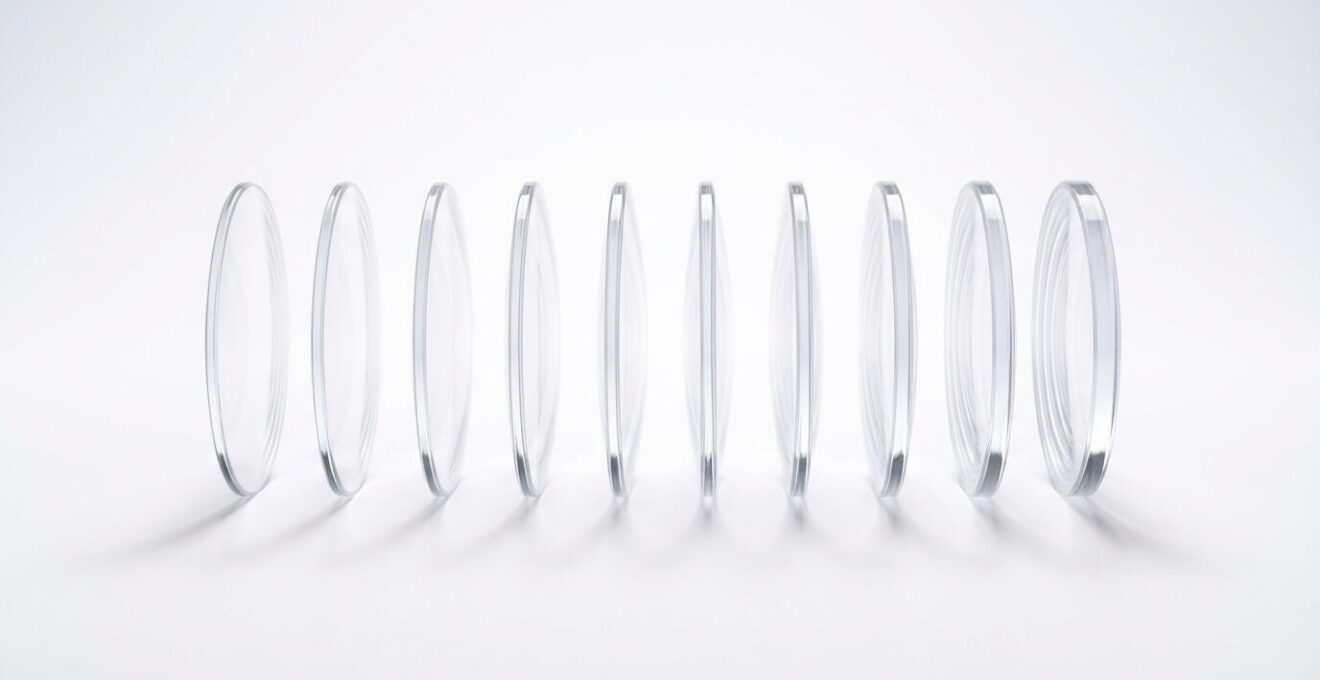
Ultimately, for a -6.00 prescription, a 1.67 index is a fantastic and necessary upgrade. The 1.74 index is best reserved for those with even stronger prescriptions, very large frames, or for whom achieving the absolute thinnest profile is the top priority, regardless of cost.
The Hidden Strain Caused by Wearing a 2-Year-Old Prescription
An eyeglass prescription typically has an expiration date of one to two years, and it’s not just a suggestion. Your vision is not static; it can change subtly over time due to age, lifestyle, and overall health. Continuing to wear an outdated prescription forces your eyes and brain to work overtime to compensate for the discrepancy. This isn’t just about tolerating slightly blurry vision; it has a real, measurable impact on your daily life.
When your eyes are straining to focus through an incorrect lens power, it triggers a cascade of issues. Headaches, fatigue, and dry eyes are the most common symptoms. But the strain goes deeper. As optometry experts warn, wearing an outdated prescription causes unnecessary eyestrain and can even make your brain work harder to process visual information. This concept of “prescription integrity”—ensuring your glasses match your current needs—is fundamental to your well-being.
Case Study: The Cognitive Load of an Old Prescription
Research shows that wearing an outdated prescription forces your eyes to work harder than necessary, leading to eye fatigue, reduced productivity during screen work, and increased irritability. The brain constantly works to sharpen blurry images, consuming mental resources that could be used for other cognitive tasks. This cognitive load directly impacts work performance and quality of life. It’s not just about seeing clearly; it’s about freeing up mental energy.
If you find yourself squinting more often, holding books or your phone further away, or experiencing more frequent headaches, it’s a clear sign your vision landscape has shifted. An updated eye exam is the only way to ensure your glasses are helping, not hindering, your daily performance.
When to Ask for a Remake: 3 Signs Your Prescription Power Is Too Strong
While an outdated prescription is a problem, a new prescription that is incorrect can be even more disruptive. One of the most common errors is over-correction, where the prescribed power is too strong. This often happens with nearsighted individuals, resulting in distance vision that feels intensely “sharp” but is deeply uncomfortable. Your brain is not wired for this kind of “HD” vision and will struggle to adapt.
As Eyelux Optometry specialists state, there are clear indicators of a problem that won’t resolve with time.
If you think that your eye problems are showing no signs of improvement and increasing day by day instead of getting better, then you are probably wearing an incorrect eye prescription.
– Eyelux Optometry specialists, Eyelux Optometry
The most telling sign of an over-strong prescription is a persistent fishbowl effect where the ground feels tilted or unnaturally close, and straight lines remain curved well past the initial adjustment period. Another key symptom is experiencing immediate eye strain or headaches when doing near-vision tasks, like looking at your phone, even if your distance vision seems clear. For those with astigmatism, an incorrect Axis can create a distinct “pulling” sensation in one direction. If these symptoms don’t fade or actually worsen after a week, it’s time to contact your optometrist or the glasses retailer.
Your Action Plan: Identifying an Incorrect Prescription
- Document Your Symptoms: Keep a daily log of what you feel (e.g., “Day 3: Sharp headache behind right eye after 20 mins of computer use. Ground still feels ‘closer’.”). This provides concrete data.
- Perform the Door Frame Test: Note if straight lines appear curved. Check if this “fishbowl effect” is constant or if it lessens after an hour of wear.
- Compare Near vs. Far Vision: Check for a clear discrepancy. Does clear distance vision come at the cost of immediate strain when looking at your phone? This is a classic sign of over-correction.
- Check for “Pulling”: For those with astigmatism (a CYL value), pay close attention to any sensation of your vision being pulled or skewed in one specific direction. This points to an Axis error.
- Contact the Provider: After 7-10 days of persistent, non-improving symptoms, contact your optometrist or online retailer. Present your documented symptoms and request a prescription re-check or remake.
How to Read Your Eye Chart Results Beyond the Bottom Line?
The term “20/20 vision” is universally known as the standard for visual excellence. During an eye exam, being able to read the bottom line of the Snellen chart feels like passing a test. However, achieving a 20/20 score is not the same as having “perfect” vision. It is simply a measure of your visual acuity, or the sharpness and clarity of your vision, at a distance of 20 feet. It’s one piece of the puzzle, not the entire picture.

Your actual quality of vision involves much more. A 20/20 result says nothing about your contrast sensitivity (how well you distinguish objects from their background), your peripheral vision, your color perception, or how quickly your eyes adapt between light and dark environments. You could have 20/20 acuity but struggle with debilitating glare when driving at night. This is why a comprehensive eye exam, which leads to your prescription, evaluates far more than just the eye chart.
Interestingly, 20/20 isn’t even the best possible human vision. Someone with 20/15 vision has above-average acuity; they can see clearly at 20 feet what a person with standard vision can only see at 15 feet. Your prescription for glasses is designed to bring your vision to a comfortable and functional level, which is usually 20/20, but its components (like Cylinder and Axis for astigmatism) also address the *quality* and *evenness* of your vision, not just its sharpness on a chart.
Glasses Rx vs. Contact Rx: Why the Powers Are Never the Same?
A common and costly mistake when ordering online is attempting to use a glasses prescription to buy contact lenses. While they both correct your vision, the prescriptions are not interchangeable. The fundamental reason for this lies in a single, critical factor: vertex distance. This is the distance between the back surface of the eyeglass lens and the front surface of your cornea.
For eyeglasses, vision experts explain that this distance is typically around 12 millimeters. Contact lenses, however, sit directly on the cornea, making their vertex distance 0mm. This difference in distance changes the effective power required to focus light correctly onto your retina. For prescriptions under +/- 4.00, the difference is often negligible. But for stronger prescriptions, the power must be mathematically converted by an optometrist to account for this change in vertex distance.
Furthermore, a contact lens prescription contains several crucial measurements that simply don’t exist on a glasses Rx. These are required to ensure the lens fits the unique curve and size of your eye safely and comfortably. Using a lens with the wrong fit can lead to discomfort, blurry vision, or even damage to your cornea.
| Parameter | Glasses Prescription | Contact Lens Prescription |
|---|---|---|
| Vertex Distance | ~12mm from eye | 0mm (on eye) |
| Base Curve (BC) | Not included | Required (e.g., 8.6) |
| Diameter (DIA) | Not included | Required (e.g., 14.2mm) |
| Material/Brand | Not included | Required and specific |
| Expiration | 1-2 years typical | 1 year maximum, by law |
Trying to guess these values or use your glasses prescription is a significant risk. A separate contact lens fitting and prescription are mandatory for a safe and successful experience.
Key Takeaways
- Your prescription is a dynamic map, not a static code; its accuracy depends on context like the time of day.
- Distinguishing between normal adjustment (~1-2 weeks) and a prescription error (immediate, sharp symptoms) is crucial for satisfaction.
- For strong prescriptions (like -6.00), high-index lenses (1.67+) are a balance of thinness, clarity, and cost—not just an upsell.
Plastic or Metal Frames: Which Is Better for Oily Skin and High Humidity?
The final piece of the puzzle, after deciphering your prescription and choosing your lenses, is the frame. This choice is about more than just style; it’s about all-day comfort and performance, especially for those with oily skin or who live in humid climates. The wrong frame material can lead to constant slipping, skin irritation, and even warping of the frame itself.
For individuals with oily or acidic skin, certain metals are superior. Titanium and stainless steel are hypoallergenic and highly resistant to corrosion from skin oils and sweat. Plastic frames, particularly standard cellulose acetate, can absorb oils over time and may require more frequent cleaning to prevent them from becoming slippery. However, newer performance plastics like TR-90 and Ultem offer excellent resistance to oils and sweat, combining the durability of metal with the lightness of plastic.
In high humidity, the primary concern is a frame that maintains its shape and grip. Metal frames are generally very stable, while some lower-quality plastics can warp slightly in extreme heat. The key to preventing slippage in any condition often lies in the frame’s design features, such as adjustable silicone nose pads, which provide far better grip than the integrated plastic nose pieces found on many acetate frames.
| Material | Oil Resistance | Humidity Performance | Weight | Best For |
|---|---|---|---|---|
| Titanium | Excellent | Corrosion-proof | Ultra-light | Acidic/oily skin |
| Stainless Steel | Good | Good | Moderate | Hypoallergenic needs |
| Cellulose Acetate | Poor | Can warp in heat | Light | Fashion-forward styles |
| TR-90/Ultem | Excellent | Sweat-resistant | Ultra-light | Active lifestyle |
If your glasses constantly slide down your nose, regardless of material, look for frames with adjustable nose pads or consider adding aftermarket silicone ear grips. A proper fit from the start is your best defense against slippage.
Now that you are equipped with the knowledge to decode your prescription and select the right materials, your next step is to confidently browse for frames that match both your measurements and your lifestyle.