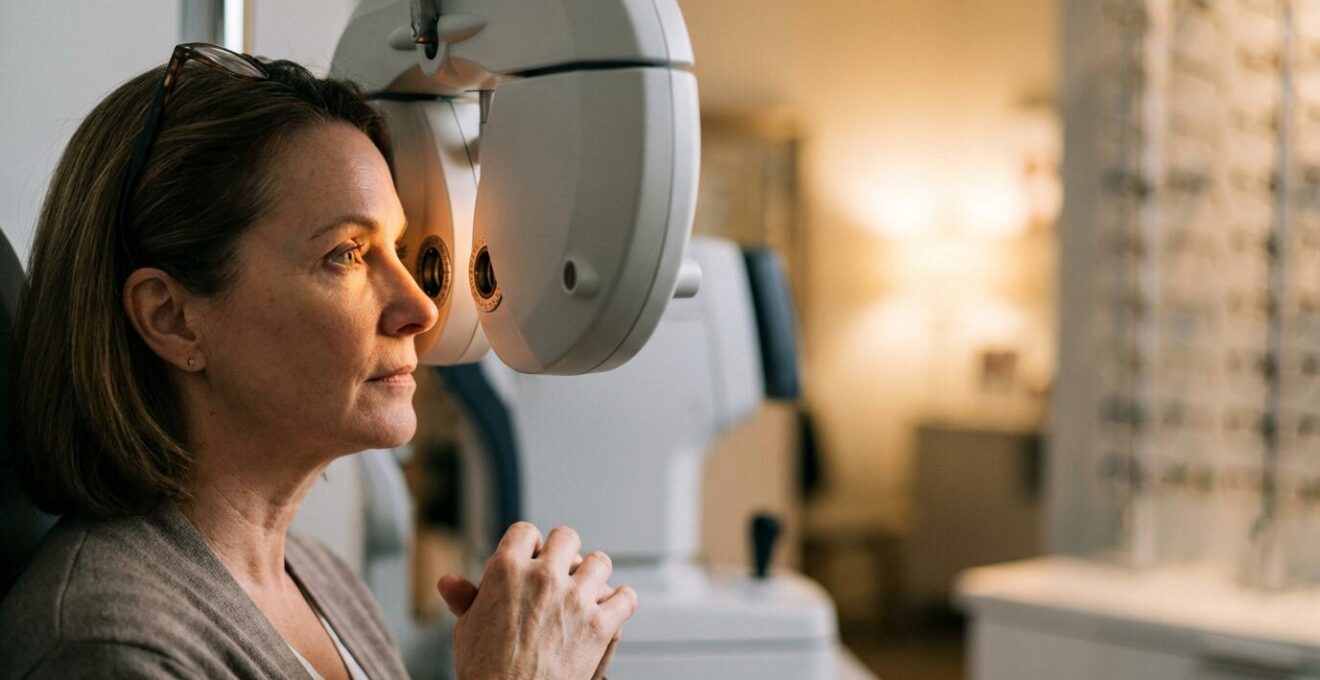
The “air puff” test is more than just an uncomfortable moment; it’s an essential part of a larger diagnostic system protecting you from silent, irreversible vision loss.
- Skipping any part of the exam, including the pressure test, creates diagnostic “blind spots” that can miss serious conditions like normal-tension glaucoma.
- Factors like the time of day, your anxiety levels, and even how you answer “which is better, 1 or 2?” directly impact the accuracy of your final prescription and health assessment.
Recommendation: View your annual exam not as a series of tests to pass, but as a collaborative process to build a precise, long-term map of your eye health.
For many patients, the thought of the annual eye exam brings one specific moment to mind: that startling puff of air. It’s a common point of anxiety, leading many to wonder if it’s truly essential or just a formality that can be skipped. As a clinical technician, I understand the apprehension. The test can feel abrupt and unpleasant. However, the question isn’t just about enduring a moment of discomfort; it’s about understanding the clinical integrity of the entire examination process.
The “air puff” test, or non-contact tonometry (NCT), is a single data point in a complex diagnostic system. Your eye exam is not a simple vision check. It is a comprehensive assessment designed to create a precise refractive blueprint for your glasses or contacts and, more importantly, to establish a health baseline for your eyes. Every test, from the subjective “which is better, 1 or 2?” to the objective pressure measurement, contributes a vital piece to this puzzle. Omitting one element doesn’t just leave a small gap; it compromises the accuracy and preventative power of the entire system.
But if the real goal is accuracy, what does that truly involve? It goes far beyond a single pressure reading. This article will deconstruct the key components of a genuinely accurate eye exam. We will explore how your own feedback, advanced technology, specific protocols, and even your state of mind all function as part of an interconnected system designed to protect your most valuable asset: your sight.
To fully grasp the importance of each step, this guide breaks down the critical factors that ensure the accuracy and completeness of your eye health assessment. The following sections detail why each component, from your honest feedback to advanced imaging, is a non-negotiable part of modern eye care.
Contents: The System of an Accurate Eye Exam
- Why Being Honest About “Option 1 or 2” Prevents Headaches Later?
- How Digital Phoropters Improve Accuracy for Patients With High Astigmatism?
- Cycloplegic Drops or Standard Exam: Which Finds the True Prescription for Kids?
- The “White Coat” Effect That Skews Your Vision Test Results
- When to Schedule Your Eye Exam: Morning vs. Afternoon Accuracy
- Why You Can Lose Vision Even With “Normal” Eye Pressure?
- Photo Documentation or Live Inspection: Why You Need Both?
- How Often Should You Get an Eye Exam if You Have 20/20 Vision?
Why Being Honest About “Option 1 or 2” Prevents Headaches Later?
The subjective refraction—the part of the exam where you’re asked, “which is better, option one or option two?”—is often underestimated by patients. It can feel like a test with right and wrong answers, causing pressure to “get it right.” In reality, this is a collaborative process. Your feedback is not a guess; it is the central input used to build your final refractive blueprint. Dishonesty or uncertainty here doesn’t just lead to a slightly blurry view; it can result in an incorrect prescription that causes persistent headaches, eye strain, and visual fatigue.
Answering “they look the same” is one of the most valuable pieces of information you can provide. It tells the optometrist that they have successfully bracketed your ideal prescription, confirming the endpoint of the test. Rushing or guessing introduces noise into the diagnostic system, forcing the clinician to make assumptions. The goal is to find the lens power that provides the clearest vision with the least amount of effort from your eyes. Providing clear, deliberate feedback is your most important role in ensuring the clinical integrity of your prescription.
Your Action Plan: Giving Better Feedback During an Eye Exam
- Take your time: There’s no rush to answer immediately when comparing options. A moment of consideration improves accuracy.
- Describe what you see: Go beyond ‘better’ or ‘worse’. Mention if letters appear darker, smaller, or have halos.
- Say ‘they look the same’: When they truly do, this confirms the optometrist has found the ideal prescription zone.
- Ask to see the options again: If you’re unsure, multiple comparisons are a standard and effective way to improve accuracy.
- Mention any eye strain: If an option causes you to squint or feel fatigue, that is critical data for the examiner.
How Digital Phoropters Improve Accuracy for Patients With High Astigmatism?
For patients with astigmatism, achieving a perfectly crisp prescription can be challenging. Astigmatism means the eye is shaped more like a football than a sphere, causing light to focus on multiple points. Correcting this requires not only the right lens power but also the precise axis of orientation. This is where modern technology like the digital phoropter provides a significant advantage over its manual counterpart. The precision of this tool is a cornerstone of the modern diagnostic system.
A digital phoropter allows the optometrist to make adjustments in much finer increments and to switch between lens options instantly. This rapid comparison makes it easier for you, the patient, to discern subtle differences, especially when determining the exact axis of your astigmatism. Manual phoropters have a longer, more noticeable delay between lens changes, which can disrupt your visual memory and make comparisons less reliable. For high astigmatism, where a few degrees of rotation can mean the difference between clear vision and distorted lines, this technological precision is not a luxury—it’s a clinical necessity.
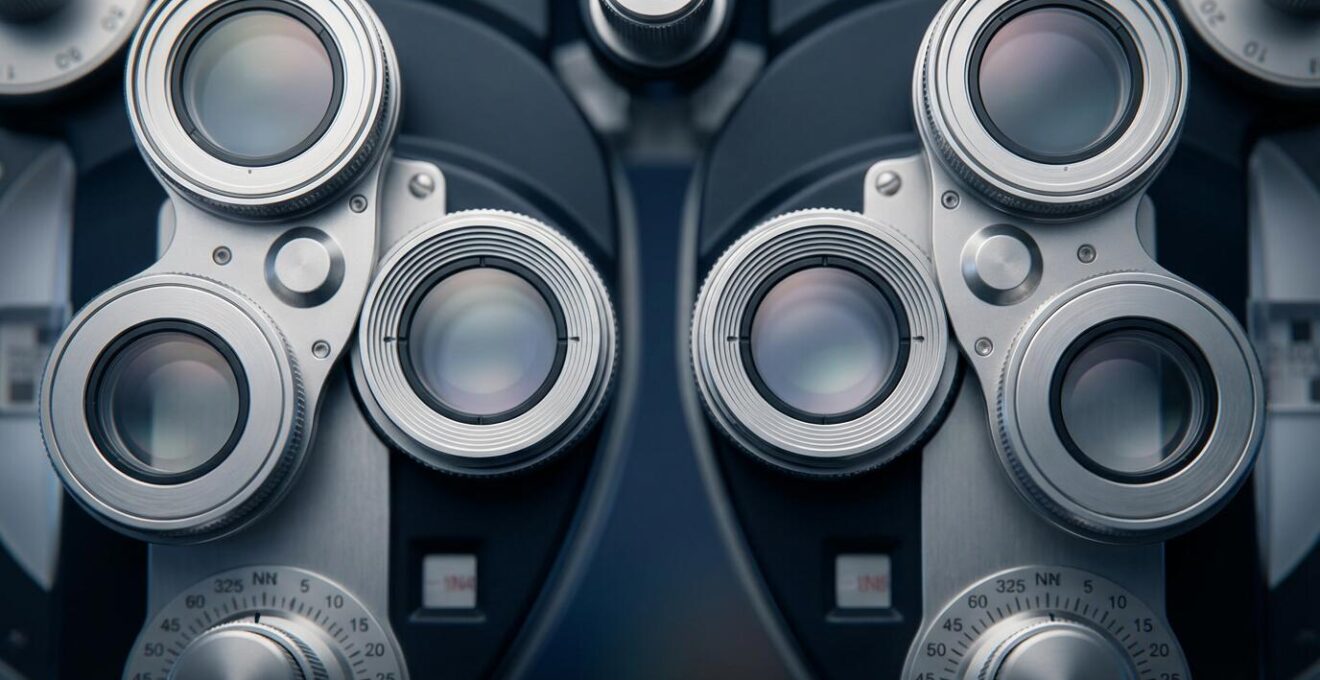
This table highlights the objective advantages that directly translate to a more accurate prescription, particularly for complex cases involving astigmatism. The ability to refine both power and axis with greater precision reduces the margin of error significantly.
| Feature | Manual Phoropter | Digital Phoropter |
|---|---|---|
| Adjustment Increments | 0.25 diopter steps | 0.125 diopter steps |
| Axis Rotation Precision | 5-degree increments | 1-degree increments |
| Comparison Speed | 2-3 seconds between options | Instant toggle |
| Previous Rx Integration | Manual reference | Automatic display |
Cycloplegic Drops or Standard Exam: Which Finds the True Prescription for Kids?
Children’s eyes have an incredible ability to focus, a mechanism known as accommodation. While this is great for seeing things up close, this powerful focusing muscle can work overtime during an eye exam, effectively hiding a child’s true refractive error, especially hyperopia (farsightedness). A child might test as having perfect vision or even slight myopia (nearsightedness) when they are actually farsighted. This is why a standard exam is often insufficient for young patients, and why a specific protocol involving cycloplegic eye drops is required.
These drops temporarily relax the eye’s focusing muscle, preventing it from interfering with the measurement. This allows the optometrist to uncover the full, unbiased refractive error. Ignoring this step can lead to misdiagnosis, resulting in uncorrected vision problems that contribute to learning difficulties, headaches, and even the development of amblyopia (“lazy eye”). The use of cycloplegic drops is a perfect example of how the diagnostic system must adapt its protocol based on the patient’s physiology to ensure clinical integrity.
Case Study: Uncovering Hidden Hyperopia in Children
A 7-year-old presenting with reading difficulties showed -0.50 myopia in a standard exam. After cycloplegic drops, as detailed in an American Academy of Ophthalmology overview on eye testing, the true prescription revealed +2.00 hyperopia that the child’s accommodation had been masking. Proper correction eliminated the reading problems and prevented potential amblyopia development.
The “White Coat” Effect That Skews Your Vision Test Results
Just as some people experience elevated blood pressure in a doctor’s office—a phenomenon known as “white coat hypertension”—a similar effect can occur during an eye exam. The anxiety and stress of being in a clinical setting, combined with the pressure to perform well on the tests, can physically impact your vision. This “white coat” effect can cause your eye muscles to tense up, skewing the results of both the refractive and pressure tests. Acknowledging and managing this anxiety is a key part of ensuring an accurate exam.
When you’re anxious, your body is in a “fight or flight” state, which isn’t conducive to the relaxed focus needed for precise measurements. This can lead to inconsistent answers during the “1 or 2” portion or artificially elevated intraocular pressure readings during the air puff test. As a technician, part of the job is to create a calm environment, but you also have the power to mitigate this effect yourself. Simple relaxation techniques can make a significant difference in the reliability of your test results.
To help reduce anxiety and improve the accuracy of your exam, consider these techniques:
- Practice deep breathing exercises for 2-3 minutes before entering the exam room.
- Request a countdown before the air puff test to regain a sense of control.
- Focus on a distant point to naturally relax your eye muscles when not being tested.
- Ask the technician to explain each test before performing it to eliminate the element of surprise.
When to Schedule Your Eye Exam: Morning vs. Afternoon Accuracy
Did you know that the time of day you have your eye exam can influence the results? Your eyes, like the rest of your body, go through daily cycles. Factors like intraocular pressure (IOP), the quality of your tear film, and muscle fatigue all fluctuate throughout the day. Integrating this chronobiological factor into the diagnostic system is another layer of ensuring accuracy, especially for monitoring specific conditions like glaucoma.
Generally, IOP is at its highest in the morning shortly after waking and gradually decreases as the day progresses. For a patient being monitored for glaucoma, a morning appointment is crucial to catch the peak pressure reading. Conversely, a patient experiencing eye strain at work might benefit from an afternoon exam, as it can reveal issues related to accommodative fatigue or dry eye that are less apparent in the morning. Your tear film is also most stable in the morning and can degrade over the day, which is particularly relevant for contact lens wearers.
| Factor | Morning (8am-12pm) | Afternoon (2pm-6pm) |
|---|---|---|
| IOP Levels | Typically highest | Lower by 2-3 mmHg |
| Accommodation Fatigue | Fresh and responsive | May show pseudo-myopia |
| Tear Film Quality | Most stable | Degraded, especially for contact wearers |
| Best For | Glaucoma monitoring, first prescriptions | Comfort-focused exams |
Case Study: Diurnal IOP Variation in Glaucoma Management
A glaucoma patient consistently scheduled afternoon appointments showing normal IOP of 18 mmHg. When switched to morning appointments, as documented in guidelines from the Cleveland Clinic on tonometry, readings revealed 24 mmHg pressure, prompting medication adjustment. This 6 mmHg diurnal variation was critical for proper disease management and preventing vision loss.
Why You Can Lose Vision Even With “Normal” Eye Pressure?
This is the single most important reason why the “air puff” test is a necessary, but not sufficient, part of your exam. Many patients believe that as long as their eye pressure is “normal,” they are safe from glaucoma. This is a dangerous misconception. A significant portion of glaucoma cases occurs in individuals with statistically normal eye pressure. This condition is called Normal-Tension Glaucoma (NTG), and it is just as capable of causing irreversible optic nerve damage and blindness as high-pressure glaucoma.
In NTG, the optic nerve is damaged even though the pressure inside the eye is not elevated. This highlights that eye pressure is just one of several risk factors. Other factors, such as poor blood flow to the optic nerve, are thought to play a major role. According to the American Academy of Ophthalmology, it’s estimated that 30-40% of glaucoma cases occur with eye pressure in the ‘normal’ range of 10-21 mmHg. This statistic alone underscores why a comprehensive exam that looks directly at the optic nerve’s health through imaging and live inspection is absolutely non-negotiable.
Skipping the pressure test removes a key data point, but relying on it alone creates a false sense of security. The complete diagnostic system—including visual field testing and optic nerve evaluation—is designed to detect damage regardless of the pressure reading. The air puff test is part of the baseline, not the final verdict.
Photo Documentation or Live Inspection: Why You Need Both?
Evaluating the health of your optic nerve is the most critical part of a glaucoma screening. In the past, this was done solely through a live, stereoscopic (3D) view with a special lens. Today, we have high-resolution retinal photography. A common question is whether one has replaced the other. The answer, central to the philosophy of a robust diagnostic system, is a firm “no.” Both methods provide unique, complementary information, and using them together provides the most comprehensive assessment.
Retinal photography provides a permanent, objective 2D record of your optic nerve. Its greatest strength is in tracking changes over time. By digitally overlaying photos from year to year, even the most subtle changes in the nerve’s structure become apparent. This is invaluable for detecting slow, progressive damage. However, a photo is flat. It cannot provide the true depth perception that a live, stereoscopic inspection can. During a live look, the optometrist can assess the three-dimensional cupping of the optic nerve head, a key indicator of glaucomatous damage. The live view also allows for a much wider inspection of the peripheral retina.
As Dr. Steven Liem, O.D., F.A.A.O., states in the Zenni Optical Blog, the synergy between these tools is undeniable:
The combination of photographic documentation and live stereoscopic examination increases detection of glaucomatous progression by up to 40% compared to either method alone.
– Dr. Steven Liem, O.D., F.A.A.O., Zenni Optical Blog on Eye Pressure Testing
| Capability | Photo Documentation | Live Inspection |
|---|---|---|
| Historical Comparison | Excellent – Digital overlay possible | Limited – Relies on memory |
| 3D Assessment | Limited – 2D image only | Excellent – True depth perception |
| Field of View | Central 30-45 degrees | Up to 200 degrees peripherally |
| Documentation | Permanent record | Written notes only |
Key Takeaways
- The “air puff” test is a crucial but incomplete part of glaucoma screening; many people develop glaucoma with “normal” eye pressure.
- Your accuracy depends on a system: your honest feedback, the time of day, advanced technology, and managing your own anxiety.
- A comprehensive exam, including optic nerve photos and live inspection, is non-negotiable for creating a health baseline to track changes over time.
How Often Should You Get an Eye Exam if You Have 20/20 Vision?
One of the most common reasons patients skip exams is because they believe their vision is fine. “I have 20/20 vision, why do I need an exam?” This line of thinking dangerously conflates visual acuity (the ability to see clearly on a chart) with eye health. Many of the most serious, sight-threatening diseases, including glaucoma, diabetic retinopathy, and even certain cancers, have no symptoms in their early stages and do not affect your 20/20 vision until significant, irreversible damage has already occurred.
Glaucoma is famously known as the “silent thief of sight” precisely because it attacks your peripheral vision first—something you would not notice in your daily life until the disease is very advanced. According to the Glaucoma Research Foundation, over 3 million Americans have glaucoma, and about 50% are unaware of it despite many having clear central vision. An annual comprehensive eye exam is not a vision test; it is a health screening. It is the only way to establish a health baseline and detect these silent diseases early enough to manage them and prevent vision loss.
The frequency of these essential health checks depends on your age and risk factors, not on your perceived quality of vision. Adhering to a recommended schedule is a fundamental act of preventative health care.
- Ages 18-39 (low risk): Every 2-3 years
- Ages 40-54: Every 2 years
- Ages 55-64: Every 1-2 years
- Ages 65+: Annually
- Any age with diabetes or family history of eye disease: Annually
Protecting your long-term vision starts with a complete and accurate health baseline. The next logical step is to schedule a comprehensive eye examination with your optometrist to ensure your diagnostic system is complete.
Frequently Asked Questions About Procedures in an Eye Exam
Are the drops uncomfortable?
Children may experience a brief stinging sensation for 10-15 seconds when cycloplegic drops are administered, followed by temporary light sensitivity for a few hours. The discomfort is minimal compared to the benefit of getting an accurate prescription.
At what age are cycloplegic exams most important?
These exams are most critical between the ages of 3 and 8. During this period, a child’s natural focusing ability (accommodation) is at its strongest and can most easily mask significant refractive errors like hyperopia, which could otherwise go undetected.