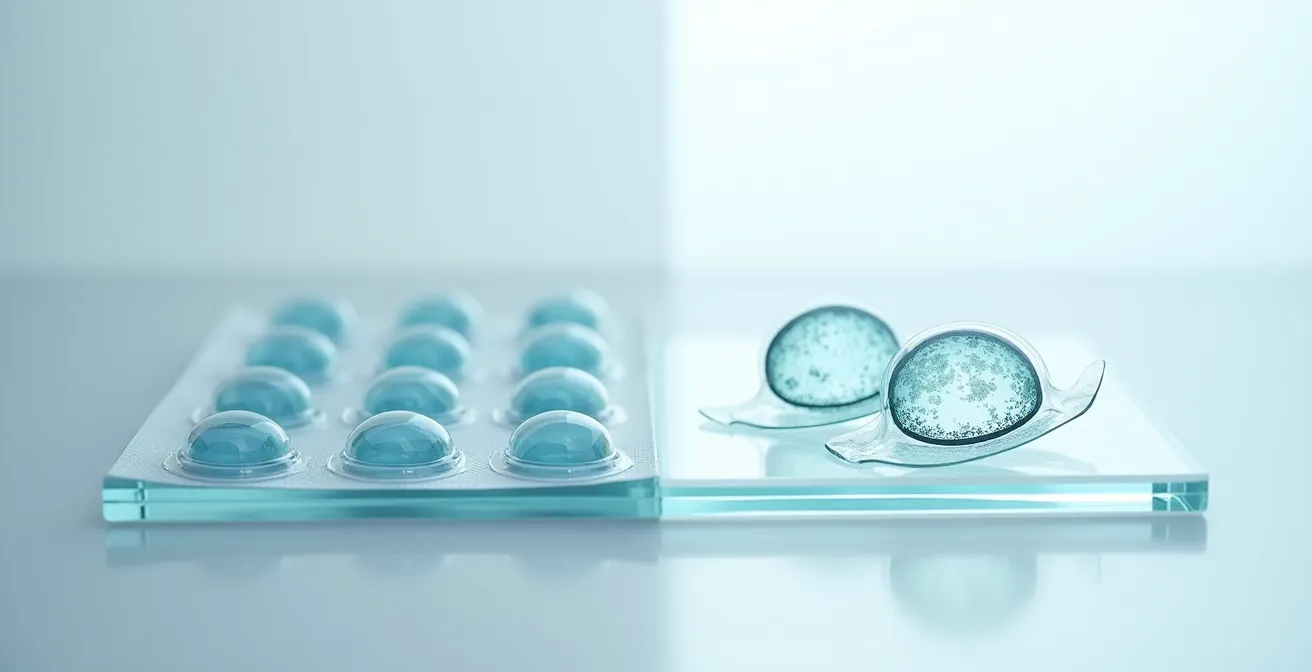
Choosing monthly lenses to save money often leads to significant hidden costs from maintenance, discomfort, and compounding health risks.
- Monthlies act as “deposit magnets,” rapidly accumulating proteins and lipids that reduce oxygen flow and comfort long before day 30.
- Consistently overwearing lenses creates an “oxygen debt” in the cornea, leading to serious health risks with tangible financial consequences like doctor visits and lost wear time.
Recommendation: Instead of comparing box prices, calculate your personal “value-per-wear” by factoring in the real costs of cleaning solutions, replacement cases, and the financial risk of non-compliance.
As a student, every dollar counts. When faced with the choice between daily and monthly contact lenses, the math seems simple: monthlies have a much lower upfront cost. It’s a tempting proposition for anyone on a tight budget. You buy a box, a bottle of solution, and you’re set for half a year. But this initial calculation often overlooks a cascade of hidden variables—the subtle, compounding costs of maintenance, discomfort, and the very real financial risks of what we can call “compliance fatigue.” The true cost isn’t what you pay at the register; it’s a complex equation involving your time, your health, and the inevitable human tendency to stretch a 30-day lens to day 35, or even 40.
The standard advice revolves around hygiene and replacement schedules, but it rarely quantifies the financial impact of failing to adhere to them. What is the real cost of that itchy, dry feeling that creeps in around the third week? What is the long-term price of chronically depriving your eyes of oxygen? This analysis moves beyond the sticker price. We will dissect the material science of lens deposits, calculate the financial liability of overwear, and build a framework to determine your personal break-even point. The crucial question isn’t just “which is cheaper?” but “which option delivers the most predictable value and lowest financial risk for your specific lifestyle?” This guide provides a rigorous, value-focused breakdown to help you make a truly informed financial decision, not just a purchase.
To navigate this complex decision, we’ll deconstruct the costs, risks, and benefits layer by layer. This structured analysis will provide the clarity needed to see beyond the initial price tag and understand the long-term value of your vision correction choice.
Contents: Your Financial Roadmap to Contact Lens Value
- Why Your Monthly Lenses Get Itchy Around Day 21?
- How to Remember Your Lens Change Day Without Relying on Memory?
- Bi-Weekly Acuvue or Monthly Air Optix: Which Stays Cleaner?
- The Oxygen Blockage That Occurs When You Wear Monthlies for 45 Days
- Problem & Solution: Deep Cleaning Lenses to Survive the Fourth Week
- Daily Disposables vs. High-Index Glasses: Which Costs Less Over 2 Years?
- The Oxygen Deprivation Caused by Wearing “Monthlies” for 6 Weeks
- Problem & Solution: Preventing “Dried Out” Monthly Lenses by Switching to Dailies
Why Your Monthly Lenses Get Itchy Around Day 21?
That familiar, nagging itch that starts around the third week of wearing monthly lenses isn’t your imagination. It’s a tangible sign that the lens material is beginning to fail under the bio-load of your own tears. From the moment you insert a new lens, it begins a 30-day battle against your eye’s natural environment. Your tear film, essential for comfort, is also a rich soup of proteins, lipids (oils), and calcium. These components are inevitably attracted to the lens surface, a phenomenon we can call deposit magnetism. Over time, these deposits denature—they cook onto the lens—creating a rough, irritating surface that disrupts the smooth flow of your eyelid.
By day 21, this microscopic layer of build-up becomes significant. It not only causes physical irritation but also acts as a barrier, reducing the lens’s ability to transmit oxygen to your cornea. This subtle suffocation contributes to dryness and end-of-day discomfort. Furthermore, the deposits create a welcoming environment for bacteria, increasing the risk of inflammation and infection. The itchiness is your body’s early warning system, signaling that the lens has reached the end of its effective lifespan, even if the calendar says you have another week to go. Pushing through this discomfort is the first step toward accumulating a significant health and financial risk, transforming a cost-saving measure into a potential liability.
How to Remember Your Lens Change Day Without Relying on Memory?
Relying on memory to manage a 30-day replacement cycle is a losing strategy, especially with a busy student schedule. The mental burden of tracking replacement dates, known as compliance fatigue, is a major reason why users overwear their lenses. Forgetting is not a personal failing; it’s a predictable outcome of a system that demands constant vigilance. The key is to outsource this mental task to a reliable, external system. Creating a multi-layered reminder strategy removes willpower and memory from the equation, turning a chore into an automatic habit.
The most effective methods are those that integrate into your existing routines. A recurring digital alert is a great start, but it can be easily dismissed and forgotten. The real power comes from combining digital prompts with physical, environmental cues. This creates a system of fail-safes, ensuring that even if you ignore one reminder, another will catch your attention. The goal is to make the correct replacement date impossible to miss. This simple organizational investment pays significant dividends by preventing the costly consequences—both in terms of health and finances—of unintentional overwear.
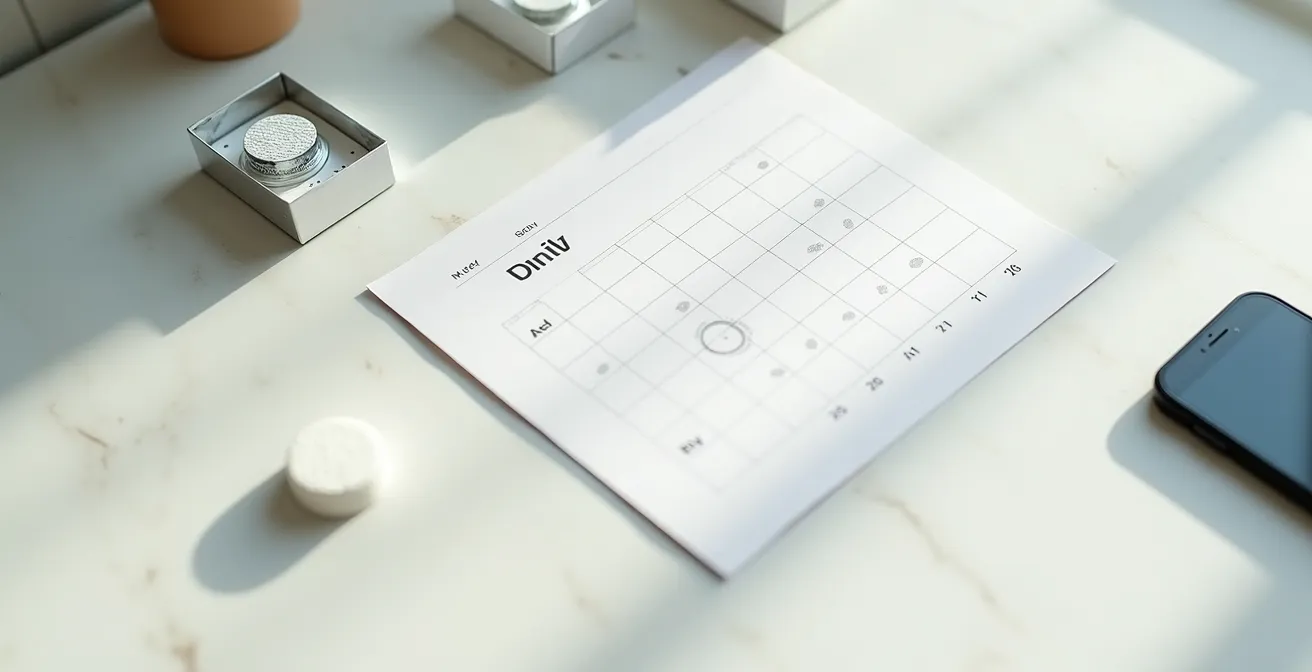
Implementing a robust tracking system is the single most effective way to combat compliance fatigue. Consider these evidence-based methods to build your own foolproof system:
- Set recurring smartphone reminders on the 1st of the month for monthly replacements, or on the 1st and 15th for bi-weekly lenses.
- When opening a new box, immediately mark the replacement dates directly on the individual blister packs with a permanent marker.
- Use a dedicated contact lens tracking app that can monitor both your replacement schedule and the expiration date of your cleaning solutions.
- Create a ‘lens change ritual’ by linking it to another recurring event, such as paying your rent or a specific monthly subscription renewal.
- Keep physical reminder cards in high-visibility locations: inside your lens case, taped to your bathroom mirror, and even in your wallet as a final back-up.
Bi-Weekly Acuvue or Monthly Air Optix: Which Stays Cleaner?
The question of which lens stays cleaner is not about the brand name, but the underlying material science. All soft contact lenses are not created equal; they fall into different categories based on their material properties, particularly their water content and ionic (electrical) charge. As a leading research team noted in a study for the PMC Journal on proteomic analysis, the type and quantity of deposits are fundamentally “lens material-dependent.” This is the core of deposit magnetism.
Deposits on worn lenses are mainly proteins and lipids from tear fluid, the residual quantities of which are lens material-dependent and lens care solution-dependent. Since tear fluid comprises many proteins, it is quite likely that a variety of proteins will deposit onto contact lenses.
– Research team, PMC Journal – Proteomic Analysis Study
For example, traditional hydrogel lenses with a high water content and an ionic (negatively charged) surface, like Acuvue 2, act like a magnet for positively charged proteins in your tears (such as lysozyme). Conversely, modern silicone hydrogel materials, like those in Air Optix, are often non-ionic. They attract far fewer protein deposits but can have a higher affinity for lipids (oils). Understanding your personal tear chemistry—whether you are a “heavy protein depositor” or a “heavy lipid depositor”—is key to selecting a lens that will remain cleaner and more comfortable for its entire intended wear cycle.
The following table, based on established material science principles, breaks down these differences. It illustrates why a one-size-fits-all approach to monthly lenses is flawed and how choosing the right material can dramatically impact comfort and safety. This data is critical for any value-focused analysis.
| Characteristic | Ionic Hydrogel (Acuvue) | Non-Ionic Silicone Hydrogel (Air Optix) |
|---|---|---|
| Protein Attraction | High (acts as ‘protein magnet’) | Low protein binding |
| Lipid Deposits | Moderate | Higher lipid attraction |
| Best Cleaning Solution | Hydrogen peroxide systems | Multi-purpose with surfactants |
| Deposit Type by Day 14 | Heavy protein accumulation | Moderate lipid buildup |
| Recommended For | Low protein depositors | Heavy protein depositors |
The Oxygen Blockage That Occurs When You Wear Monthlies for 45 Days
Wearing a monthly lens for 45 days isn’t just stretching a recommendation; it’s actively creating an “oxygen debt” for your cornea. Your cornea has no blood vessels; it breathes directly from the atmosphere. A contact lens, even a fresh one, is a barrier. Lens manufacturers combat this with materials that have high oxygen transmissibility, measured as Dk/t. However, this value is for a new, clean lens. As protein and lipid deposits build up, they clog the microscopic pores in the lens, systematically reducing its Dk/t value each day you wear it past its replacement date.
By day 45, the lens is a suffocating shield. When the cornea is starved of oxygen (a state called hypoxia), it panics. Its survival response is to grow new, fragile blood vessels into the normally clear tissue to find an oxygen source. This condition, called corneal neovascularization, is a serious red flag. These new vessels can impair vision and lead to inflammation and scarring. According to a study on contact lens-induced issues, an alarming 18% of extended soft lens wearers show some degree of this condition. Furthermore, clinical research demonstrates that a peripheral Dk/t of 30-40 Fatt units is the minimum required to prevent this dangerous vessel growth, a threshold a 45-day-old lens has likely fallen far below.

This image provides an artistic interpretation of the damaging vessel growth that occurs under chronic oxygen deprivation. The financial “savings” of stretching a lens for two extra weeks are instantly erased by the potential cost of treating these complications, which can include expensive medicated drops, forced time out of contact lenses, and urgent appointments with an eye care professional. This is the hidden financial risk of overwear.
Problem & Solution: Deep Cleaning Lenses to Survive the Fourth Week
By the fourth week, many monthly lens wearers face a dilemma: the lenses feel gritty and uncomfortable, but there are still a few days left on the calendar. This discomfort is a direct result of accumulated, denatured protein deposits that the eye’s immune system begins to perceive as a foreign threat. As one clinical study notes, this can trigger an inflammatory response.
The ocular system may perceive denatured protein deposits as a foreign body invasion and produce antibodies in response. These antibodies can cause inflammation and ocular side effects such as irritation, redness and itching.
– Clinical study, Contact Lens Spectrum – Dealing with Deposits
When faced with this situation far from home or before a new supply arrives, some users may be tempted to perform a “deep clean” to try and restore comfort. It is critical to understand that this is a harm reduction strategy, not a recommended practice. You cannot truly restore a lens to its original state. However, a meticulous cleaning protocol can, in an emergency, break down some of the surface deposits to make the lens tolerable for a short, final period. The following protocol is for emergency use only and should never replace on-time replacement.
Your Action Plan: Emergency Deep-Clean Protocol for Monthly Lenses
- Warning: This is harm reduction only. The safest action is always to replace lenses on their scheduled date.
- Manual Rub: Perform a 30-second manual rub, gently massaging the lens between your fingers with fresh multi-purpose solution to mechanically loosen debris.
- Thorough Rinse: Rinse each side of the lens thoroughly with a sterile saline solution for at least 10 seconds to wash away the dislodged deposits.
- Peroxide Soak: Soak the lenses overnight in a fresh hydrogen peroxide-based cleaning system. This is more effective at breaking down stubborn protein deposits than multi-purpose solutions.
- Prevent Contamination: Immediately discard your old lens case and replace it with a brand new, sterile case to avoid re-introducing biofilm.
Daily Disposables vs. High-Index Glasses: Which Costs Less Over 2 Years?
For a complete financial analysis, we must establish a baseline. High-index glasses, while involving a significant one-time purchase, often represent a stable, predictable cost over a two-year period. However, the primary debate for most contact lens wearers is between the high recurring cost of dailies and the lower upfront cost of monthlies. On the surface, daily disposables appear far more expensive. Market analysis shows that daily disposables cost between $600 and $900 per year, a figure that can seem daunting for a student budget.
This number, however, is an all-inclusive cost. It requires no additional purchases of cleaning solutions, storage cases, or emergency deep-cleaning products. The “value-per-wear” is fixed and predictable. The cost of monthlies, while lower at the outset, is a variable that depends heavily on user compliance. The initial box price is only the beginning of the total cost of ownership. A truly accurate comparison must factor in the non-negotiable expense of cleaning and disinfection supplies, which can add hundreds of dollars over two years.
The following table, based on a total cost of ownership model, provides a more honest financial comparison. It includes not just the product cost but also the necessary accessories and potential ancillary costs like backup pairs and prescription updates. As this recent comparative analysis shows, when all factors are considered, the cost gap between lens types begins to narrow considerably, and the financial stability of glasses becomes a relevant benchmark.
| Cost Category | Daily Disposables | Monthly Contacts | High-Index Glasses |
|---|---|---|---|
| Initial/Annual Product Cost | $1,200-1,800/2 years | $400-800/2 years | $400-800 one-time |
| Solutions & Accessories | $0 | $120-240/2 years | $40 (cleaning supplies) |
| Backup/Emergency | $200 (backup glasses) | $200 (backup glasses) | $400 (second pair) |
| Prescription Updates | Included in boxes | Included in boxes | $200-400 (new lenses) |
| Total 2-Year Cost | $1,400-2,000 | $720-1,240 | $1,040-1,640 |
This table clearly shows that while monthlies maintain a cost advantage on paper, the gap is not as vast as the box price suggests. The final decision depends on how much you value the elimination of maintenance costs and health risks.
Key Takeaways
- Monthly lenses feel itchy and blurry over time because they act as “deposit magnets” for proteins and lipids from your tears, reducing comfort and oxygen flow.
- The true cost of monthlies must include cleaning solutions and cases, and the financial risk of eye infections from “compliance fatigue” and overwear.
- Daily disposables offer a higher upfront cost but provide a fixed, predictable “value-per-wear” with zero maintenance costs and significantly lower health risks.
The Oxygen Deprivation Caused by Wearing “Monthlies” for 6 Weeks
Pushing a monthly lens to six weeks is a dangerous financial gamble disguised as frugality. We’ve already established that overwear leads to a critical drop in oxygen transmissibility. Extending this practice from 45 days to over 6 weeks exponentially increases the cornea’s oxygen debt. At this stage, the lens is not just uncomfortable; it’s a hazardous barrier that has been saturated with biofilm and denatured deposits for over 40 days. The risk of a painful and expensive eye infection, such as microbial keratitis, rises dramatically.
From a financial planning perspective, this is an unforced error. The cost of treating a single serious eye infection—including doctor’s visits, prescription antibiotic drops, lost time from classes or work, and the necessity of purchasing emergency backup glasses—can easily exceed an entire year’s supply of daily disposable lenses. You are trading a guaranteed small expense (the cost of a new lens) for a small but non-zero risk of a catastrophic one. For a budget-conscious student, this is a poor risk-reward calculation. The perceived savings of $10 or $20 from stretching a lens are dwarfed by the potential liability of a $500+ medical event. The accumulated oxygen debt from chronic overwear isn’t just a health issue; it’s a ticking financial time bomb.
Problem & Solution: Preventing “Dried Out” Monthly Lenses by Switching to Dailies
The recurring problem of monthly lenses feeling “dried out” and uncomfortable is a symptom of a flawed system, not a random occurrence. It’s the end result of deposit accumulation, reduced oxygen flow, and the breakdown of the lens material itself. While deep-cleaning protocols exist for emergencies, they are merely treating the symptom. The only definitive solution to preventing this cycle of discomfort and risk is to eliminate its cause. This means starting every single day with a brand new, perfectly clean, maximally breathable lens.
This is where daily disposables transition from a “luxury” to a strategic financial choice. By switching to dailies, you are effectively buying an insurance policy against the hidden costs of monthlies. You eliminate the recurring expense of cleaning solutions and cases. You erase the mental load of compliance fatigue, as the only rule is to open a new pack. Most importantly, you drastically reduce the cost of risk associated with eye infections and inflammatory events caused by overwear and deposit buildup. The “value-per-wear” is not only about money but also about the guaranteed comfort, clarity, and safety you get every morning.
For a student, this translates to predictable expenses, fewer health-related disruptions to your studies, and the ultimate convenience. The decision is no longer just about the number on the price tag, but about the total value delivered. When you factor in the elimination of maintenance and risk, daily disposables can represent the most economically sound and healthiest option in the long run.
To determine the most valuable and cost-effective option for your own eyes and budget, the next logical step is to discuss your specific wearing habits and tear film characteristics with an eye care professional. Book an appointment to get a personalized financial and health assessment.