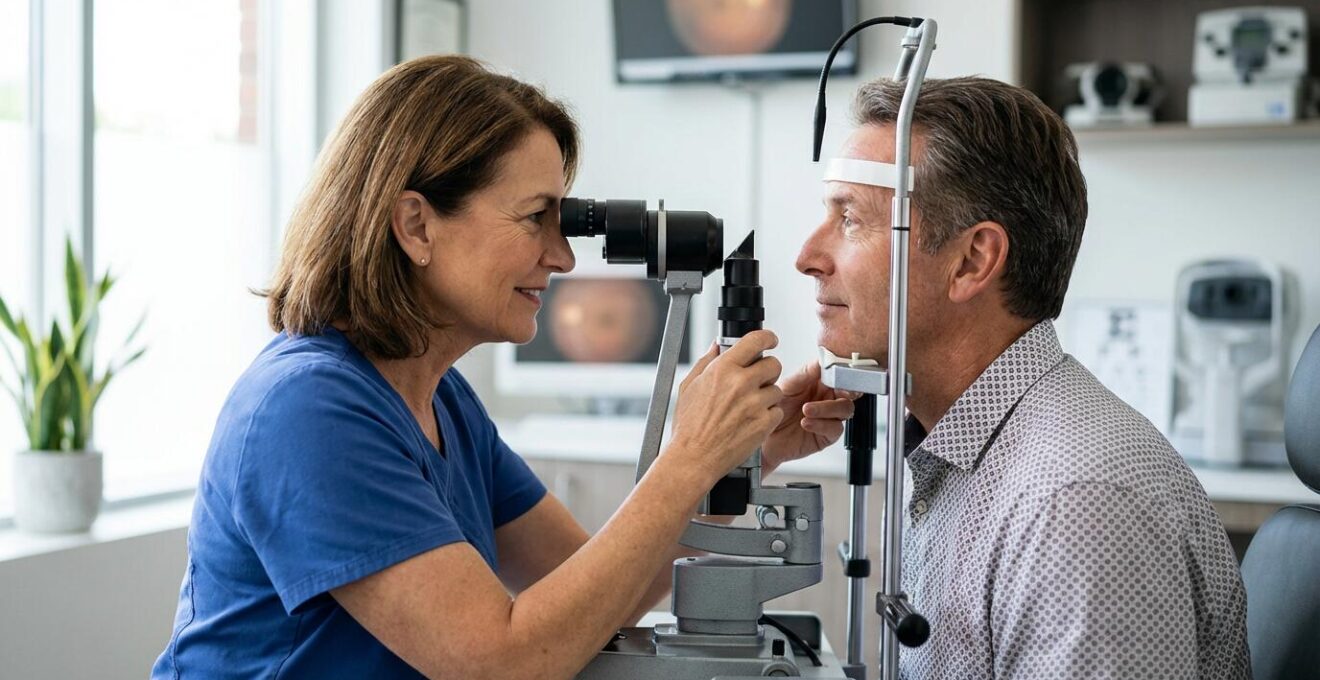
For sudden eye pain, choosing the right specialist isn’t about the title, but about who has the right diagnostic tools for an immediate, accurate assessment.
- An optometrist is the best first call for most urgent issues, equipped with technology a general practitioner lacks.
- An ophthalmologist is a medical and surgical specialist for complex diseases, most effectively accessed via a referral from an optometrist.
Recommendation: For any sudden, severe eye pain or vision change, call your optometrist’s office first; they are trained to triage you to the ER or an ophthalmologist if your condition exceeds their scope of practice.
Sudden, sharp eye pain is a uniquely alarming experience. In that moment of panic, a critical question arises: who do you call? Your family doctor? An optometrist? Do you rush to the emergency room? The confusion between an optometrist and an ophthalmologist often leads to hesitation or the wrong choice, wasting precious time when your vision could be at stake. Many believe the difference is simply that one performs surgery and the other prescribes glasses, but this oversimplification misses the most crucial point in an urgent situation.
The key to making the right first call lies not in the professional’s title, but in their diagnostic toolkit. The fundamental difference is the specialized equipment and dedicated time an eye care professional has versus a general practitioner. This guide acts as your healthcare navigator, moving beyond basic definitions to provide a clear, directive framework. We will dissect the diagnostic capabilities of each specialist, clarify when the ER is non-negotiable, and explain why your optometrist is often the most strategic starting point for almost any eye-related concern. Understanding this hierarchy of care is the first step toward protecting your vision effectively.
This article will provide a clear path through the confusion, outlining the specific roles, diagnostic advantages, and critical symptoms that dictate your choice. Follow this guide to understand how to navigate your eye care with confidence, especially when time is of the essence.
Contents: Your Guide to Navigating Eye Care Professionals
- Why “Board Certified” Matters More Than “Years of Experience” for Eye Surgery?
- How to Verify if Your Optician Is Licensed in Your State or Province?
- Private Clinic or Retail Chain: Which Offers Better Continuity of Care?
- The Danger of Relying on App-Based Vision Tests for Prescription Renewals
- When to Go to the ER: 3 Eye Symptoms That Cannot Wait Until Morning
- Why Your Optometrist Might Detect Your High Cholesterol Before Your GP?
- How to Connect Your Optometrist With Your Primary Care Doctor?
- What Can an Optometrist Diagnose That a GP Cannot Detect?
Why “Board Certified” Matters More Than “Years of Experience” for Eye Surgery?
When considering a significant procedure like eye surgery, many patients weigh a surgeon’s “years of experience” as the top credential. While experience is valuable, it is not a standardized measure of current skill or knowledge. A surgeon could have 20 years of experience but may not have kept up with the latest techniques. This is where board certification becomes the most critical factor. Board certification, granted by an entity like the American Board of Ophthalmology, is a voluntary process that demonstrates a physician has exceeded the minimum licensing requirements. It proves they have not only passed a rigorous examination of their knowledge and skills but are also committed to lifelong learning and continuous professional development.
This commitment is a key differentiator. A board-certified ophthalmologist is actively participating in programs that keep them at the forefront of medical advancements. This ensures the techniques, technology, and safety protocols they use are current and adhere to the highest standards of care. It’s an ongoing, verifiable benchmark of excellence, whereas “experience” is a subjective and unverified metric. For a patient, choosing a board-certified surgeon provides an objective layer of assurance that you are in the hands of a professional dedicated to maintaining peak expertise in their field.

As the image suggests, performing due diligence on your surgeon’s credentials is a crucial step in your healthcare journey. It’s a proactive measure that empowers you to make an informed decision based on proven, standardized qualifications rather than ambiguous claims of experience. Verifying this status is straightforward and should be a non-negotiable part of your selection process.
How to Verify if Your Optician Is Licensed in Your State or Province?
While optometrists and ophthalmologists are doctors, an optician is a technician trained to design, verify, and fit eyeglass lenses and frames, contact lenses, and other devices to correct eyesight. Their role is crucial for ensuring your prescription is filled correctly and your eyewear fits properly. Just as with medical doctors, verifying an optician’s credentials is an important step. Most states or provinces have a licensing board or regulatory body for opticianry. A quick search for “[Your State/Province] Board of Opticianry” will typically lead you to their official website, which often includes a public-facing license lookup tool.
The education and training for eye care professionals vary significantly. While ophthalmologists complete 12-14 years of education and training, and optometrists complete about eight years, opticians typically complete a one- or two-year degree or apprenticeship. Licensure ensures they have met the required educational and practical standards to practice. In a field with growing demand, where the Bureau of Labor Statistics projects an 8% growth for optometrists from 2024 to 2034, ensuring every member of your eye care team is qualified is paramount. Verifying your optician’s license confirms they are accountable to a professional standard, which is a key part of a trustworthy healthcare experience.
This verification provides peace of mind that the person responsible for the final product—your glasses or contacts—is qualified to do so accurately. An incorrect fitting or lens error can cause headaches, eye strain, or simply ineffective vision correction, undermining the work of your optometrist or ophthalmologist. Taking a few minutes to verify their license is a simple and effective quality control measure.
Private Clinic or Retail Chain: Which Offers Better Continuity of Care?
The choice between a private ophthalmology or optometry clinic and a large retail vision chain often comes down to convenience and cost. However, a crucial factor that is often overlooked is continuity of care. This refers to having a consistent relationship with a single healthcare provider who understands your medical history, lifestyle, and vision needs over time. Private clinics are typically structured to foster this relationship. You are more likely to see the same doctor at every visit, who becomes familiar with the subtle changes in your eye health year after year. This is invaluable for managing chronic conditions like glaucoma or diabetic retinopathy.
Retail chains, while offering convenience, can have higher staff turnover. You may see a different optometrist with each visit, which can fragment your care. Each new doctor must start from scratch, relying solely on your chart notes. This model can be sufficient for straightforward prescription renewals, but it is less ideal for managing long-term health. The trend toward market consolidation further complicates this. As one study noted, between 2015 and 2022, the total number of ophthalmology practices decreased from 7,149 to 5,890 (-18%), indicating a shift toward larger, less personal practice models. This industry trend makes proactively seeking out a stable provider relationship more important than ever.
Ultimately, while retail chains serve an important purpose, a private clinic generally offers a superior model for building a long-term, trusted partnership for your eye health. This relationship ensures that nuanced changes in your vision are not missed and that your care is managed proactively, not reactively.
Your 5-Point Continuity of Care Audit
- Points of Contact: List all places you receive eye care (e.g., retail store for glasses, private optometrist for exams, ER for emergencies).
- Collect: Gather your existing records, including your last prescription, exam summaries, and any referral notes you have.
- Coherence: Review the advice and diagnoses you’ve received. Are the recommendations consistent, or do they conflict?
- Mémorability: Does your primary eye doctor recognize you and recall your history without first consulting a file? Do you feel like a known patient or a new customer?
- Plan for Integration: To improve continuity, choose one primary eye care provider and formally request that all your past records be transferred to their office.
The Danger of Relying on App-Based Vision Tests for Prescription Renewals
In an age of digital convenience, app-based vision tests that promise a quick and easy prescription renewal are increasingly popular. While they may seem like a harmless shortcut, relying on them is incredibly dangerous. These apps can only measure your refractive error—how your eye focuses light. They cannot perform a health check. An in-person eye exam is not just about updating your prescription; it is a critical opportunity to screen for asymptomatic, sight-threatening diseases that an app can never detect. Conditions like glaucoma, diabetic retinopathy, macular degeneration, and even retinal tears often have no symptoms in their early stages.
An optometrist uses specialized equipment like a slit-lamp and retinal imaging to look inside your eye, checking the health of your optic nerve, retina, and blood vessels. An app-based test completely bypasses this vital health assessment. Relying on an app is like assuming your car is in perfect condition just because the radio works—it ignores everything happening under the hood. The temptation to use these apps may grow, as some workforce projections predict a potential 30% shortage in ophthalmologist FTEs by 2035, making access to specialists more challenging. However, this potential scarcity makes comprehensive, preventive exams with an optometrist even more critical, not less.
Bypassing a comprehensive eye exam for the convenience of an app is a gamble with your vision. Many forms of vision loss are irreversible, but early detection and treatment can slow or halt their progression. Below are just a few of the serious conditions an app cannot detect:
- Peripheral retinal holes, which have no symptoms until a detachment occurs
- Early-stage macular drusen, a precursor to macular degeneration
- Optic nerve cupping from glaucoma, which is silent until significant vision loss
- Diabetic retinopathy changes that can progress without any symptoms
- Corneal abnormalities that may not affect central vision initially
- Melanoma or other eye cancers, often found incidentally during a comprehensive exam
When to Go to the ER: 3 Eye Symptoms That Cannot Wait Until Morning
For most eye issues, even urgent ones, your optometrist’s office is the best place to start. However, some situations are true medical emergencies that require immediate attention at a hospital’s Emergency Room (ER). Knowing how to distinguish these is critical. The three most unambiguous signs that you should go directly to the ER are chemical exposure, a penetrating eye injury, or sudden, complete vision loss accompanied by other neurological symptoms like a severe headache or weakness on one side of the body (which could signal a stroke).
In cases of chemical splashes, every second counts. Immediately flush the eye with clean water for at least 15 minutes and then head to the ER. For any object that has punctured the eye, do not attempt to remove it; stabilize it if possible and seek immediate emergency care. Beyond these clear-cut traumas, the decision can be more nuanced. Symptoms like flashes of light, a sudden shower of “floaters,” or a curtain-like shadow over your vision are highly urgent but may be best handled by calling your optometrist’s emergency line first. They can direct you to the right place, potentially meeting you at their office for a more specialized exam than an ER doctor can provide.
The following decision tree can help you navigate this choice. For anything less severe than trauma or chemical exposure, your first call should be to your optometrist’s office, as they possess the specific tools for a detailed eye diagnosis.
- Chemical exposure or penetrating trauma → Go directly to the ER.
- Sudden, painless vision loss in one eye → Call your ophthalmologist or optometrist’s emergency line first.
- Severe eye pain with nausea and light sensitivity → Call your optometrist for an urgent, same-day appointment.
- A sudden flash of light followed by many new floaters → Contact your eye doctor’s on-call service immediately.
- Foreign body sensation with significant tearing → Visit an urgent care center or your optometry office.
Why Your Optometrist Might Detect Your High Cholesterol Before Your GP?
It may seem surprising, but your optometrist is in a unique position to detect signs of systemic health problems like high blood pressure, diabetes, and even high cholesterol, sometimes before you or your general practitioner (GP) are aware of them. This is because the eye is the only place in the body where a doctor can non-invasively view your blood vessels, nerves, and arteries in their natural state. This provides a direct window into your cardiovascular health. During a comprehensive dilated eye exam, an optometrist examines the retina at the back of your eye, and changes in its delicate vasculature can be the first clue that something is amiss elsewhere in your body.
For example, high cholesterol can cause visible changes in and around the eyes. An optometrist might spot a corneal arcus, a white or gray ring around the cornea, which can be an indicator of high cholesterol, especially in younger patients. They might also see yellowish cholesterol deposits on the eyelids, known as xanthelasma, or even small blockages (emboli) in the tiny arteries of the retina. These are direct signs of cardiovascular disease risk that a GP would not be able to see without invasive tests.
Because they are trained to spot these abnormalities, optometrists and ophthalmologists can recognize health problems that aren’t directly related to the eye and refer patients for further medical treatment. Below are some systemic conditions and their tell-tale signs visible during an eye exam:
- Corneal arcus: A white or grayish ring around the cornea indicating cholesterol deposits.
- Xanthelasma: Yellowish cholesterol bumps on or around the eyelids.
- Retinal hemorrhages: Small bleeds in the retina that can signal diabetes or hypertension.
- Optic nerve swelling: Can suggest high blood pressure or increased intracranial pressure.
- Retinal emboli: Tiny clots in the retinal arteries, a strong indicator of cardiovascular disease risk.
How to Connect Your Optometrist With Your Primary Care Doctor?
Creating a bridge between your optometrist and your primary care doctor (GP) is a powerful step toward holistic health management. As your optometrist can detect signs of systemic diseases, ensuring their findings are shared with your GP closes the loop on your care. The process is straightforward but requires your active participation. The most important step is to formally grant permission for them to communicate. Due to privacy laws like HIPAA, you must sign a “release of information” form at both your optometrist’s and your GP’s offices. This creates a permanent, legally sanctioned information bridge between them.
When you sign the release, be specific about what you’d like shared. Ask your optometrist to send your full exam report to your GP, with special attention to any notes on your optic nerve health, retinal photos, and any indicators of systemic disease they may have found. This is particularly crucial for managing chronic conditions like diabetes or hypertension. For a diabetic patient, the detailed retinal photos from an optometrist provide a GP with concrete evidence of how well blood sugar is being controlled, allowing for more effective medication management and lifestyle counseling.
This collaborative approach elevates your care from a series of disconnected appointments to an integrated health strategy. When your optometrist refers you to an ophthalmologist for a condition they’ve detected, this communication becomes even more critical. Given that ophthalmologists complete 12 to 14 years of intensive medical and surgical training, their specialized assessment is a high-value piece of information that your entire care team should have access to. Proactively managing this flow of information ensures everyone is working from the same complete, up-to-date playbook.
Key takeaways
- For most urgent eye pain or vision issues, your optometrist is the best first call due to their specialized diagnostic equipment.
- Ophthalmologists are surgeons and disease specialists, best accessed via referral for conditions an optometrist has already diagnosed.
- The ER is for clear trauma (chemical exposure, penetrating injury) or eye symptoms paired with signs of a stroke.
What Can an Optometrist Diagnose That a GP Cannot Detect?
The primary reason an optometrist should be your first call for an eye problem over a general practitioner (GP) comes down to one thing: the diagnostic technology gap. A GP’s eye exam is typically very brief, using a handheld direct ophthalmoscope that offers a limited, two-dimensional view of the back of the eye. It’s a quick screening tool, not a diagnostic instrument. In contrast, an optometrist’s office is equipped with a suite of advanced tools designed specifically for in-depth ocular assessment.
The cornerstone of this is the slit-lamp biomicroscope, which provides a highly magnified, three-dimensional view of all the structures of your eye, from the cornea at the front to the optic nerve at the back. This allows for the detection of subtle abnormalities that are invisible with a handheld scope. Furthermore, optometrists utilize tools like retinal cameras for high-resolution photos of your retina and OCT (Optical Coherence Tomography) scanners that provide cross-sectional images of the retina, akin to an MRI for the eye. These technologies are essential for diagnosing conditions like glaucoma, macular degeneration, and diabetic retinopathy in their earliest stages.
This table highlights the significant difference in diagnostic capability, which is why a dedicated 30-60 minute eye exam with an optometrist yields far more information than the 1-2 minutes a GP can spare for your eyes during a general check-up. This is not a criticism of GPs, but a clarification of roles: an optometrist is the primary care provider for your eyes.
The following table, based on common office equipment, clearly illustrates the technological disparity between a GP’s office and an optometrist’s office for eye examinations, as detailed in analyses by sources like WebMD’s comparison of standard office equipment.
| Equipment/Tool | GP’s Office | Optometrist’s Office |
|---|---|---|
| Basic Eye Exam Tool | Handheld direct ophthalmoscope (2D view) | Slit-lamp biomicroscope (3D magnified view) |
| Retinal Imaging | Not typically available | Retinal camera, OCT scanner |
| Visual Field Testing | Basic confrontation test | Automated perimetry |
| Exam Duration for Eyes | 30 seconds to 2 minutes | 30-60 minute dedicated appointment |
| Magnification Level | Limited (2-3x) | High (10-40x with slit lamp) |
Your eyesight is too important to leave to guesswork. Establishing a relationship with a dedicated optometrist for your primary eye care is the single most effective step you can take. They will serve as your trusted navigator, providing comprehensive annual exams and acting as the expert first point of contact for any urgent issues that arise, ensuring you are directed to the right specialist at the right time.