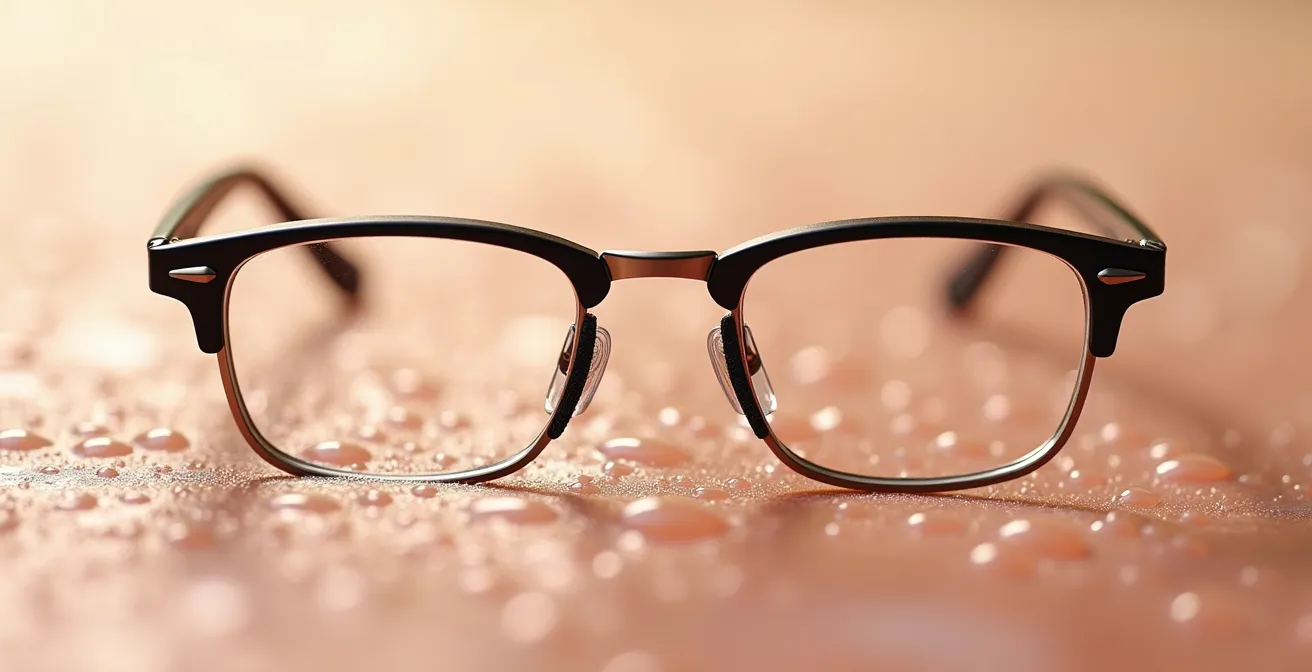
The constant battle against slipping glasses in humid weather isn’t just about fit; it’s a problem of material science and weight engineering.
- Plastic frames like TR-90 with a matte finish offer superior grip (higher material friction), while metal frames like titanium provide unparalleled lightness and corrosion resistance.
- Adjustable silicone nose pads on metal frames are critical for distributing pressure and preventing slippage on an oily nose bridge.
Recommendation: For maximum stability, prioritize lightweight titanium frames with large, adjustable silicone nose pads. If you prefer plastic, choose a matte-finished TR-90 or acetate frame with built-in nose pads designed for a low bridge fit.
For anyone living in a high-humidity environment, the struggle is universal: glasses that perpetually slide down a slippery nose. It’s a constant, frustrating cycle of pushing them back up, cleaning the lenses, and enduring the discomfort. Most advice centers on getting a proper fit or cleaning your face more often, but these are merely temporary fixes. They fail to address the fundamental physics at play when moisture and skin oils conspire against your eyewear.
The problem isn’t just you or your skin; it’s a mismatch between your environment and the materials resting on your face. The real solution lies in understanding the core properties of your frames—from the raw material and hinge mechanics to the very density of your lenses. It requires thinking like an optical engineer, focusing on concepts like material friction, weight distribution, and pressure point dynamics.
But what if the key to all-day comfort wasn’t just finding frames that fit, but choosing frames engineered to perform in your specific climate? This guide moves beyond the surface-level tips. We will deconstruct the components of modern eyewear to reveal how material choices directly impact comfort and stability. By understanding the science behind the slip, you can finally select a pair of glasses that feels secure, comfortable, and perfectly balanced, no matter how humid the day gets.
This comprehensive guide breaks down every aspect of frame selection, from the causes of pressure marks to the nuances of lens materials. Explore the sections below to build a complete understanding of how to achieve ultimate eyewear comfort.
Summary: A Practical Guide to Frame Selection for Comfort and Stability
- Why Your Glasses Leave Red Marks on Your Nose After 2 Hours?
- How to Adjust Glasses for Ears That Are Not Level Without Breaking Them?
- Spring Hinges or Fixed: Which Survives Better With Toddlers in the House?
- The Migraine Caused by Frames That Sit Too Low on Your Face
- Problem & Solution: Keeping Oversized Frames From Touching Your Cheeks
- 1.67 or 1.74 Index: Which Is Necessary for a -6.00 Prescription?
- New Glasses Headache or Adjustment Period: Which Is It?
- Why Your New Progressive Lenses Cause Dizziness After 3 Days?
Why Your Glasses Leave Red Marks on Your Nose After 2 Hours?
Those persistent red marks on the bridge of your nose are more than just a minor annoyance; they are a clear signal of improper pressure point dynamics. When the entire weight of your glasses is concentrated on two small points, the pressure restricts blood flow and indents the skin. For individuals with oily skin, this issue is magnified. The lack of friction causes the frames to slip, prompting the wearer to push them up higher and tighter, thereby increasing the pressure and worsening the marks.
However, pressure is not the only culprit. The irritation can also be a sign of allergic contact dermatitis. Many metal frames, particularly those made from Monel or other alloys, contain nickel. In fact, nickel is identified as one of the most common allergens in eyeglass frames, leading to redness, itching, and even blistering in sensitive individuals. It’s crucial to distinguish between a pressure mark, which is typically symmetrical and fades after removing the glasses, and an allergic reaction, which may be rash-like and persist for days.
In chronic cases, consistent and severe pressure can lead to a more serious condition. A condition known as Acanthoma Fissuratum can develop from the chronic irritation and friction where the frame contacts the skin. According to dermatological resource DermNet NZ, this presents as a firm, flesh-coloured papule or nodule, typically appearing on the side of the nose or behind the ear. This underscores the importance of addressing poor fit not just for comfort, but for long-term skin health. The solution lies in frames that distribute weight more broadly, such as those with large, soft silicone nose pads, or lightweight materials like titanium that reduce the overall load.
How to Adjust Glasses for Ears That Are Not Level Without Breaking Them?
A common and often-overlooked cause of frame instability is asymmetrical anatomy—specifically, having one ear slightly higher than the other. This seemingly minor difference can cause your glasses to sit crooked, leading to constant adjustments, uneven pressure on your nose, and a perpetual feeling of imbalance. Attempting to bend the frames yourself without understanding the material properties is a risky endeavor that often ends with a snap. The key to a successful adjustment lies in knowing what your frames are made of and applying the correct technique.
The material of your frame dictates the adjustment method. Acetate frames, a type of plastic, require gentle heat to become pliable, allowing an optician to carefully bend the temple arm into the correct position. In contrast, many metal frames, such as those made from titanium or memory metal, can be adjusted cold. Their inherent flexibility allows for precise bending without the risk of stress fractures. The technique is not about brute force but a gentle, rolling motion at the bend point just behind the ear to change the angle of the temple tip.
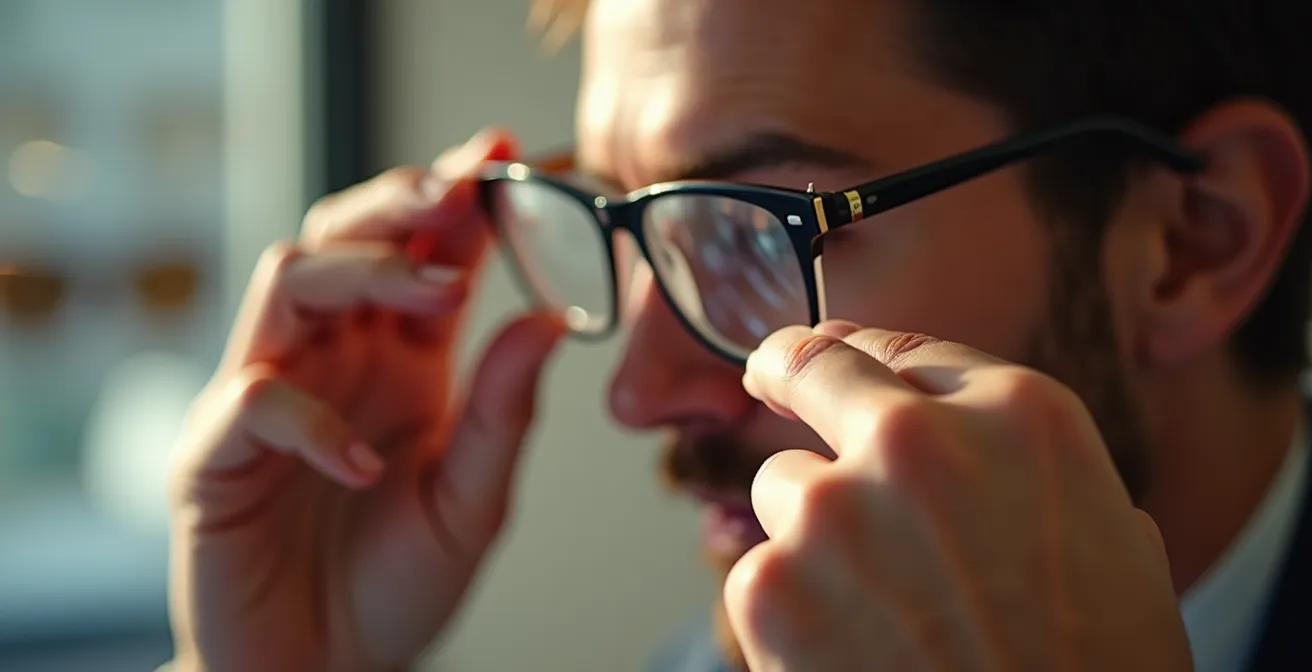
The image above illustrates the precise hand placement used by professionals to adjust a temple arm. This controlled technique ensures the frame’s integrity is maintained. Forcing a cold plastic frame or incorrectly bending a metal one can easily lead to breakage. Understanding the properties of different materials is crucial for safe and effective adjustments.
The following table outlines the different adjustment requirements for common frame materials, highlighting the risk involved with each. This is why a professional adjustment from a skilled optician is always recommended.
| Material | Adjustment Method | Temperature Required | Risk Level |
|---|---|---|---|
| Acetate | Heat and bend | 120-140°F | Medium |
| Titanium | Cold adjustment | Room temp | Low |
| Monel | Gentle bending | Room temp | Medium |
| TR-90 | Heat required | 160°F+ | High |
Spring Hinges or Fixed: Which Survives Better With Toddlers in the House?
When there are small children in the house, eyeglasses transform from a vision tool into a tempting toy. They are pulled, twisted, and snatched with surprising frequency, making hinge durability a paramount concern. The debate between spring hinges and standard (or fixed) hinges is central to this. A standard hinge has a simple 90-degree range of motion. Once bent beyond that point, the metal or plastic is permanently damaged. Spring hinges, on the other hand, have a small, built-in spring that allows the temple arms to flex outward beyond 90 degrees, providing a crucial buffer against accidental overextension.
For this reason, spring hinges are unequivocally superior for surviving the rigors of a household with toddlers. When a child grabs the frames from your face, the spring mechanism absorbs the force, allowing the temples to hyper-extend and then return to their original alignment without damage. This feature significantly increases the frame’s lifespan and reduces the need for frequent, costly repairs. The enhanced torsional rigidity and flexibility are a practical form of insurance for any parent who wears glasses.
While hinge type is critical, the frame material itself plays an equally important role in overall durability. Even the best hinge is useless if the frame front or temple arm snaps. This is where advanced materials offer a significant advantage. Frame material specialists note that titanium and memory metal frames withstand bending without breaking, making them an ideal partner for spring hinges.
Case Study: The Resilience of Memory Metal
Materials like Flexon, a titanium-based alloy, are a game-changer for durability. The American Academy of Ophthalmology highlights that Flexon is a highly flexible material that comes back into shape even after it is twisted or bent. This “memory” property makes it exceptionally suitable for active lifestyles and, most importantly, for the unpredictable stress inflicted by children. A pair of Flexon frames with spring hinges represents the pinnacle of durable eyewear, engineered to survive daily life with a family.
The Migraine Caused by Frames That Sit Too Low on Your Face
A headache that develops after wearing glasses isn’t always a sign of a wrong prescription. Often, it’s a mechanical issue: your frames are sitting too low on your face. When glasses slide down your nose, your eyes are no longer looking through the optical center of the lenses. This misalignment forces your eye muscles to work harder to focus, causing strain that can quickly escalate into a tension headache or even a migraine. For people with oily skin in humid climates, this is a chronic problem, as the constant slippage ensures the lenses are almost never in the correct position.
High humidity makes it harder for sweat to evaporate, causing an oily nose and discomfort, especially where glasses sit
– Optics Town Editorial, Why Does My Nose Get Oily When I Wear Glasses
This constant downward slide creates a vicious cycle. You push the glasses up, they slide back down, and your brain is left to compensate for the ever-changing visual input. This effect is particularly pronounced with higher prescriptions and progressive lenses, where precise positioning is paramount. The solution isn’t to tolerate the headaches but to eliminate the root cause: the slippage. This requires choosing a frame with materials and features engineered for grip and stability.

The diagram above visualizes the core problem. The gap between where the optical center should be (aligned with the pupil) and where it ends up creates prismatic effects that the brain must struggle to correct, leading directly to eye strain and headaches. Fortunately, modern frame technology offers several material-based solutions to prevent this.
Action Plan: Material-Based Solutions for Frame Slippage
- Choose matte-finished TR-90 plastic: Inspect frames for a non-glossy, slightly textured surface, which provides better grip on oily skin.
- Opt for titanium frames with large silicone nose pads: Verify that the nose pads are made of soft, tacky silicone and are large enough to distribute weight and increase surface contact.
- Apply specialized wax products: Acquire an eyewear-specific wax and apply a thin layer to the nose pads to significantly increase friction.
- Select frames with adjustable nose pads: Ensure the pads are mounted on metal arms that can be bent to perfectly contour to your nose bridge, unlike fixed plastic bridges.
- Consider frames with rubberized temple tips: Check the ends of the temple arms for embedded rubber or silicone for added grip behind the ears.
Problem & Solution: Keeping Oversized Frames From Touching Your Cheeks
Oversized frames are a popular style, but they come with a common fitting challenge: resting or rubbing against the cheeks. This is especially true for individuals with high cheekbones or a lower nose bridge. When you smile or talk, the frames lift off your nose, compromising your vision and causing irritation. In humid conditions, this constant contact also traps sweat and oil, which can lead to skin breakouts and smudged lenses. The problem stems from a lack of clearance, which is often a feature of plastic frames with a fixed, molded nose bridge.
While stylish, many plastic acetate frames lack the adjustability needed to solve this issue. Their one-piece design means the distance from the lens to your face is non-negotiable. If the frame’s base curve is too flat or the bridge is too wide, cheek contact is almost inevitable. The most effective solution is to choose a frame with an adjustable nose pad system. This feature is standard on most metal frames and is a game-changer for customizing fit.
By selecting a metal frame, an optician can manipulate the small metal arms (pad arms) that hold the silicone nose pads. They can widen or narrow the pads to secure the frame on your nose, and more importantly, they can adjust the arms to lift the entire frame slightly up and away from your face. This creates the necessary clearance to prevent the lower rims from touching your cheeks. As noted by eyewear fitting experts, while plastic frames are lightweight, they often lack the grip and customization of metal frames with adjustable silicone nose pads, which can be tailored to prevent cheek contact. For those committed to a plastic look, seeking out “low bridge” or “alternative fit” designs, which have larger, built-out nose pads, can offer a similar benefit.
1.67 or 1.74 Index: Which Is Necessary for a -6.00 Prescription?
For those with a strong prescription, such as -6.00, lens choice is about more than just vision correction; it’s a crucial component of the overall weight-distribution engineering of your eyewear. High-index lenses are designed to bend light more efficiently, allowing them to be significantly thinner and lighter than standard plastic lenses. The two most common options for this prescription range are 1.67 and 1.74 high-index. While 1.74 is technically the thinnest and lightest material available, the choice is not always straightforward, especially for those concerned with slippage on oily skin.
A 1.67 index lens is already about 40% thinner than a standard lens, offering a dramatic cosmetic and weight improvement. A 1.74 index lens pushes that to around 50% thinner. The trade-off, however, comes in two forms: cost and optical clarity. 1.74 lenses are significantly more expensive. They also have a lower Abbe value, which means they are more prone to chromatic aberration—visible color fringing around high-contrast objects, particularly in your peripheral vision. For many wearers, the minimal additional thinness of 1.74 doesn’t justify the higher cost and potential decrease in optical quality compared to the excellent performance of 1.67.
From a material science perspective, there’s another critical factor for those with oily skin.
For oily skin, added weight from denser 1.74 lenses can increase slippage, making 1.67 in a well-balanced, grippy frame a more comfortable choice
– Optical Frame Specialists, Frame Material Considerations
This is a crucial insight. While 1.74 lenses are thinner, they are also denser. This concentrated weight can actually exacerbate slippage on an oily nose bridge. Therefore, for a -6.00 prescription, a 1.67 lens often strikes the perfect balance: it provides a significant reduction in thickness and weight without the optical drawbacks of 1.74, and its slightly lower density can contribute to better overall balance and less slippage, especially when paired with a lightweight titanium frame.
| Property | 1.67 Index | 1.74 Index |
|---|---|---|
| Thickness Reduction | 40% thinner than standard | 50% thinner than standard |
| Abbe Value | 32-36 | 28-33 |
| Weight | Moderate density | Higher density |
| Chromatic Aberration | Minimal | More noticeable |
| Best For | Most prescriptions | Rimless/thin frames |
New Glasses Headache or Adjustment Period: Which Is It?
Getting a new pair of glasses should be exciting, but for many, it’s accompanied by an unwelcome side effect: headaches. The immediate concern is often that the prescription is wrong. While this is possible, it’s more common that your brain is simply going through an adjustment period. Your brain has become accustomed to your old prescription (or no prescription) and has been working to “correct” for any visual deficiencies. When you put on new, perfectly corrected glasses, your brain and eye muscles have to unlearn their old habits and adapt to a new, clearer way of seeing. This recalibration process can cause eye strain and mild headaches.
This adjustment period typically lasts from a few days to a week. The key is consistent wear. Taking your new glasses off frequently will only prolong the process, as your brain has to keep switching between the old and new visual information. If the headaches are mild and improve with each day of consistent wear, it’s almost certainly a normal adaptation. However, if the headaches are severe, cause dizziness or nausea, or do not improve after a week, it’s time to revisit your optician. The issue could be an incorrect prescription, an inaccurate pupillary distance (PD) measurement, or a poorly fitted frame.
For those with oily skin, there’s a compounding factor. If the new frames are constantly slipping, the repeated motion of pushing them up can create tension in your neck and shoulders, leading to a tension headache that has nothing to do with the lenses themselves. Furthermore, as discussed previously, glasses that sit too low misalign the optical center, forcing your eyes to strain. Therefore, it’s crucial to differentiate between a headache from optical adjustment and one from mechanical instability. If your headache subsides when you hold the glasses in the correct position, the problem is likely the fit, not the prescription.
Key Takeaways
- Frame material directly impacts grip and stability; matte finishes and lightweight metals like titanium are superior for oily, humid conditions.
- Adjustability is non-negotiable for comfort. Metal frames with adjustable silicone nose pads offer the best customization to prevent slippage and pressure marks.
- The weight and balance of your complete eyewear, including lens index, are critical. Heavier lenses, even if thinner, can increase slippage.
Why Your New Progressive Lenses Cause Dizziness After 3 Days?
Progressive lenses are a marvel of optical engineering, providing seamless vision correction for distance, intermediate, and near tasks all in one lens. However, this technology comes with a notorious adjustment period. Feeling dizzy, disoriented, or experiencing a “swim” effect when you move your head is a common complaint during the first few days. This is because unlike a single-vision lens, a progressive lens has multiple vision zones, or corridors. Your brain needs time to learn how to automatically find the right part of the lens to look through for any given task.
The number one rule for adapting is: point your nose, not just your eyes. If you want to look at something to your side, turn your head to face it. This keeps your line of sight within the clear central corridor of the lens. Looking sideways through the periphery will put your vision into the distorted zones of the lens, causing the swimmy, off-balance sensation. Starting with short wearing sessions and gradually increasing them over a week can help ease your brain into this new visual world. It’s also crucial that the frame is fitted correctly, with the pupil aligned perfectly with the lens’s fitting marks.
Frame choice itself has a significant impact on progressive lens comfort. The lightweight nature of certain materials is a huge asset. As explained by optical experts, titanium is a popular choice for skin-friendly eyewear because it is lightweight and durable. For a progressive lens wearer, this is especially important. Progressive lenses, particularly in higher prescriptions, are inherently heavier than single-vision lenses. A lightweight titanium frame helps to offset this added weight, reducing the overall load on your nose and preventing the slippage that can throw the precise corridors out of alignment and reintroduce dizziness.
By understanding the interplay of material science, weight distribution, and proper fitting, you can move from being a passive wearer to an informed consumer. The next time you choose frames, you will be equipped to select a pair that not only suits your style but is also perfectly engineered for your face and your environment, ensuring all-day comfort and stability.
Frequently Asked Questions About New Glasses and Comfort
What’s the normal adjustment period for new glasses?
Most adaptation headaches or feelings of slight unease improve significantly within 72 hours of consistent wear. If symptoms worsen, include severe dizziness, or persist beyond one week, it is essential to consult your optician to re-check the prescription and fit.
Can oily skin cause headaches from glasses?
Yes, indirectly. Oily skin causes glasses to slip down the nose. Constantly pushing them back up can create muscular tension in the neck and shoulders, leading to tension headaches. Furthermore, when glasses sit too low, the optical center is misaligned, causing eye strain that can also result in headaches.