For high-impact activities, the choice between Polycarbonate and Trivex is a critical trade-off between absolute impact strength and superior visual performance.
- Polycarbonate offers higher resistance to extreme velocity impacts, making it the standard for maximum-threat environments.
- Trivex delivers significantly clearer, distortion-free vision due to its higher Abbe value, while also being the lightest safety material available.
Recommendation: Choose Polycarbonate for ballistic-rated protection where impact is the primary concern. Choose Trivex for any activity where visual acuity, all-day comfort, and clarity are paramount to performance and safety.
When selecting safety eyewear, the conversation often begins and ends with “impact resistance.” DIY enthusiasts and athletes know that protecting their vision from high-speed debris is non-negotiable. This leads many to grab the nearest pair of “shatterproof” glasses, assuming all safety lenses are created equal. The standard advice revolves around ensuring the eyewear meets a certified safety standard, but this overlooks a crucial performance variable: the lens material itself.
The debate between the two leading materials, Polycarbonate and Trivex, is often simplified to a basic list of pros and cons. Polycarbonate is the industry workhorse, known for its incredible toughness. Trivex is the newer challenger, praised for its optical clarity and light weight. But this surface-level comparison fails to answer the most important question for anyone engaged in a dynamic, high-stakes activity: how does the material choice *directly* affect your ability to see clearly and perform safely under pressure?
The true difference lies not just in their specifications, but in their fundamental molecular properties. The key is to understand that you are not just choosing a lens; you are choosing a specific balance of protection and visual performance. This guide moves beyond the spec sheets to analyze how Polycarbonate and Trivex behave in real-world scenarios—from the workshop to the sports field—so you can make an informed decision based on your specific needs.
We will deconstruct the science behind material failure, fogging, prescription comfort, and optical distortion to reveal which material provides the best combination of safety and clarity for your chosen activity. This detailed breakdown will help you understand the critical nuances that define a truly effective piece of safety equipment.
Summary: Polycarbonate vs. Trivex: A Clarity and Impact Guide for Safety Eyewear
- Why Standard Plastic Lenses Turn Into Shrapnel Upon Impact?
- How to Apply Anti-Fog Paste to Safety Goggles for Clear Work?
- Prescription Inserts or Over-Glasses: Which Is More Comfortable for Paintball?
- The Weed Whacker Injury: Why You Need Wraparound Protection
- Problem & Solution: Keeping Sports Goggles on a Sweaty Child
- 1.67 or 1.74 Index: Which Is Necessary for a -6.00 Prescription?
- Why Living in High-UV Zones Accelerates Cataract Formation by 5 Years?
- Static vs. Dynamic Acuity: Which Matters More for Tennis Players?
Why Standard Plastic Lenses Turn Into Shrapnel Upon Impact?
To understand the value of Polycarbonate and Trivex, one must first understand what they replaced. Standard plastic lenses, like CR-39 used in regular eyeglasses, are fundamentally unsafe for impact-rated activities. The reason lies in their molecular structure. CR-39 has a brittle molecular bond that cannot effectively absorb and distribute kinetic energy. When struck by a high-velocity object, the force is concentrated at the point of impact, causing the material to fracture instantly.
This type of failure is catastrophic. The lens doesn’t just crack; it shatters into sharp, high-velocity shards that become secondary projectiles, posing a severe threat to the eye. In contrast, safety-rated materials like Polycarbonate and Trivex are engineered to fail safely. Their molecular structures are more flexible, allowing them to deform and absorb energy across the entire lens surface, much like a trampoline. Instead of shattering, they will “craze” or develop a hole with blunt edges, containing the impact and protecting the wearer.
While both are safety materials, Polycarbonate demonstrates a higher ultimate impact velocity tolerance. However, both far exceed the capabilities of standard plastics. The critical takeaway is that any lens not explicitly rated for safety acts as a hazard multiplier. Choosing a material designed to manage impact energy is the first and most crucial step in eye protection, as the difference in failure mode is the difference between a blocked projectile and a severe eye injury.
How to Apply Anti-Fog Paste to Safety Goggles for Clear Work?
While impact is the primary threat, loss of vision due to fogging is a constant and dangerous nuisance for any active user. This leads many to rely on anti-fog pastes and sprays. However, the question isn’t just *how* to apply them, but whether you *should*. The effectiveness and safety of topical treatments are directly linked to the lens material’s chemical resistance.
Polycarbonate, despite its toughness, is susceptible to chemical attack. Harsh chemicals, including some found in anti-fog solutions or even common cleaners like acetone, can cause the material to degrade, cloud, or become brittle. In contrast, Trivex boasts superior chemical resistance. For example, testing reveals Trivex remains unaffected by acetone, while polycarbonate shows significant degradation. This means a Trivex lens can withstand a wider range of cleaning agents and is less likely to be damaged by topical anti-fog treatments.
This technical illustration shows the microscopic surface of a modern, factory-bonded anti-fog coating, which is a superior solution to pastes.

Ultimately, the most effective strategy is to choose eyewear with a factory-bonded hydrophilic coating. As testing from industry leader PPG shows, these advanced coatings, which are permanently bonded to the lens, maintain their anti-fog effectiveness far longer than any reapplied paste, especially in high-humidity environments. They work by absorbing moisture and spreading it into an invisible, non-distorting film. This approach eliminates the risk of chemical damage to the lens and provides more reliable, long-lasting clarity.
Prescription Inserts or Over-Glasses: Which Is More Comfortable for Paintball?
For athletes and hobbyists requiring corrective vision, the choice between wearing large Over-The-Glasses (OTG) goggles or using a dedicated prescription insert is a major decision impacting comfort and performance. While OTG goggles offer a simple solution, they introduce significant compromises in weight, balance, and optical quality. For an activity like paintball, comfort is directly tied to weight.
This is where Trivex has a distinct advantage. With a specific gravity of 1.11 compared to polycarbonate’s 1.20, Trivex is the lightest optical safety material available. In a prescription insert system, this translates to a noticeably lighter, more balanced feel on the face. Reduced weight minimizes pressure on the nose bridge and ears, which is a significant factor during long hours of wear and intense physical activity. Less weight also means the goggles are less likely to shift or slip when running or making sudden movements.
The following table, based on common optical principles, breaks down the key trade-offs between the two setups. It highlights how an insert system, especially with a lightweight material like Trivex, offers superior optical performance.
| Feature | Prescription Inserts | Over-The-Glasses (OTG) |
|---|---|---|
| Total Weight | Lower (single lens system) | Higher (double lens system) |
| Optical Center Alignment | Optimal (closer to eye) | Compromised (further from eye) |
| Fogging Risk | Higher (sealed air gap) | Moderate (better ventilation) |
| Peripheral Distortion | Minimal with Trivex | Increased with polycarbonate |
While inserts can present a higher fogging risk due to the trapped air gap, the benefits of optimal optical center alignment and reduced peripheral distortion are significant. A lens positioned closer to the eye provides a wider field of clear vision, which is a competitive advantage. For the prescription wearer, an insert made from lightweight, clear Trivex offers a far more comfortable and optically superior solution than a bulky OTG setup.
The Weed Whacker Injury: Why You Need Wraparound Protection
The “weed whacker injury” is a classic example of a high-velocity impact threat in a common DIY scenario. A string trimmer can launch small rocks, wood chips, and other debris at incredible speeds. This is precisely the scenario the ANSI Z87.1 standard is designed to prevent. This standard is not just a suggestion; it is a benchmark for real-world protection. To earn the high-velocity “Z87+” rating, eyewear must prove it can stop a projectile without failing.
The testing is rigorous. For example, ANSI Z87.1 testing requires safety glasses to withstand a quarter-inch steel ball impact at over 100 mph, while goggles must withstand the same projectile at 170 mph. Both Polycarbonate and Trivex lenses are capable of meeting this standard. However, the lens material is only one part of the equation. A crucial and often overlooked aspect is the integrity of the frame and the overall design.
Wraparound designs are essential because they protect against projectiles coming from the side, a common occurrence when using equipment like weed whackers or grinders. The most critical concept to understand here is system integrity. An impact-rated lens in a non-rated, standard fashion frame offers zero guaranteed protection. The frame itself can shatter on impact or fail to retain the lens, exposing the eye. As safety experts at HexArmor point out in their standards guide:
The ‘+’ mark for high-velocity impact applies to the frame and lens working together. A Trivex or Polycarbonate lens in a non-rated frame offers zero guaranteed protection.
– HexArmor Safety Equipment, ANSI Z87.1 Safety Standards Guide
Therefore, when facing threats like those from a weed whacker, you are not just choosing a lens material. You must select a complete, certified system—a Z87+ rated frame and lens combination with a wraparound design—to ensure comprehensive protection from all angles.
Problem & Solution: Keeping Sports Goggles on a Sweaty Child
Getting a child to wear, and keep on, their protective sports goggles can be a frustrating battle for parents and coaches. The primary reasons for non-compliance are almost always discomfort from weight and pressure, or impaired vision from fogging. Solving this problem requires a strategic approach that addresses these root causes, where the choice of lens material plays a surprising role.
Trivex lenses are a game-changer for children’s eyewear. As they are the lightest safety material, they significantly reduce the overall weight of the goggles. This reduces pressure on the child’s nose bridge and ears, making the eyewear much more comfortable for extended periods of play. Children are far more likely to forget they are even wearing lightweight goggles. Furthermore, the exceptional optical clarity of Trivex (discussed later) means vision is crisp and clear, preventing the visual frustration that can lead a child to remove their eyewear.
This image demonstrates how a well-designed goggle with proper ventilation and a lightweight build contributes to a secure and comfortable fit, even during intense activity.
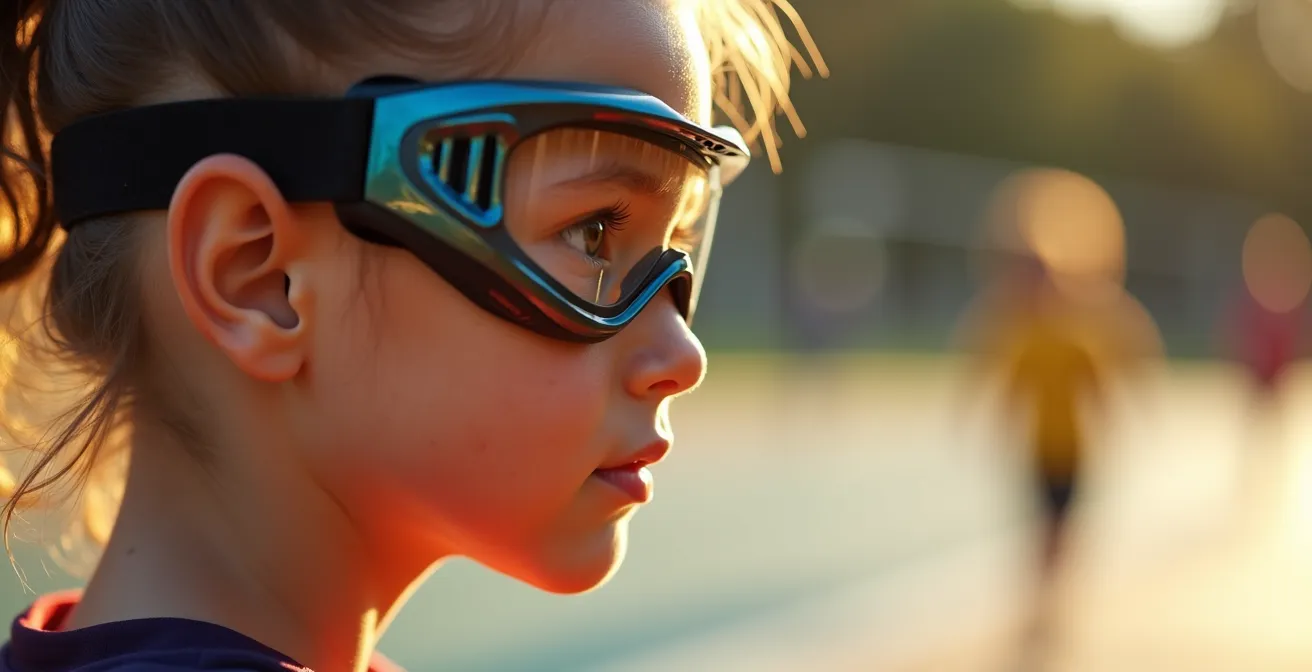
Comfort and compliance are not just about the lens, but about the entire system. A lightweight Trivex lens, combined with a well-ventilated frame and a reliable factory-applied anti-fog coating, creates a comfortable, high-performance piece of equipment that a child is more likely to wear consistently, ensuring they stay protected.
Action Plan: Achieving Better Goggle Compliance in Children
- Choose Trivex lenses: Opt for Trivex to measurably reduce pressure on the nose bridge and ears, significantly increasing comfort during extended wear.
- Select a well-ventilated frame: Ensure the frame has excellent top and bottom ventilation channels to actively manage moisture and heat buildup.
- Insist on factory anti-fog coating: Select goggles with a permanent, factory-applied hydrophilic anti-fog coating to prevent removal due to fogging discomfort.
1.67 or 1.74 Index: Which Is Necessary for a -6.00 Prescription?
For individuals with strong prescriptions (typically beyond +/-3.00D), the thickness and weight of lenses become a major concern. This often leads them to consider “high-index” materials, such as those with a refractive index of 1.67 or 1.74, which bend light more efficiently and allow for thinner lenses. A common question for safety eyewear users is whether these thinner materials are a viable option for a -6.00 prescription.
The answer is an emphatic no. High-index materials are not safety-rated. They are inherently more brittle than Polycarbonate or Trivex and will shatter on high-velocity impact, much like standard CR-39 plastic. For safety applications, the choice must be between Polycarbonate and Trivex. For a -6.00 prescription, Polycarbonate’s higher refractive index (1.59) compared to Trivex (1.53) will result in a slightly thinner and lighter lens. This makes Polycarbonate the technically superior choice for high-prescription safety lenses where minimizing thickness is the primary goal.
However, this comes with the optical clarity trade-offs discussed elsewhere in this article. The user must weigh the benefit of a marginally thinner lens against the potential for more chromatic aberration. The following table, based on data from leading optical resource All About Vision, clarifies the appropriate use cases for each material.
| Material | Refractive Index | Best For Prescription | Safety Rating |
|---|---|---|---|
| Trivex | 1.53 | +/-3.00D to +/-6.00D | Impact Resistant |
| Polycarbonate | 1.59 | Beyond +/-6.00D | Impact Resistant |
| High-Index 1.67 | 1.67 | Not for safety use | Not Safety Rated |
| High-Index 1.74 | 1.74 | Not for safety use | Not Safety Rated |
As this analysis of lens materials for prescriptions clearly shows, the safety rating is the first and most important filter. For a -6.00 prescription in a safety context, Polycarbonate is the standard recommendation, while Trivex remains an excellent, albeit slightly thicker, option for those prioritizing optical quality over minimal thickness.
Why Living in High-UV Zones Accelerates Cataract Formation by 5 Years?
While impact resistance is the immediate focus of safety eyewear, long-term protection against invisible threats is just as critical. Chronic exposure to the sun’s ultraviolet (UV) radiation is a primary environmental risk factor for the development of cataracts, a clouding of the eye’s natural lens. For those who work or play outdoors, especially in high-UV zones, this cumulative damage can significantly accelerate cataract formation.
This is an area where both Polycarbonate and Trivex excel. A key, often overlooked benefit of these materials is their inherent UV-blocking capability. Unlike standard plastic lenses that require a separate UV-blocking coating that can scratch or wear off over time, both Polycarbonate and Trivex inherently block 100% of harmful UVA and UVB rays. This protection is part of the material’s chemistry and does not degrade.
This built-in protection provides a reliable, full-time shield against the radiation that damages the cells of the eye’s lens. While some sources note that the manufacturing quality can lead to slight variations, material properties confirm both materials are designed to offer complete UV protection. Choosing eyewear made from either material ensures that your eyes are not only safe from physical impact but are also shielded from the long-term, degenerative effects of sun exposure. For anyone spending significant time outdoors, this feature is not just a bonus—it’s an essential component of comprehensive eye health.
Key Takeaways
- Failure Mode is Critical: Standard plastics shatter into dangerous shards; Polycarbonate and Trivex are engineered to deform and absorb impact safely.
- Clarity vs. Strength: The core choice is between Polycarbonate’s superior impact velocity resistance and Trivex’s significantly better optical clarity and lighter weight.
- System Matters Most: A safety-rated lens is useless without a correspondingly rated frame. Always look for the “Z87+” mark on both components for guaranteed protection.
Static vs. Dynamic Acuity: Which Matters More for Tennis Players?
For an athlete, vision is not a passive sense. It is an active, dynamic process of tracking objects, judging distances, and making split-second decisions. The standard eye chart in a doctor’s office measures “static acuity”—your ability to see stationary objects clearly. For a tennis player, however, “dynamic acuity”—the ability to see objects clearly while they, or you, are in motion—is far more critical. This is where the optical quality of a lens material becomes a decisive performance factor.
The key metric for optical clarity is the Abbe value, which measures how much a lens disperses light into its component colors, a phenomenon known as chromatic aberration. This aberration is visible as “color fringing” or a rainbow-like halo around high-contrast objects. Lenses with a low Abbe value produce more of this visual noise, which can impair the brain’s ability to lock onto a target. Polycarbonate has a low Abbe value of 30. In contrast, optical measurements demonstrate Trivex’s Abbe value of 45 versus polycarbonate’s 30, which is much closer to the human eye’s natural clarity.
This difference is not merely academic; it has real-world consequences. As optical specialists at ReFocus Eye Health explain, this translates directly to a better visual experience:
Trivex lenses have a higher Abbe value, resulting in sharper, clearer vision with minimal to no chromatic aberration. This means you are less likely to see rainbow edges around objects, which can make activities like reading, computer work, and driving more comfortable and reduce eye strain.
– ReFocus Eye Health Branford, Optical Clarity Comparison Study
For a tennis player tracking a fast-moving yellow ball against a varied background, the minimal distortion from a Trivex lens allows for faster target acquisition and more accurate judgment. The brain receives a cleaner signal, reducing the cognitive load required to process the visual information. For any activity demanding peak visual performance, Trivex’s superior optical purity provides a tangible competitive advantage.
Your choice between Polycarbonate and Trivex should now be clear, guided by your primary activity. Assess your environment’s specific risks and visual demands, and select the material that provides the optimal balance of protection and performance for your needs.