The safety of frequent eye drop use hinges not on the bottle type, but on avoiding a single toxic preservative (BAK) and mastering sterile application.
- Preservative-free (PF) drops are essential for use more than 4-6 times a day to prevent long-term corneal cell damage.
- Vasoconstrictor “redness relief” drops (like Visine) cause a harmful rebound effect and should be avoided entirely.
Recommendation: For frequent relief, switch to single-dose, preservative-free vials and support your long-term tear film health through targeted nutrition.
The familiar gritty, burning sensation of severe dry eye creates a relentless cycle. You reach for your eye drops, feel a moment of relief, and then, all too soon, the discomfort returns. This leads to a desperate search in the pharmacy aisle, surrounded by a dizzying array of bottles, gels, and single-use vials, all promising comfort. The common advice—”just get preservative-free” or “avoid the redness-relief drops”—is a good starting point, but for someone needing hourly relief, it’s critically incomplete. True, sustainable comfort isn’t just about what you buy; it’s about understanding the science behind the ingredients and mastering the techniques to use them safely and effectively.
This guide moves beyond surface-level tips. It is built on the principle of transforming you from a passive patient into an informed manager of your own ocular health. We will delve into the specific mechanisms of ocular surface toxicology, focusing on the hidden dangers in many multi-dose bottles. You will learn the precise application mechanics that prevent waste and contamination, ensuring every expensive drop counts. By understanding the strategic differences between formulations and the systemic support your eyes need from within, you can finally build a routine that provides not just temporary relief, but long-term safety and health for your eyes.
To help you navigate this complex topic, this article is structured to build your knowledge step-by-step. We will cover the most critical aspects of choosing and using artificial tears for frequent, severe dry eye symptoms.
Contents: A Guide to Safe and Effective Dry Eye Management
- Why Benzalkonium Chloride Damages Corneas With Long-Term Use?
- How to Put in Eye Drops Without Touching the Bottle to Your Eye?
- Gel Drops for Night or Liquid for Day: How to Combine Them?
- The Rebound Redness: Why You Must Stop Using Vasoconstrictors
- When to Use Rewetting Drops: Before or During Contact Lens Wear?
- How to Put in Eye Drops Without Missing or Wasting Expensive Medication?
- The Rebound Effect: Why Visine Makes Conjunctivitis Look Worse Later
- Why Meibomian Glands Need High-Quality Fats to Function?
Why Benzalkonium Chloride Damages Corneas With Long-Term Use?
For individuals with severe dry eye requiring frequent application, the most significant danger isn’t the artificial tear itself, but the preservative used to keep it sterile in a multi-dose bottle. The most common of these is Benzalkonium Chloride (BAK). While effective at preventing bacterial growth in the bottle, its impact on the eye is a classic case of the cure being worse than the disease. The prevalence of this chemical is staggering; research published in the Nature Eye journal reveals that over 70% of ophthalmic formulations contain BAK.
The problem lies in its mechanism of action. BAK is a detergent-like compound that disrupts cell membranes—not just on bacteria, but also on the delicate surface of your cornea. This leads to a dose-dependent toxicity. While one or two drops a day might be tolerated, hourly use exposes the ocular surface to a continuous chemical assault. This chronic exposure leads to what experts call ocular surface disease, ironically the very condition you are trying to treat.
The scientific evidence is unequivocal. As a comprehensive review in the Nature Eye Journal explains, BAK’s effect is far from benign:
BAK causes cytotoxic damage to conjunctival and corneal epithelial cells, resulting in signs and symptoms of ocular surface disease including ocular surface staining, increased tear break-up time, and higher OSD symptom scores.
– Multiple authors, Nature Eye Journal – Ocular benzalkonium chloride exposure
In simple terms, the very preservative meant to keep the drops safe is actively damaging your eye cells, worsening your symptoms over time. This is why the first and most crucial rule for anyone using artificial tears more than four to six times a day is to exclusively use preservative-free formulations, typically found in single-use vials.
How to Put in Eye Drops Without Touching the Bottle to Your Eye?
Even when using preservative-free drops, maintaining sterility is paramount to prevent infection. The single biggest mistake users make is allowing the tip of the dropper to touch the eye, eyelid, or eyelashes. This act of contamination can transfer bacteria into the vial, turning a sterile product into a source of infection. Mastering a “no-touch” technique is a fundamental skill for safe eye care.
The key to a successful, sterile application is stabilizing your hand. Trying to hold the bottle free-floating above your eye often leads to misses and accidental contact. A much more reliable method is the “tripod anchor” technique, where you use parts of your hand and face to create a stable platform. This ensures the dropper remains a safe distance from the ocular surface while improving your aim dramatically.
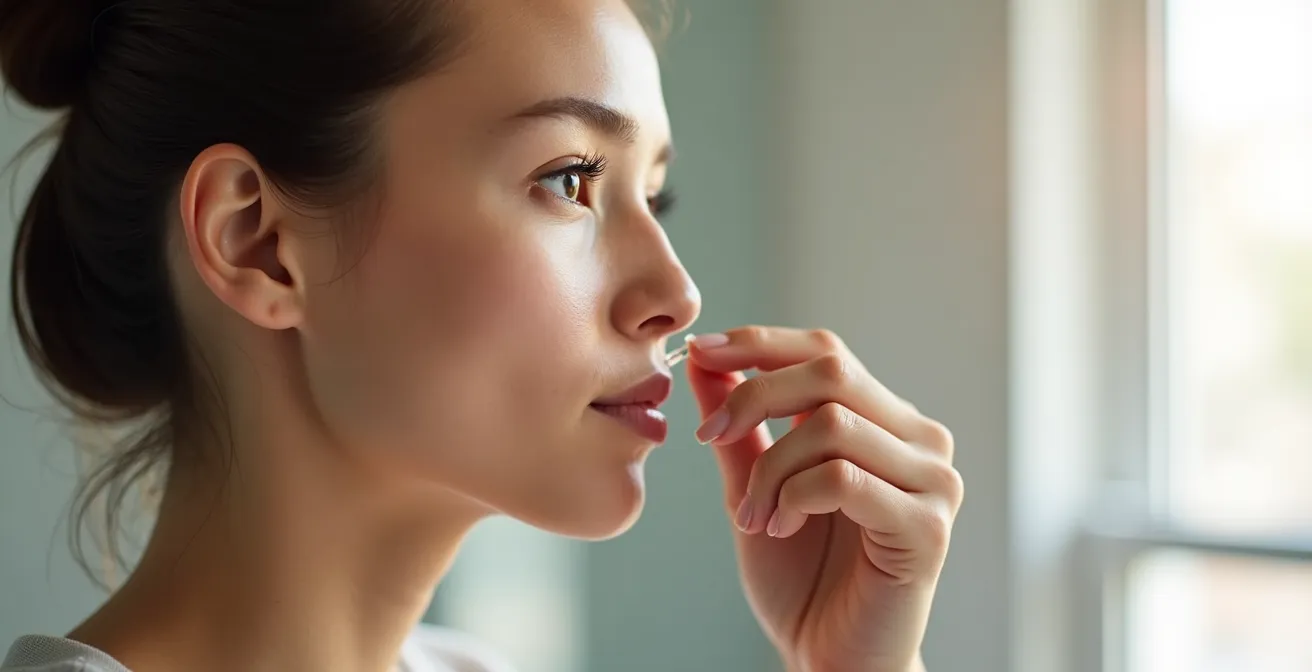
As you can see in the demonstration, by bracing your hand against your cheek or the bridge of your nose, you create a fixed system that prevents shaking. This allows for precise, one-drop application into the lower eyelid pocket. Follow these steps to perfect your technique:
- Wash your hands thoroughly with soap and water.
- Tilt your head back and look up toward the ceiling.
- With one hand, gently pull down your lower eyelid to create a small pocket.
- Brace the hand holding the bottle against your face (cheek or nose bridge) to stabilize it.
- Position the dropper tip directly over the pocket without it touching any surface.
- Squeeze gently to release a single drop into the pocket.
- Close your eye gently (do not squeeze shut) and follow with punctal occlusion (see section 15.2) to maximize absorption.
Gel Drops for Night or Liquid for Day: How to Combine Them?
The world of artificial tears is not one-size-fits-all. Different formulations are designed for different purposes, primarily distinguished by their viscosity (thickness). Understanding how to strategically combine thin, liquid drops with thicker gels can provide comprehensive, 24-hour symptom management for severe dry eye.
During the day, the priority is clear vision and frequent relief. This is where low-viscosity liquid drops excel. Their watery consistency provides immediate lubrication without causing significant blurriness, making them ideal for use at work or while driving. However, their effects are short-lived, often requiring reapplication every hour or two. At night, the goal shifts to long-lasting protection and healing. This is the role of high-viscosity gels and ointments. Their thick formulation creates a durable protective barrier over the cornea, preventing overnight moisture loss and promoting surface healing while you sleep. The trade-off is significant temporary blurriness, making them impractical for daytime use.
The following table, based on guidance from the American Academy of Ophthalmology, breaks down the key differences:
| Time of Use | Type | Consistency | Duration | Best For |
|---|---|---|---|---|
| Daytime | Liquid drops | Thin, watery | 1-2 hours | Quick relief without blur |
| Nighttime | Gel/Ointment | Thick, viscous | 6-8 hours | Extended protection during sleep |
For those with severe evaporative dry eye, a combined approach is often the most effective strategy for complete symptom management.
Case Study: A Dual-Action Strategy for 24-Hour Relief
Ophthalmologist Christopher Starr, MD, an expert cited by the American Academy of Ophthalmology, recommends a dual approach for patients with evaporative dry eye. He suggests using lipid-based preservative-free drops during the day to actively protect the tear film from environmental stress. This is then combined with thicker, more viscous gel formulations applied just before bed. This strategy addresses both immediate comfort during waking hours and provides an intensive, uninterrupted period for ocular surface repair and regeneration during sleep, leading to better overall outcomes.
The Rebound Redness: Why You Must Stop Using Vasoconstrictors
In the quest for white, clear eyes, many people reach for “redness relief” drops. However, these products are one of the most misused and counterproductive treatments on the pharmacy shelf, especially for someone with underlying dry eye. They work not by lubricating, but by using drugs called vasoconstrictors to forcibly shrink the blood vessels on the surface of the eye. This provides a temporary cosmetic fix, but it comes at a high cost.
The primary danger is a phenomenon known as rebound hyperemia, or rebound redness. As the vasoconstrictor drug wears off, the blood vessels don’t just return to normal; they often dilate even wider than before as the tissue cries out for blood flow and oxygen it was deprived of. This creates a vicious cycle: your eyes look redder, so you use more drops, leading to an even stronger rebound. This dependency is known as tachyphylaxis. The expert consensus is clear on this risk.
Expert Warning on Red-Eye Relievers
As Dr. Christopher Starr, MD, warns in an article for the American Academy of Ophthalmology: “Be careful of eye drops that are marketed to relieve red eyes, as they often contain vasoconstrictors which can actually worsen symptoms and redness over time. Ingredients to stay away from include tetrahydrozoline and naphazoline.” These are the active ingredients in many popular brands.
The only way to break this cycle is to stop using vasoconstrictors completely. The transition can be difficult, as the rebound redness will initially get worse before it gets better. However, with supportive care, your eyes can return to their natural state.

Your Action Plan: Weaning Off Vasoconstrictor Drops
- Days 1-3: Cut your current vasoconstrictor use in half. Supplement aggressively with preservative-free lubricating tears every 1-2 hours to keep the surface soothed.
- Days 4-7: Stop vasoconstrictor use completely. Expect your eyes to look significantly redder; this is the normal rebound phase and a sign that your blood vessels are recovering.
- Week 2: Continue using preservative-free artificial tears 4-6 times daily, or as needed, to manage dryness symptoms. The redness should begin to slowly subside.
- Week 3: Use cold compresses for 5-10 minutes several times a day. This can provide comfort and help naturally constrict blood vessels without drugs.
- Week 4: Most rebound symptoms should have resolved. Your eye’s natural state will be revealed. Continue with a maintenance routine of safe, preservative-free lubricants.
When to Use Rewetting Drops: Before or During Contact Lens Wear?
For contact lens wearers, dry eye presents a unique challenge. The lens itself can disrupt the natural tear film, leading to discomfort, blurry vision, and end-of-day dryness. While rewetting drops designed for contact lenses can provide relief, *when* you use them is just as important as *which* ones you use.
Most people reach for rewetting drops only when they start to feel discomfort during the day. While this provides temporary relief, a more proactive approach can significantly enhance all-day comfort. This involves using drops *before* lens insertion to create a moisture buffer. This preemptive strategy can be a game-changer for extending comfortable wear time.
The Pre-emptive Cushion Technique
Applying contact lens-safe rewetting drops 5-10 minutes before inserting your lenses creates a hydrating “cushion” between the cornea and the lens surface. This simple step can drastically improve initial comfort and prevent the lens from immediately wicking away your natural tears. For even better results, look for advanced formulas containing hyaluronic acid. This powerful humectant binds to water, keeping the lens surface hydrated for hours longer than standard rewetting drops.
Another critical, yet often overlooked, time to use drops is just before lens removal. At the end of a long day, a contact lens can become “stuck” to a dry cornea. Forcibly peeling it off can cause micro-abrasions and irritation. Applying a few drops 15 minutes before removal rehydrates the lens, allowing it to “float” freely on the tear film for a much gentler and safer removal process. Always ensure your chosen drops are explicitly labeled as “for use with contact lenses” to avoid ingredients that could damage the lens material.
How to Put in Eye Drops Without Missing or Wasting Expensive Medication?
Preservative-free artificial tears, especially in single-use vials, can be costly. It’s frustrating to feel half the drop run down your cheek, a sign of both waste and reduced efficacy. The reason this happens is simple anatomy: the human eye’s conjunctival sac can only hold about 20 microliters of fluid. A standard eye dropper dispenses 50-70 microliters. This means, as corneal care specialists point out, that the eye can only hold about one-fifth of a standard drop. The rest is destined to overflow.
Squeezing the bottle harder or instilling multiple drops is not only wasteful but can also increase the washout of beneficial components of your natural tear film. The goal is not to flood the eye, but to deliver a single drop and keep it in contact with the ocular surface for as long as possible. The single most effective method for achieving this is a technique called punctal occlusion.
The puncta are tiny openings in the inner corners of your eyelids that act as drains, leading to your nasal passages (this is why you can sometimes “taste” your eye drops). By applying gentle pressure to this area after instilling a drop, you temporarily block these drains, doubling the time the medication stays in contact with your eye and maximizing its therapeutic effect.
Here is the proper technique for punctal occlusion:
- After successfully instilling a single drop, close your eye gently (do not squeeze it shut).
- Use your index finger to apply light, steady pressure to the inner corner of your eyelid, right next to your nose.
- Hold this pressure for a minimum of 60 to 90 seconds.
- This action prevents the drop from draining away, allowing for maximum absorption by the cornea and conjunctiva.
- After the time is up, gently wipe away any excess liquid from your closed eyelids with a clean tissue.
The Rebound Effect: Why Visine Makes Conjunctivitis Look Worse Later
Brand names like Visine have become synonymous with “getting the red out.” They are marketed as a quick fix for tired, irritated eyes. However, as discussed earlier, these products rely on vasoconstrictor drugs that lead to a harmful rebound effect. Using them to mask the redness of an underlying condition like dry eye or allergic conjunctivitis is like turning off a fire alarm while the fire continues to burn.
When your eye is red, it’s a signal. The blood vessels have dilated to bring more oxygen, nutrients, and immune cells to the area to fight inflammation or irritation. Using a vasoconstrictor chokes off this natural healing response. When the drug wears off, the body overcompensates, leading to even more intense redness. Clinical observations show it can take an average of 7 days for this rebound redness to resolve after stopping the drops.
Instead of masking the symptom, the correct approach is to address the root cause. If the redness is from dryness, use proper lubricating drops. If it’s from allergies, use antihistamine or mast cell stabilizer drops. These treatments are safe for daily use and do not carry the risk of rebound redness. Understanding the safe alternatives is key to making better choices in the pharmacy aisle.
This table compares the mechanisms and risks of different types of redness-relief options:
| Type | Active Ingredient | Action | Rebound Risk | Safe for Daily Use |
|---|---|---|---|---|
| Vasoconstrictors | Tetrahydrozoline | Constricts vessels | High | No |
| Lubricants | Carboxymethylcellulose | Moisturizes | None | Yes |
| Antihistamines | Ketotifen | Blocks histamine | None | Yes |
| Mast Cell Stabilizers | Cromolyn | Prevents histamine release | None | Yes |
Key Takeaways
- Always choose preservative-free (PF) drops for use more than 4-6 times daily to avoid long-term corneal damage from BAK.
- Master the “no-touch” application and punctal occlusion techniques to ensure safety, maximize absorption, and prevent waste.
- Never use vasoconstrictor “redness-relief” drops; they create a cycle of dependency and worsen redness over time.
Why Meibomian Glands Need High-Quality Fats to Function?
Thus far, we’ve focused on topical treatments—the drops you put in your eye. However, for a truly holistic and sustainable approach to managing dry eye, we must look at systemic support. A significant portion of severe dry eye cases, particularly evaporative dry eye, is caused by Meibomian Gland Dysfunction (MGD). These tiny glands in your eyelids are responsible for producing the essential oily layer of your tear film, which prevents your tears from evaporating too quickly.
The health and function of these glands are directly tied to your diet. Meibomian glands produce a lipid-based secretion called meibum. For this meibum to be of high quality—thin and clear, flowing easily to coat the eye—it requires a steady supply of high-quality fatty acids, particularly Omega-3s. A diet lacking in these essential fats can lead to thick, cloudy, or clogged meibum, which destabilizes the tear film and accelerates evaporation, causing classic dry eye symptoms.
Scientific research has increasingly validated the therapeutic role of Omega-3 supplementation in treating MGD and improving the quality of the tear film’s lipid layer.
Clinical Trial: High-Dose Omega-3 for MGD
A randomized controlled trial published in the National Library of Medicine investigated the effects of high-dose Omega-3 supplementation on patients with MGD. The study group received 600mg of EPA and 1640mg of DHA daily for 8 weeks. The results were significant: the supplemented group showed marked improvements in tear break-up time and MGD scores compared to the placebo group. This demonstrates a clear therapeutic benefit, proving that nutritional intervention can directly improve meibomian gland function and stabilize the tear film.
Incorporating Omega-3s is a proactive step toward addressing a root cause of evaporative dry eye. While dietary sources like fatty fish are beneficial, achieving therapeutic doses often requires targeted supplementation. Here are evidence-based guidelines for Omega-3 dosing for dry eye:
- Starting Dose: A minimum of 1000mg EPA + 500mg DHA daily.
- Moderate MGD: Doses around 1680mg EPA + 560mg DHA daily have shown clinical benefit.
- Severe Cases: Some protocols may use up to 2000mg EPA + 1000mg DHA daily under medical supervision.
- Source Matters: Choose marine-sourced (fish or algal oil) over plant-based (flaxseed) for the more bioavailable EPA and DHA forms.
- Absorption: Take supplements with a meal containing fat to improve absorption and reduce potential side effects.
Frequently Asked Questions About Artificial Tears and Eye Health
Can I use preservative-free drops with contacts in?
Yes, preservative-free drops are generally safe to use with soft contact lenses. However, it is always best to check the product’s label for a specific “contact lens compatible” or “for use with contacts” designation to be certain.
Should I apply drops before removing contacts?
Yes, this is a highly recommended practice. Applying a few rewetting drops 10-15 minutes before you plan to remove your lenses rehydrates them. This allows the lens to “float” off the corneal surface rather than being peeled from a dry, sensitive eye, which significantly increases comfort and reduces irritation.
How often can I use rewetting drops during wear?
If you are using preservative-free rewetting drops that are approved for contact lens use, you can typically use them as needed throughout the day. Unlike preserved drops, which are often limited to four times a day, preservative-free formulas offer more flexibility for managing dryness and discomfort during lens wear.