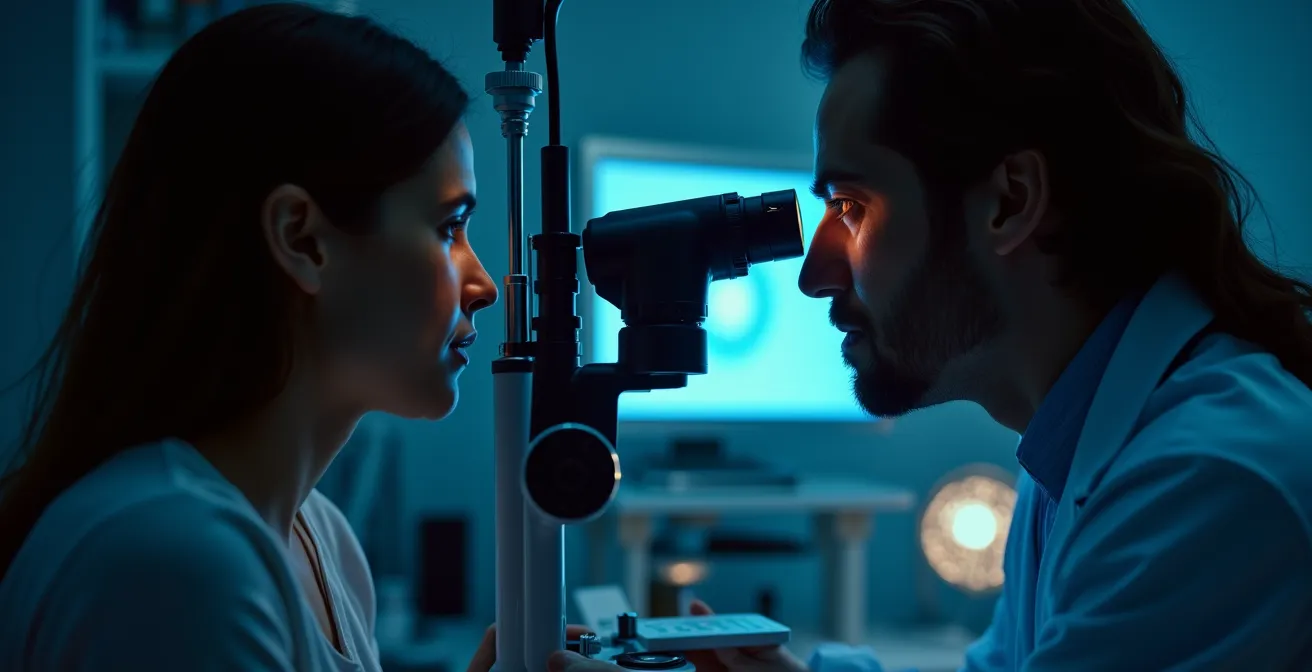
That painful red eye isn’t just ‘contact lens irritation’—it could be a fast-moving infection capable of causing permanent vision loss in as little as 24 hours.
- Aggressive bacteria like Pseudomonas don’t just infect; they release enzymes that literally melt corneal tissue (liquefactive necrosis).
- A distinct white or gray spot on the clear part of your eye is not a sty; it is a corneal infiltrate, the frontline of an ulcer that is a medical emergency.
Recommendation: If you wear contacts and have a painful red eye with blurred vision, light sensitivity, or see a white spot, remove your lenses immediately and seek urgent medical care from an eye doctor. If symptoms are severe, go to the ER.
As a contact lens wearer, you’re familiar with the occasional red eye. It’s easy to dismiss it as a consequence of a long day, dry air, or perhaps sleeping in your lenses by mistake. You tell yourself it will clear up. But what if this time is different? That nagging, gritty feeling and worsening pain aren’t just signs of irritation; they could be the first signals of a full-scale assault on your cornea by an aggressive microbe. The line between a minor problem and a sight-threatening emergency is terrifyingly thin, and the clock is always ticking.
Many people believe they should just wait and see, or that any doctor can handle an eye issue. This is a critical mistake. Understanding the specific culprits, from flesh-eating bacteria to microscopic amoebas, is not about causing panic. It’s about empowering you to act as your own triage officer. This guide is not a list of vague symptoms; it is an emergency briefing. You will learn to conduct a forensic self-examination, identify the specific signs of a corneal attack, and understand the non-negotiable symptoms that mean you need to be in an emergency room, not waiting for a morning appointment. Your vision may depend on the decisions you make in the next few hours.
This article provides an urgent and clear framework for assessing your situation. We will dissect the most dangerous pathogens, show you how to spot the earliest warning signs, and provide a definitive guide on when and where to seek immediate help. The following sections are your triage protocol.
Summary: Distinguishing a Dangerous Eye Infection from Minor Irritation
- Why Pseudomonas Bacteria Destroy Corneas Faster Than Other Microbes?
- How to Spot a Corneal Infiltrate Before It Becomes an Ulcer?
- Bacterial or Fungal: Which Infection Comes From Vegetable Matter?
- The Acanthamoeba Risk: Why Swimming in Lenses Can Cause Blindness
- When to See a Doctor: Why Waiting 24 Hours Can Cost You Vision
- When to Go to the ER: 3 Eye Symptoms That Cannot Wait Until Morning
- Why Bacteria Multiply 5x Faster Under a Closed Eyelid?
- The Myth That Optometrists Only Prescribe Glasses and Contacts
Why Pseudomonas Bacteria Destroy Corneas Faster Than Other Microbes?
Not all bacteria are created equal. When it comes to contact lens-related infections, Pseudomonas aeruginosa is the supervillain. This bacterium isn’t just opportunistic; it’s aggressively destructive, armed with a cocktail of toxins and enzymes that can devastate corneal tissue with shocking speed. While many microbes cause inflammation, Pseudomonas wages a chemical war. Its primary weapon is a class of enzymes called proteases, which cause liquefactive necrosis—a horrifying process where the enzymes literally dissolve the cornea, turning the strong, structural tissue into a liquid state. This is why a Pseudomonas ulcer can create a hole in the cornea within 24-48 hours if left untreated.
The bacterium’s efficiency is terrifying. Upon contact with a microscopic scratch on the cornea (often caused by a contact lens), it adheres tightly and immediately begins its assault. It secretes a protective biofilm, a slimy shield that makes it highly resistant to your eye’s natural defenses and even some initial antibiotic drops. Furthermore, it uses a specialized weapon called a Type III secretion system, which acts like a microscopic syringe to inject toxins directly into your corneal cells. This one-two punch of tissue-melting enzymes and direct cellular poison is what makes it so uniquely dangerous. In fact, various studies have shown that Pseudomonas aeruginosa accounts for 6.8 to 55% of all bacterial keratitis cases, making it a primary threat every contact lens wearer must respect.
This microbe doesn’t wait, and neither should you. Recognizing the signs of its presence is the critical next step.
How to Spot a Corneal Infiltrate Before It Becomes an Ulcer?
The first tangible sign of a serious corneal infection is not the redness or even the pain—it’s the appearance of a corneal infiltrate. This is the frontline of the battle, a concentrated collection of white blood cells rushing to fight the invading microbes. To the naked eye, it appears as a distinct, localized white or greyish spot on the cornea (the clear dome covering your iris and pupil). Mistaking this for a sty or simple conjunctivitis is a catastrophic error. An infiltrate is the direct precursor to an ulcer, and spotting it early is your best chance to prevent permanent scarring and vision loss.
You can perform a crucial forensic self-examination. In a dark room, use your phone’s flashlight and a mirror. Shine the light onto your eye from the side. Look carefully at the surface of your cornea. Are you seeing generalized redness, or can you identify a specific, opaque spot that wasn’t there before? This spot is the infiltrate. It signals a localized, deep infection, not the widespread, superficial irritation of pink eye. The sensation is also different: an infiltrate often causes a sharp, gritty, foreign-body feeling that doesn’t go away, while pink eye is typically more of a general itch or mild discomfort.
Differentiating between the symptoms of a potentially blinding corneal infiltrate and a benign case of pink eye is a critical triage skill. This is not a situation for guesswork.
| Symptom Type | Corneal Infiltrate | Pink Eye (Conjunctivitis) |
|---|---|---|
| Sensation | Gritty foreign body feeling that doesn’t go away | General itchiness and irritation |
| Pain Level | Moderate to severe, increasing | Mild discomfort |
| Visual Changes | Blurred vision, light sensitivity | Minimal vision changes |
| Appearance | White/gray spot on cornea | Red eye without corneal spots |
Your Emergency Eye Self-Audit: 5 Steps to Assess the Threat
- Symptom Check: Is the pain sharp and localized, or a general itch? Is your vision blurry or sensitive to light? Note these specific symptoms.
- Visual Inspection: Go to a dark room. Use a phone flashlight from the side to examine your cornea in a mirror. Look for a distinct white or grey spot.
- Contact Lens Status: If you are wearing a contact lens, remove it immediately. Do not discard it; place it in its case with solution. Your doctor may need to culture it.
- Compare to Baseline: Does this feel like any previous irritation or something entirely new and more severe? A significant increase in pain or a new white spot is a red flag.
- Action Plan: If you identify a white spot OR have severe pain and vision changes, this is an emergency. Contact an eye doctor immediately or go to the ER. Do not wait.
If you see this white spot, the investigation is over. It’s time to call for professional help, immediately.
Bacterial or Fungal: Which Infection Comes From Vegetable Matter?
While bacteria like Pseudomonas are the most common culprits in contact lens-related ulcers, they are not the only threat. Fungal keratitis, an infection caused by fungi, presents a different and often more challenging diagnostic and treatment problem. The primary risk factor for this type of infection is not poor lens hygiene, but ocular trauma involving organic or vegetable matter. A seemingly minor scratch from a tree branch while gardening, a flick of dirt while doing yard work, or exposure to plant debris on a windy day can implant fungal spores directly into the cornea.
These infections are notoriously difficult to treat. Fungi grow more slowly than bacteria, meaning symptoms might develop over several days rather than overnight, potentially giving a false sense of security. However, they are highly invasive and can penetrate deep into the eye, and the antifungal medications required are often less effective and more toxic than standard antibiotics. This threat is particularly pronounced in certain climates; in tropical and subtropical environments, fungal keratitis accounts for up to 50% of all microbial keratitis cases.
If you experience an eye injury, no matter how small, involving a plant, soil, or any organic material, you must be on high alert. Do not assume it will heal on its own. Common risk scenarios for fungal keratitis include gardening without eye protection, agricultural work, and even construction projects involving wood or other organic materials. Any subsequent pain, redness, or vision change in that eye should be treated as a potential fungal infection until proven otherwise by an eye doctor.
The environment you were in when the irritation started is a critical clue. If it involved plants or dirt, you must communicate this to your doctor.
The Acanthamoeba Risk: Why Swimming in Lenses Can Cause Blindness
There is a reason every contact lens box and every eye doctor warns you: do not let your lenses touch water. This isn’t about the lens getting washed away; it’s about Acanthamoeba, a microscopic, free-living amoeba found in virtually all water sources: tap water, showers, pools, hot tubs, lakes, and oceans. When this organism gets trapped between your cornea and a contact lens, it can cause Acanthamoeba keratitis, one of the most painful and difficult-to-treat eye infections, often resulting in permanent vision loss or the need for a corneal transplant.
This infection is rare but devastating. The amoeba slowly eats its way through the layers of the cornea, causing excruciating pain that is often described as wildly disproportionate to the initial appearance of the eye. Early symptoms can mimic a more common infection, leading to misdiagnosis and critical delays in treatment. The fight against Acanthamoeba is a long, arduous process that can involve a toxic regimen of eye drops for months, or even over a year. Despite this, the prognosis is often poor. A CDC investigation into an outbreak in Iowa highlighted the risks: of 63 patients, 22.2% had swum in lakes or rivers, 17.5% showered with contacts, and a shocking 41.3% of patients became legally blind in the affected eye. Globally, it’s estimated that more than 23,000 people are diagnosed with Acanthamoeba keratitis each year.
The rule is absolute: contact lenses and water do not mix. This includes showering, using a hot tub, or swimming. Rinsing your lenses or case with tap water is also a major risk factor. This is a non-negotiable principle of safe contact lens wear. The convenience is not worth the risk of a life-altering infection.
If your symptoms began after any contact with water, you must inform your eye care provider immediately. This is a critical piece of diagnostic information.
When to See a Doctor: Why Waiting 24 Hours Can Cost You Vision
In the world of corneal infections, time is tissue. The difference between a full recovery and a permanent corneal scar—or worse—is measured in hours, not days. The instinct to “wait and see if it gets better” is the single most dangerous decision you can make. With aggressive bacteria like Pseudomonas, a significant portion of your cornea can be destroyed in a single day. The damage is often irreversible. Once corneal tissue is lost, it does not grow back. It is replaced by scar tissue, which is opaque and can lead to permanent blurring or vision loss, requiring a corneal transplant to restore sight.
The medical consensus is unequivocal. As the highly-respected Merck Manual states:
A corneal ulcer is an emergency that should be treated immediately. Antibiotic, antiviral, or antifungal eye drops are usually needed immediately and must be given frequently, sometimes every hour around the clock for several days.
– Merck Manual, Merck Manual Consumer Version
This is not a “wait until morning” situation. If you are a contact lens wearer and experience the trifecta of eye pain, light sensitivity, and blurred vision, you must seek care from an eye doctor immediately. If a doctor is not available, go to an urgent care center or an emergency room. Do not go to sleep assuming it will be better when you wake up. The infection will have had an uninterrupted 8-hour window to multiply and destroy tissue.

The goal is to begin targeted, high-frequency antibiotic therapy as soon as possible to halt the microbial assault before it causes structural damage. Every hour you wait allows the infection to dig deeper into your cornea, increasing the likelihood of scarring, perforation, and permanent vision impairment.
If you suspect an ulcer, your next stop should be a medical facility, not your bed.
When to Go to the ER: 3 Eye Symptoms That Cannot Wait Until Morning
While any suspected corneal ulcer requires immediate medical attention, certain symptoms are “red line” indicators that you should bypass urgent care and go directly to a hospital Emergency Room. These symptoms can signal not only a severe ulcer but other ocular emergencies that can cause blindness in hours. An ER has on-call ophthalmologists and specialized equipment, like slit lamps for high-magnification examination and tonometers to measure eye pressure, which are essential for diagnosing these conditions.
Do not hesitate. If you experience any of the following, it is a true medical emergency:
- Sudden, painless vision loss. This is often described as a curtain or shadow falling over your field of vision. It can be a sign of a retinal detachment, which requires immediate surgical intervention to prevent permanent blindness.
- Severe, deep, throbbing eye pain accompanied by nausea or vomiting. This classic combination is a hallmark of an acute angle-closure glaucoma attack, a condition where eye pressure spikes to dangerous levels, rapidly damaging the optic nerve. It is an absolute emergency.
- A chemical splash or a penetrating injury to the eye. Any incident where the eyeball has been cut, punctured, or exposed to a chemical substance requires immediate ER evaluation to minimize damage.
For a contact lens wearer, if your severe eye pain is combined with significant discharge (pus) and a rapid decline in vision, the ER is your safest bet. This indicates a very advanced ulcer that may require hospitalization for around-the-clock fortified antibiotics. Waiting until morning with these symptoms is not an option. Eye emergencies involving vision loss or severe pain are triaged as high priority in the ER; you will be seen quickly.
If you have any of these three symptoms, stop reading this and go to the nearest hospital emergency room.
Why Bacteria Multiply 5x Faster Under a Closed Eyelid?
Sleeping in contact lenses, even those approved for “extended wear,” is one of the single greatest risk factors for developing a severe corneal infection. A landmark study found that sleeping while wearing contact lenses increases the risk of infection by up to an 8-fold. The reason is simple and terrifying: a closed eyelid over a contact lens transforms your eye into a perfect bacterial incubator. This environment creates a trifecta of ideal conditions for microbial growth.
First, there is warmth. Your body heat is trapped under the lid, maintaining the eye at a balmy 98.6°F (37°C), the optimal temperature for bacteria like Pseudomonas to replicate. Second, there is moisture. Tears are trapped behind the lens, creating a stagnant, swampy environment instead of a clean, flowing river that would normally wash debris away. Third, and most critically, there is a lack of oxygen. The cornea gets its oxygen directly from the air. A contact lens already reduces this supply, but a closed eyelid cuts it off almost completely. This oxygen deprivation, or hypoxia, causes the corneal surface cells (the epithelium) to weaken and break down, creating tiny openings that are perfect entry points for bacteria.
This combination effectively shuts down all of your eye’s natural cleaning systems. The mechanical flushing action of blinking stops. The fresh, oxygenated, and antibody-rich tear film is no longer circulating. You have created a warm, moist, dark, oxygen-poor petri dish on the surface of your eye, giving any bacteria present an 8-hour, uninterrupted window to multiply and launch their attack. This is the “incubator effect,” and it’s how a minor contamination can escalate into a full-blown ulcer overnight.
Every time you consider sleeping in your lenses, picture this incubator. The risk is never worth the convenience.
Key Takeaways
- A corneal ulcer is a medical emergency. The difference between recovery and permanent vision loss is measured in hours.
- A distinct white or grey spot on the cornea is a classic sign of an infiltrate, the precursor to an ulcer. It is not a sty.
- Water and contact lenses do not mix. This includes showers, pools, and tap water, all of which can harbor the dangerous Acanthamoeba parasite.
The Myth That Optometrists Only Prescribe Glasses and Contacts
In the midst of a painful eye emergency, a common point of confusion is who to call. Many people mistakenly believe that optometrists are only qualified to prescribe glasses and contact lenses, and that any “medical” eye problem requires an ophthalmologist. This myth can cause dangerous delays in care. A Doctor of Optometry (OD) is a primary eye care physician who is fully trained and licensed to diagnose and treat a wide range of eye diseases, including corneal ulcers.
Optometrists are on the front lines of ocular disease management. Their daily work involves far more than refraction. They are equipped to diagnose and treat bacterial, viral, and fungal eye infections; manage glaucoma; remove foreign bodies from the eye; and handle eye emergencies like chemical burns and injuries. They can prescribe the necessary topical antibiotics, antifungals, and other medications needed to treat a corneal ulcer. In many cases, an optometrist is the most accessible and fastest route to getting proper treatment started.
The key difference is that an ophthalmologist is a medical doctor (MD) who is also a trained surgeon. While you would need an ophthalmologist for a corneal transplant or other surgical procedure, the initial diagnosis and medical management of an infection fall squarely within the scope of optometry.
Understanding the roles of different eye care providers is crucial for getting the right help quickly. An optician is a technician who fits glasses, an optometrist is a doctor who diagnoses and medically treats eye disease, and an ophthalmologist is a surgeon who does all of that plus performs surgery.
| Provider Type | Credentials | Primary Functions | Emergency Care Capability |
|---|---|---|---|
| Optician | Licensed Technician | Fits glasses and contacts | No medical treatment |
| Optometrist | OD (Doctor of Optometry) | Diagnoses and treats most eye diseases, prescribes medications | Can treat infections, remove foreign bodies, manage urgent conditions |
| Ophthalmologist | MD (Medical Doctor) | All optometry functions plus surgery | Full emergency care including surgical intervention |
If you have a painful red eye and suspect an infection, your first call should be to an optometrist’s office. They will tell you if you need to be seen immediately or if your symptoms warrant a direct trip to the ER.
Frequently Asked Questions About Corneal Ulcers and Eye Emergencies
Why go to the ER instead of urgent care for severe eye symptoms?
The ER has on-call ophthalmologists and specialized equipment (for measuring eye pressure, emergency surgery) that urgent care clinics lack.
What if I’m not sure if it’s serious enough for the ER?
If you have severe eye pain with vision changes, don’t wait. Corneal ulcers can cause permanent damage within hours.
Will I be seen quickly at the ER for an eye problem?
Eye emergencies involving vision loss or severe pain are typically triaged as high priority.