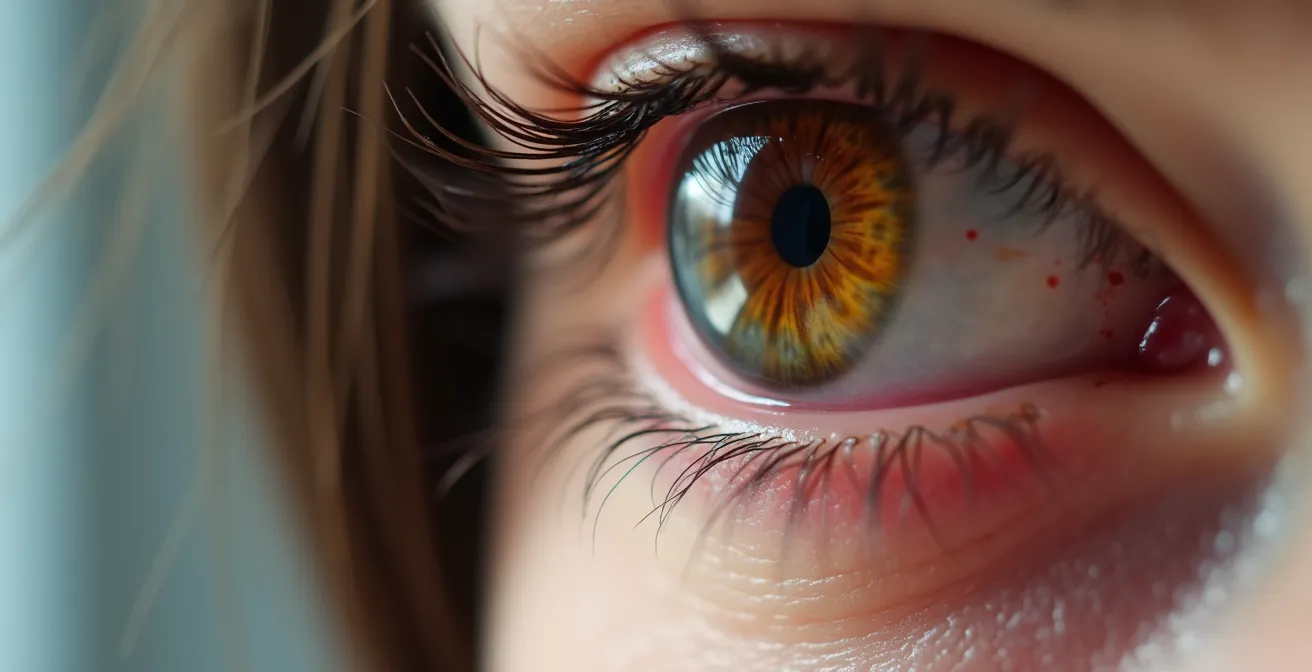
The key to managing a red eye isn’t just identifying the cause, but understanding the critical ‘red flags’ that separate a minor irritation from a sight-threatening emergency.
- Bacterial conjunctivitis typically involves thick, colored discharge, while viral is watery and often starts in one eye.
- Common “redness-relieving” eye drops can cause a rebound effect, making your eye look worse over time.
- The 24-hour rule for being non-contagious only applies to bacterial infections after starting antibiotics.
Recommendation: Immediately stop wearing contact lenses and use the red flag symptom checklist in this guide to determine if you need urgent medical attention.
Waking up to a mirror that reflects a red, swollen, and crusty eye is a universally alarming experience. The immediate questions are always the same: Is this contagious? Do I need to see a doctor? Can I still go to work? Many people lump all forms of “pink eye” together, leading to confusion and improper self-treatment. You might hear general advice to simply use warm compresses or assume you need antibiotics, but these actions can be ineffective or even counterproductive depending on the cause.
The reality is that conjunctivitis—the medical term for inflammation of the conjunctiva, the thin membrane covering the white of your eye—is not a single condition. It has multiple origins, each requiring a different approach. But what if the key wasn’t just knowing the difference between viral, bacterial, and allergic, but learning to think like a clinician? The real power lies in understanding the diagnostic reasoning behind the symptoms, recognizing what is a minor nuisance versus what is a true ocular emergency, and knowing the precise, safe actions to take at each step.
This guide is designed to give you that framework. We will move beyond a simple list of symptoms and empower you with a triage-based approach. We’ll start with the most urgent actions for high-risk individuals, move to environmental safety, differentiate treatments, debunk common myths about eye drops, and clarify the rules of contagion. Most importantly, we’ll equip you to identify the critical red flags that signal a problem more dangerous than simple pink eye.
To help you navigate this diagnostic process, we’ve structured this article to take you from immediate first aid to recognizing true emergencies. Follow these steps to understand your symptoms and manage them safely.
Summary: Viral, Bacterial, or Allergic: A Triage Guide to Identifying Your Conjunctivitis
- Why You Must Discard Your Lenses Immediately Upon Seeing Redness?
- How to Disinfect Pillowcases and Towels to Prevent Pink Eye Reinfection?
- Antibiotic Drops or Warm Compresses: Which Treats Viral Pink Eye?
- The Rebound Effect: Why Visine Makes Conjunctivitis Look Worse Later
- When Are You No Longer Contagious: The 24-Hour Rule Explained
- The Myth That Optometrists Only Prescribe Glasses and Contacts
- Bacterial or Fungal: Which Infection Comes From Vegetable Matter?
- Red Eye or Ulcer: How to Tell if Your Infection Is Dangerous?
Why You Must Discard Your Lenses Immediately Upon Seeing Redness?
For a contact lens wearer, any sign of a red eye is a stop sign. It’s not just a recommendation; it’s a critical first step in preventing a potentially sight-threatening infection. The soft, moist environment of a contact lens is an ideal breeding ground for bacteria and other pathogens. When your eye’s natural defenses are compromised, what might be a mild conjunctivitis in a non-wearer can escalate into a severe corneal infection (keratitis) for you. The biofilm that develops on lenses can harbor aggressive microorganisms that are difficult to eradicate.
Continuing to wear a lens—even for a few more hours—can trap these pathogens against the cornea, the clear front surface of your eye. This significantly increases the risk of a corneal ulcer, a serious open sore on the cornea that can cause permanent scarring and vision loss. This is why the first, non-negotiable action is to remove the lenses. Do not try to “clean” them and reinsert them. The risk of re-inoculating your eye with a concentrated dose of bacteria is too high.
Your lens case is equally compromised. It’s a dark, moist container that has been housing the same contaminated lens. Discarding the lenses and the case is the only way to break the cycle of infection. Switch to glasses immediately and do not resume contact lens wear until you have been evaluated by an eye care professional and your eyes are completely white and comfortable for at least 24 hours.
- Step 1: Remove contact lenses immediately upon noticing redness, pain, or discharge.
- Step 2: Discard both the lenses and the contaminated lens case without hesitation.
- Step 3: Switch to wearing your glasses exclusively until you are cleared by an eye care professional.
- Step 4: Schedule an immediate appointment with your optometrist or an ophthalmologist for a proper diagnosis.
- Step 5: After your eye has fully recovered, always start with a brand new lens case and fresh solution before resuming wear.
How to Disinfect Pillowcases and Towels to Prevent Pink Eye Reinfection?
Once you’ve addressed the immediate personal risk, the next step in our triage is to contain the spread. Infectious conjunctivitis, particularly the viral and bacterial types, is highly contagious. The pathogens responsible thrive on surfaces that come into contact with your face and hands. Your home environment can become a reservoir for reinfection for yourself and a source of infection for family members. The key is to focus on high-risk items first.
Anything that directly touches your eyes or face is a primary vector for transmission. This includes pillowcases, washcloths, hand towels, and any eye makeup. These items must be isolated and disinfected daily. Simply throwing them in a regular wash might not be enough. They should be washed in the hottest water setting your machine allows and dried on high heat to effectively kill the pathogens. Any eye makeup used since the infection began should be discarded immediately; applicators and pots of mascara or eyeliner are impossible to sanitize fully and will reinfect you.
Secondary items like phones, keyboards, and remote controls should also be considered. We touch these surfaces constantly, then touch our faces. Wiping them down with a 70% alcohol wipe can significantly reduce the risk of transmission. Understanding this contamination hierarchy allows you to focus your cleaning efforts where they matter most.
This image illustrates the key household items that require diligent sanitization to prevent the spread of conjunctivitis.

As the table below clarifies, not all items carry the same level of risk. Prioritizing your cleaning efforts is essential for effective containment.
| Risk Level | Items | Disinfection Method |
|---|---|---|
| High-Risk | Washcloths, pillowcases, eye makeup, contact lens cases | Discard makeup; wash fabrics in hottest water setting + high heat drying |
| Medium-Risk | Hand towels, phones, keyboards, TV remotes | Daily washing for towels; 70% alcohol wipes for electronics |
| Low-Risk | Clothing, bedsheets, door handles | Regular washing cycle with added bleach when appropriate |
Antibiotic Drops or Warm Compresses: Which Treats Viral Pink Eye?
This is one of the most common points of confusion, and the answer lies in a single, crucial fact: antibiotics only kill bacteria. They have absolutely no effect on viruses. Given that studies indicate approximately 80% of adult conjunctivitis cases are viral, reaching for an old bottle of antibiotic drops is often not only useless but can contribute to antibiotic resistance. Viral conjunctivitis is more like the common cold—your body’s immune system has to fight it off, which typically takes one to two weeks. There is no “cure” that will shorten this duration.
So, what is the role of treatment? For viral pink eye, the goal is supportive care to manage symptoms and make you more comfortable while your body does the work. This is where warm compresses become the primary tool. Applying a clean, warm, wet washcloth to the closed eyelid for 5-10 minutes several times a day provides significant relief. The mechanism isn’t just about feeling good; the warmth helps stimulate tear production, which flushes out the virus, and it liquefies the crusts that form on your eyelids, making them easier to clean away. Furthermore, the heat increases blood flow to the area, helping your body’s own immune cells reach the site of infection more effectively.
While warm compresses don’t kill the virus, they are the cornerstone of managing viral conjunctivitis. They reduce the gritty discomfort and help clear the watery discharge that characterizes this type of infection. Artificial tears (lubricating eye drops) can also be used to help soothe irritation and flush the eye. The key is patience and understanding that you are treating the symptoms, not the underlying cause, which must run its course.
The Rebound Effect: Why Visine Makes Conjunctivitis Look Worse Later
When faced with a red, angry-looking eye, the instinctive reaction is to reach for a “get the red out” eye drop like Visine. These drops work quickly, and the cosmetic improvement is almost immediate. However, this is a dangerous trap known as rebound hyperemia, or the rebound effect. These drops don’t solve the underlying problem; they merely mask it by using a class of drugs called vasoconstrictors (like Naphazoline or Tetrahydrozoline).
Vasoconstrictors work by artificially squeezing the blood vessels on the surface of your eye, forcing the blood out and making the white of the eye appear whiter. The problem is that your body notices this artificial constriction. As the drug wears off, your blood vessels don’t just return to normal; they overcompensate and dilate even wider than before to restore blood flow. This makes the eye appear even more red and inflamed than it was originally. This rebound redness tempts you to use more drops, creating a vicious cycle of dependency and worsening symptoms.
This effect is especially problematic when you have an active infection. Redness is a sign of inflammation, which is your body’s natural healing response. It indicates increased blood flow bringing immune cells to fight the infection. By artificially suppressing this process, you may be hindering your body’s ability to heal while masking symptoms that could indicate a worsening condition. For a red eye, the only safe over-the-counter drops are preservative-free artificial tears, which simply provide lubrication and flushing without interfering with your blood vessels.
The following guide is essential for choosing a safe eye drop and avoiding the rebound effect:
- Redness Relievers (Avoid): Contain vasoconstrictors like Naphazoline or Tetrahydrozoline that cause rebound redness. Never use for more than two consecutive days.
- Lubricants/Artificial Tears (Safe): Preservative-free formulations provide moisture and flushing without rebound effects.
- Antihistamine Drops (For Allergies): Specifically target allergic conjunctivitis by blocking histamine, without the risks of vasoconstriction.
- Prescription Antibiotics: Only effective for bacterial infections and must be prescribed by an eye care professional after a proper diagnosis.
When Are You No Longer Contagious: The 24-Hour Rule Explained
The question of “how long am I contagious?” is critical for parents deciding when a child can return to school or for adults planning their return to the workplace. A common piece of advice is the “24-hour rule,” but it’s one of the most misunderstood aspects of conjunctivitis. This rule applies only to bacterial conjunctivitis and only after a proper course of antibiotic eye drops has been started. The antibiotics quickly reduce the bacterial load, making a person non-contagious 24 hours after the first dose.
However, this rule is completely irrelevant for viral pink eye. Since antibiotics don’t work on viruses, starting them does nothing to change your contagious period. For viral infections, you are contagious for as long as the virus is actively shedding from your eye. The best indicator of this is symptoms: you remain contagious as long as your eye is tearing and producing discharge. Medical evidence shows that viral pink eye remains contagious for 7-14 days, often for as long as the eye is visibly red and watery.
Therefore, the real determinant of contagiousness for the most common form of pink eye isn’t a clock, but your symptoms. If your eye is still tearing and has discharge, you are still a risk to others. Once the tearing and discharge have completely stopped, you are generally considered no longer contagious, even if some residual redness (from lingering inflammation) remains. This distinction is vital for preventing the spread of infection in schools and offices.
The Myth That Optometrists Only Prescribe Glasses and Contacts
When an eye problem arises, many people are unsure of who to see. They may think of an optometrist as someone who only handles vision correction—prescribing glasses and contact lenses. This is a common and dangerous misconception. An Optometrist (OD) is a primary healthcare provider for the eye, fully trained and licensed to diagnose and treat a wide range of eye diseases, including infections.
Crucially, an optometrist possesses the specialized equipment necessary for a definitive diagnosis. As noted by Dr. Sezen Karakus of the Johns Hopkins Medicine Wilmer Eye Institute, optometrists use tools like the slit lamp biomicroscope, a high-powered microscope that allows them to examine the structures of your eye in minute detail. This is what allows them to accurately differentiate between a simple conjunctivitis and more severe, sight-threatening conditions like a corneal ulcer, iritis (inflammation inside the eye), or a hidden foreign body. A general practitioner, while knowledgeable, does not have this critical diagnostic equipment.
Optometrists possess the specialized equipment like slit lamp biomicroscopes to accurately differentiate between simple conjunctivitis and sight-threatening conditions like corneal ulcers, iritis, or foreign bodies.
– Dr. Sezen Karakus, Johns Hopkins Medicine Wilmer Eye Institute
Furthermore, optometrists have the authority to prescribe necessary medications, including topical antibiotics, antivirals, and anti-inflammatory steroid drops. Seeing an optometrist first ensures you get a correct diagnosis and the right prescription from the start, avoiding the delays and potential misdiagnoses that can occur when seeing a non-specialist. The following table from the American Academy of Ophthalmology clarifies the roles of different eye care professionals:
| Professional | Primary Role | Can Prescribe Medications | Performs Surgery |
|---|---|---|---|
| Optician | Fits and dispenses eyewear | No | No |
| Optometrist (OD) | Primary eye care, disease diagnosis & treatment | Yes – topical antibiotics, antivirals, steroids | Minor procedures only |
| Ophthalmologist (MD) | Medical & surgical eye specialist | Yes – all eye medications | Yes – all eye surgeries |
Bacterial or Fungal: Which Infection Comes From Vegetable Matter?
While viral and bacterial infections are the most common culprits behind conjunctivitis, it’s crucial for a diagnostic triage to consider less common but more dangerous causes. One such cause is fungal keratitis, an infection of the cornea by a fungus. This condition is particularly associated with eye trauma involving plant or vegetable matter. Gardeners, farmers, and landscaping workers are at a higher risk.
If you get poked in the eye with a tree branch, a piece of soil flies into your eye, or you handle organic material and then rub your eye, you can introduce fungal spores directly onto the corneal surface. Unlike many bacteria, fungi can penetrate a compromised cornea and are notoriously difficult to treat. The symptoms can mimic other infections initially—redness, pain, and discharge—but they often don’t respond to standard antibiotic drops. In fact, using antibacterial drops can sometimes worsen a fungal infection by killing off competing bacteria and allowing the fungus to flourish.
This type of infection is more prevalent in certain environments. Research demonstrates that fungal keratitis accounts for up to 50% of infectious keratitis in tropical climates, where the warm, humid conditions are ideal for fungal growth. Therefore, your history is critical. If your red eye started after an incident involving plants or outdoor work, you must mention this to your eye doctor immediately. It is a key piece of diagnostic information that will guide them away from a simple conjunctivitis diagnosis and toward considering a serious fungal infection, which requires specialized anti-fungal treatment to prevent permanent vision loss.
Key Takeaways
- Any redness in a contact lens wearer requires immediate lens removal and a professional evaluation.
- The 24-hour non-contagious rule only applies to bacterial conjunctivitis after starting antibiotics; viral pink eye is contagious as long as discharge is present.
- Pain, light sensitivity, or any change in vision are “red flag” symptoms that distinguish a dangerous condition from simple pink eye and require an urgent doctor’s visit.
Red Eye or Ulcer: How to Tell if Your Infection Is Dangerous?
This is the most critical part of our triage process: distinguishing a benign, self-limiting case of pink eye from a true ocular emergency that could threaten your sight. While most conjunctivitis is merely an uncomfortable nuisance, certain symptoms are red flags that indicate a deeper, more dangerous problem like a corneal ulcer, acute glaucoma, or iritis. Your ability to recognize these signs is paramount.
The single most important differentiator is pain versus irritation. Conjunctivitis typically causes a gritty, itchy, or burning sensation. It’s annoying, but not usually described as true, deep pain. A corneal ulcer, on the other hand, often causes significant, sharp pain. Another critical red flag is photophobia, or severe light sensitivity. If you find yourself needing to wear sunglasses indoors or squinting in normally lit rooms, that’s a warning sign. Finally, any change in your vision—blurriness, fogginess, or seeing halos around lights—is never normal for simple pink eye and demands immediate medical attention.
Case Study: Differentiating Conjunctivitis from a Corneal Ulcer
A 28-year-old contact lens wearer presented with what appeared to be pink eye but complained of severe pain and vision changes. A slit lamp examination by an optometrist revealed a 3mm corneal ulcer with infiltrates, not simple conjunctivitis. The key differentiators were the combination of significant pain (beyond typical irritation) and decreased visual acuity. Immediate and aggressive antibiotic therapy was initiated, which prevented a corneal perforation. This case perfectly illustrates why the severity of pain and any changes to vision are critical warning signs that require an immediate ophthalmologic evaluation.
If you experience any of these red flag symptoms, you should not wait. This is no longer in the realm of self-care. You need to be evaluated by an optometrist or ophthalmologist immediately—or go to an emergency room if it’s after hours. Do not delay, as prompt treatment is essential to preserving your vision.
Your Red Flag Symptom Checklist for Immediate Medical Attention
- Assess your pain level: Is it significant eye pain, or just irritation and grittiness?
- Check for light sensitivity: Are you suddenly unable to tolerate bright lights (photophobia)?
- Evaluate your vision: Is your vision blurry, foggy, cloudy, or decreased in any way?
- Examine your eye: Can you see a visible white spot on the colored part (iris) or clear part (cornea) of your eye?
- Review your history: Has there been any recent trauma to the eye, even minor?
Ultimately, this diagnostic framework empowers you to be an active participant in your own healthcare. By understanding the reasoning behind the symptoms and treatment protocols, you can manage minor issues confidently at home, prevent spreading infection to others, and, most importantly, recognize when to seek immediate professional help to protect your vision. When in doubt, always err on the side of caution and schedule an appointment with your optometrist.
Frequently Asked Questions About Conjunctivitis
Does the 24-hour antibiotic rule apply to all types of pink eye?
No, the 24-hour rule after starting antibiotics only applies to bacterial conjunctivitis. Viral pink eye remains contagious as long as tearing and discharge persist, which can be for one to two weeks. Allergic conjunctivitis is not contagious at all.
Can I return to work if my eye is still red but no longer discharging?
Generally, yes. The contagious period is tied to active viral or bacterial shedding, which occurs through tearing and discharge. If your eye is dry and no longer producing discharge, you are likely no longer contagious, even if some redness from lingering inflammation persists.
How long should children stay home from school with pink eye?
The guidance depends on the cause. For confirmed bacterial pink eye, they can typically return 24 hours after starting prescribed antibiotic drops. For viral pink eye, they should stay home until the watery discharge stops to prevent outbreaks at school, a period which can last up to two weeks in some cases.