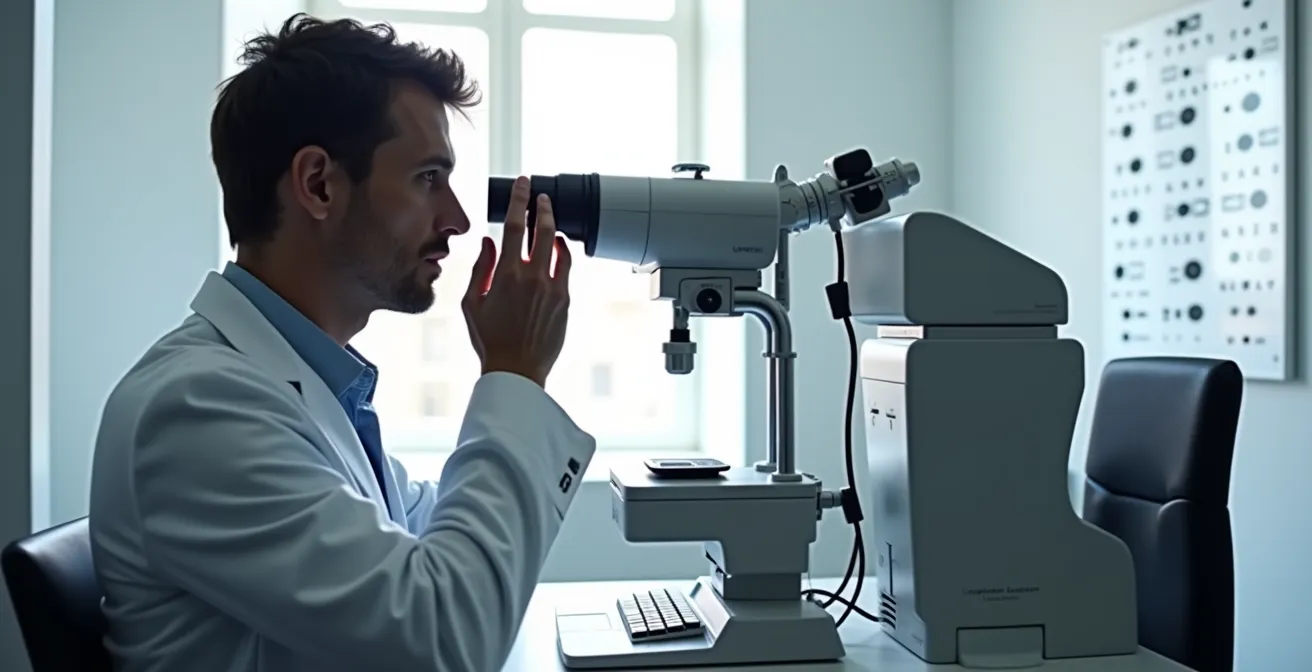
Optometrists do more than check vision; they are primary care providers who can see direct, physical evidence of systemic diseases in your eyes, often before symptoms appear elsewhere.
- They can spot cholesterol plaques in retinal arteries, a direct warning of stroke risk that blood tests alone don’t reveal.
- Many undiagnosed symptoms, such as headaches or fatigue, can originate from binocular vision disorders that only an optometrist can identify.
Recommendation: For any unexplained visual symptoms, new floaters, or persistent headaches, make your primary eye care provider the first call. Your visit is often covered by medical insurance, not your vision plan.
When a persistent headache or sudden blurry vision strikes, the default reaction for many is to schedule an appointment with their General Practitioner (GP). It’s a logical step; the GP is the gatekeeper of our overall health. However, this common path overlooks a crucial specialist who possesses a unique and powerful diagnostic advantage: the optometrist. While a GP listens to symptoms and orders blood work, an optometrist has a direct, non-invasive view into the body’s vascular and neurological systems.
The misconception that optometrists only prescribe glasses and contact lenses is not just outdated; it’s a barrier to timely and accurate diagnosis. These primary eye care providers are on the front lines of detecting a vast range of systemic health issues—from diabetes and high blood pressure to autoimmune diseases and even early signs of neurodegenerative conditions. Their tools allow them to see physical evidence of disease, not just hear a description of the symptoms. This distinction is fundamental to understanding their role as a critical partner in your healthcare team.
This article will deconstruct the myth of the “glasses-only” eye doctor. We will explore precisely why your optometrist might be the first to spot high cholesterol, how they manage specialized post-surgical care, and how to navigate the often-confusing world of insurance coverage for your visits. By understanding the unique diagnostic window your eyes provide, you can make more informed decisions about your health, starting with knowing who to call when something feels wrong.
To navigate these crucial distinctions, this guide breaks down the specific roles and capabilities of an optometrist. The following sections detail the conditions they can detect, the type of care they provide, and how to best utilize their expertise for your overall health.
Summary: Uncovering the Full Scope of Optometric Care
- Why Your Optometrist Might Detect Your High Cholesterol Before Your GP?
- How Your Optometrist Manages Your Post-LASIK Care to Save You Time?
- Vision Plan or Medical Insurance: Which Covers Your Red Eye Visit?
- The Myth That Optometrists Only Prescribe Glasses and Contacts
- Problem & Solution: Describing Your Visual Symptoms Accurately to Get a Diagnosis
- Private Clinic or Retail Chain: Which Offers Better Continuity of Care?
- Why Your Eyes Are the Window to Your Heart, Kidney, and Brain Health?
- Ophthalmologist or Optometrist: Who Should You See for Sudden Eye Pain?
Why Your Optometrist Might Detect Your High Cholesterol Before Your GP?
While your GP relies on a blood test to measure cholesterol levels, an optometrist can see the direct, physical consequences of it inside your eye. High cholesterol can lead to the formation of plaques that build up in your arteries. The eye is the only place in the body where these blood vessels can be seen directly and non-invasively. An optometrist can identify a yellowish ring around the cornea, known as arcus senilis, which can be an indicator of lipid issues; indeed, one study found that 47% of elderly individuals with arcus senilis had elevated cholesterol levels. This visual sign can prompt a referral for blood work long before a routine physical.

More critically, optometrists can detect something called a Hollenhorst plaque. This is a tiny piece of cholesterol that has broken off from a larger plaque (likely in the carotid artery) and traveled to the small arteries of the retina. Seeing a Hollenhorst plaque is not just a sign of high cholesterol; it is a direct warning of an impending stroke. This is physical evidence that cholesterol is actively mobilizing and creating blockages, a situation far more urgent than a number on a lab report. A GP cannot see this; an optometrist can, and this discovery often leads to immediate, life-saving cardiovascular intervention.
This direct visualization of vascular health is a prime example of how optometry extends beyond vision correction into systemic disease detection.
How Your Optometrist Manages Your Post-LASIK Care to Save You Time?
After a surgical procedure like LASIK, follow-up care is essential to monitor healing, manage side effects like dry eye, and ensure the best possible outcome. Many patients assume this care must be handled by the ophthalmologist at the surgical center, often requiring multiple, time-consuming trips. However, in many cases, your local optometrist can co-manage this post-operative care. This arrangement offers significant benefits in convenience and continuity.
An optometrist is equipped with the same essential tools, like a slit lamp, to examine the cornea and assess healing. They can prescribe necessary eye drops, monitor intraocular pressure, and identify any potential complications early. By handling these routine follow-ups, your primary eye care provider saves you from traveling back to a potentially distant surgical clinic. This is especially valuable for the multiple check-ups required in the first weeks and months post-surgery.
This model of co-management positions the optometrist as the central point for your eye health. They have your pre-surgical records and will continue to be your provider for years to come. A GP, lacking the specialized equipment and training in ocular surgery, simply cannot fill this role. The optometrist acts as a crucial, time-saving liaison between the patient and the surgeon, ensuring seamless care right in your community.
Ultimately, this approach streamlines your recovery process, integrating specialized surgical aftercare into your regular healthcare routine with a familiar professional.
Vision Plan or Medical Insurance: Which Covers Your Red Eye Visit?
One of the most common points of confusion for patients is understanding which insurance to use for an eye appointment. The answer depends entirely on the reason for your visit. A vision plan is designed for routine, preventative care. It covers services like annual eye exams, refraction for glasses or contacts, and basic screenings. A medical insurance plan, on the other hand, is used for diagnosing and treating medical conditions.
If you wake up with a red, painful eye, experience a sudden onset of floaters, or suffer an eye injury, your visit is medical. The optometrist is diagnosing and treating a health problem, just as a GP would for an ear infection. Therefore, you should use your medical insurance. Trying to use a vision plan for a medical issue will almost certainly result in a denied claim. Correctly identifying the purpose of your visit when you book the appointment is crucial for proper billing.
| Type of Visit | Insurance Type | Examples |
|---|---|---|
| Problem-focused | Medical Insurance | Red eye, pain, floaters, sudden vision loss |
| Routine care | Vision Plan | Annual exam, glasses prescription, contact lens fitting |
| Disease management | Medical Insurance | Glaucoma, diabetic retinopathy, macular degeneration |
| Preventive screening | Vision Plan | Basic eye health check without symptoms |
When you call to schedule, be specific about your symptoms. Use phrases like “I am experiencing sudden light sensitivity” or “I have a foreign body sensation in my eye.” This “chief complaint” is what determines the insurance routing. If you’re simply there for a “routine check-up,” the office will assume you’re using your vision plan. Always ask upfront: “Based on my symptoms, should I bring my medical or vision insurance card?”
This distinction reinforces the optometrist’s role as a medical provider, not just a vendor for corrective lenses.
The Myth That Optometrists Only Prescribe Glasses and Contacts
The most pervasive myth in eye care is that an optometrist’s job begins and ends with a refraction test. This fundamentally misunderstands their extensive training and scope of practice. Optometrists are doctors of optometry (ODs) who undergo four years of post-graduate, doctoral-level study focused on the eyes and their connection to systemic health. As a result, in the U.S., optometrists deliver 85% of primary eye and vision care services.
As one medical center clarifies, “Optometrists can diagnose conditions, prescribe medications and treat most eye diseases.” This includes prescribing antibiotics for infections, steroids for inflammation, and medicated drops to manage conditions like glaucoma. Their diagnostic capabilities are vast. For example, a patient experiencing chronic headaches might visit a GP and undergo numerous tests for migraines or neurological issues. An optometrist, however, can perform specialized testing for binocular vision disorders like convergence insufficiency. This condition, where the eyes struggle to work together for near tasks, is a common cause of headaches, eye strain, and fatigue, yet it is completely invisible to the tools available in a GP’s office.
Furthermore, optometrists play a huge role in public health by detecting diseases in asymptomatic patients. For instance, optometrists alone detect diabetes in over 250,000 patients diagnosed with type 2 diabetes annually in the United States, often by observing tell-tale hemorrhages or leaky blood vessels in the retina during a routine exam. This is a diagnosis a GP would only make after symptoms like excessive thirst or fatigue appear, or through routine blood screening.
This diagnostic role positions them not as an alternative to a GP, but as an essential, complementary specialist in your primary care circle.
Problem & Solution: Describing Your Visual Symptoms Accurately to Get a Diagnosis
One of the biggest challenges in any medical diagnosis is communication. When it comes to vision, describing what you’re experiencing can be particularly difficult. Is it a “floater” or a “blind spot”? Is the distortion “wavy” or “blurry”? Providing a clear, accurate description of your symptoms is one of the most powerful tools you have to help your optometrist reach the correct diagnosis quickly. A vague complaint of “blurry vision” can point to dozens of conditions, from simple dry eye to a detached retina.
The key is to become a better observer of your own symptoms before your appointment. Don’t just notice that something is wrong; analyze it. Pay attention to the specific characteristics of the visual disturbance. This structured information is invaluable. For example, distinguishing between a scotoma (a missing spot in your vision) and a phosphene (seeing an extra spot of light) points the doctor in two completely different diagnostic directions. Preparing for your appointment with precise details can shorten the path to an effective treatment plan.
Your Pre-Appointment Diagnostic Checklist: Preparing for Your Exam
- Location: Note if symptoms affect one eye, both eyes, or a specific part of your vision (e.g., peripheral).
- Timing: Document if the onset was sudden or gradual, and whether the symptoms are constant or intermittent.
- Triggers: Identify if anything makes it worse or better, such as bright light, darkness, screen time, or head movement.
- Type of Disturbance: Practice describing the visual event. Is it a curtain, a web, a flash of light, a dark spot, or wavy lines?
- Associated Symptoms: List any other symptoms that occur at the same time, such as headache, nausea, dizziness, or light sensitivity.
By preparing this information, you transform from a passive patient into an active partner in your own diagnosis. This clarity helps the optometrist narrow down possibilities and select the most relevant in-office tests, saving time and leading to a more accurate conclusion.
This simple preparation is a critical step in translating your subjective experience into objective, actionable medical data.
Private Clinic or Retail Chain: Which Offers Better Continuity of Care?
When choosing an eye care provider, patients often weigh the convenience of a retail chain against the perceived tradition of a private clinic. While both can provide competent care for a basic prescription, the most significant difference emerges over time: continuity of care. This concept is the cornerstone of preventative medicine and early diagnosis, particularly for slow-progressing diseases like glaucoma or macular degeneration.
A private clinic typically fosters a long-term relationship with a specific optometrist. As one clinic notes, “Having a consistent baseline of retinal photos, OCT scans, and visual field tests from a private clinic allows the optometrist to detect minuscule changes over years, which is the key to early diagnosis.” Your file is not just a collection of prescriptions; it’s a historical dataset of your unique ocular anatomy. An optometrist who sees you year after year becomes intimately familiar with the normal state of your optic nerve and retinal blood vessels. They are far more likely to spot a subtle, gradual change that a new practitioner at a retail chain, seeing you for the first time, would have no baseline to compare against.
Retail chains can have higher staff turnover, meaning you may see a different doctor with each visit. This “snapshot” approach to eye care is effective for acute problems or updating a prescription, but it is fundamentally weaker for long-term disease management. A case study in glaucoma detection highlights this: optometrists who monitored the specific shape and structure of a patient’s optic nerve over several years could identify an increased risk long before measurable vision loss occurred. This level of proactive care is only possible when there is consistent, long-term data, which is the hallmark of a stable doctor-patient relationship.
For patients with a family history of eye disease or other systemic health concerns, establishing care at a practice that prioritizes this continuity is a strategic investment in their future health.
Why Your Eyes Are the Window to Your Heart, Kidney, and Brain Health?
The old saying that “the eyes are the window to the soul” is more medically accurate than most realize—if you replace “soul” with “systemic health.” As the American Academy of Ophthalmology states, “The eye is the only place in the body where a doctor can have an unobstructed view of our blood vessels, nerves and connecting tissue — without any need for surgery.” This unique anatomical feature makes a comprehensive eye exam one of the most powerful, non-invasive physicals available. What an optometrist sees can reveal issues originating in the heart, kidneys, and brain.
For example, uncontrolled high blood pressure can cause the tiny arteries in the retina to bend, narrow, or leak, a condition called hypertensive retinopathy. These changes are clear signs that similar damage is likely occurring in other organs like the kidneys and heart. For diabetic patients, retinal exams are critical for detecting diabetic retinopathy—damage to blood vessels that can lead to blindness. This is often the first sign that a patient’s blood sugar is not well-controlled. It’s no surprise that, according to Eye-Q survey data, over 20% of Americans report an eye doctor detected a non-eye health issue.
The connection to brain health is perhaps the most compelling frontier. The optic nerve is essentially brain tissue, connecting the eye directly to the brain. Cutting-edge research is now exploring how changes in the retina can serve as early biomarkers for neurodegenerative diseases. For instance, studies are showing that a thinning of the retinal nerve fiber layer, visible on a standard OCT scan in an optometrist’s office, may be a potential early indicator for Alzheimer’s and Parkinson’s disease, appearing years before cognitive symptoms manifest. This provides a remarkable, non-invasive window into neurological health.
Treating your annual eye exam as an integral part of your overall health screening is a proactive step towards long-term wellness.
Key Takeaways
- An optometrist sees physical evidence of disease (like plaques or bleeds), while a GP often relies on patient-reported symptoms and lab results.
- Medical problems like red eyes, pain, or floaters are covered by your medical insurance, not your routine vision plan.
- A consistent relationship with one optometrist provides a crucial baseline, making it easier to detect gradual changes from diseases like glaucoma.
Ophthalmologist or Optometrist: Who Should You See for Sudden Eye Pain?
When faced with a sudden, acute eye problem like pain, severe redness, or vision loss, the question often becomes: optometrist or ophthalmologist? While both are eye doctors, they serve different primary functions. Understanding the distinction is key to getting the right care quickly. Your optometrist is your primary eye care provider. Think of them as the GP for your eyes. They are the correct first point of contact for the vast majority of eye-related issues, including sudden pain or symptoms.
Optometrists are trained and equipped to diagnose and treat a wide range of conditions, from infections and inflammation to foreign body removal. They can assess the situation, prescribe medication, and determine the urgency of the problem. If they diagnose a condition that requires surgery or highly specialized medical management—such as advanced glaucoma requiring a surgical implant, a complex retinal detachment, or severe cataracts—they will then refer you to an ophthalmologist. An ophthalmologist is a medical doctor (MD) who has completed medical school followed by a residency in ophthalmology. They are surgeons and specialists in advanced ocular disease.
Going directly to an ophthalmologist without a referral for a common problem like a red eye is like going to a cardiac surgeon for chest pain before seeing a GP—it’s an inefficient use of a specialist’s time and may lead to delays in care. Your optometrist is the gatekeeper and manager of your eye health. For any sudden, non-catastrophic eye pain, start with your optometrist. They will provide immediate care and escalate to an ophthalmologist if, and only if, it is necessary.
Therefore, if you experience any new or unexplained visual symptoms, floaters, or persistent headaches, the most direct path to a clear diagnosis begins with scheduling an appointment with your primary eye care provider.