
Relying on 20/20 vision as a sign of health is a dangerous gamble; it only measures your distance sight, ignoring the silent diseases that can cause irreversible blindness.
- A comprehensive, dilated eye exam is the only way to detect conditions like glaucoma, which can destroy 40% of your vision before you notice symptoms.
- Your eyes are a unique window into your overall health, revealing early signs of diabetes, high blood pressure, and other systemic issues.
Recommendation: Treat your annual eye exam not as an expense for vision correction, but as a critical, non-invasive health screening that offers an immense return on investment by preventing future vision loss.
If you’re in your 30s and can read road signs without squinting, the idea of paying for an eye exam can feel like a waste of money. You have 20/20 vision, after all. That’s perfect, right? This common belief is one of the most significant misconceptions in personal health. It equates sharp sight with healthy eyes, a dangerously incomplete picture. While you might be focused on the clarity of your vision, optometrists are looking for silent, progressive diseases that give no warning signs until it’s far too late.
The standard eye chart test is a one-dimensional tool in a three-dimensional world of ocular health. It tells you nothing about your peripheral vision, eye pressure, or the condition of your retina and optic nerve. Conditions like glaucoma, diabetic retinopathy, and even ocular tumors can develop for years without affecting your central acuity. They are “sneak thieves” that slowly steal your vision from the outside in, and by the time you notice a change, the damage is permanent.
But what if the key to long-term health wasn’t just about what you can see, but about what can be seen inside your eyes? This article reframes the routine eye exam from a simple vision check to a crucial, preventative health screening. We will explore how a comprehensive exam serves as an ocular window into your body’s systemic health, why risk factors—not perfect sight—should dictate your exam schedule, and how this small investment can prevent catastrophic personal and financial costs down the road.
For those who prefer a visual format, the following video from the National Eye Institute provides a clear overview of the dilated eye exam, explaining why this procedure is so fundamental to uncovering the hidden health issues this article discusses.
To help you navigate these critical insights, this article is structured to build your understanding from the ground up. We’ll start by revealing how significant vision loss can occur silently and then provide actionable guidance on assessing your personal risk, understanding different exam types, and leveraging your insurance to protect your health.
Summary: Uncovering the Hidden Truth Behind 20/20 Vision
- Why You Can Lose 40% of Your Vision Without Noticing It?
- How to Determine Your Exam Frequency Based on Risk Factors?
- School Nurse Screening or Doctor Exam: Which Finds the Problem?
- The Retinal Tear Risk That Undilated Exams Miss Completely
- Problem & Solution: Using Medical Insurance for Routine Eye Exams
- The Silent Retinal Issue That Standard Acuity Tests Miss in 1 out of 5 Patients
- Why Skipping Dilation Might Cost You Your Peripheral Vision?
- Glaucoma or Hypertension: Which Silent Killer Strikes the Eyes First?
Why You Can Lose 40% of Your Vision Without Noticing It?
The human brain is remarkably adept at compensating for missing information, a trait that becomes a serious liability in eye health. When a disease like open-angle glaucoma begins, it doesn’t dim your central vision; it quietly erodes your peripheral (side) vision. You can lose up to 40% of your optic nerve fibers before you personally detect any change in your sight. Your brain fills in the gaps, creating a dangerous false sense of security. You continue to pass the 20/20 chart test with ease while a progressive, irreversible disease gains a stronger foothold.
This phenomenon is why glaucoma is often called the “sneak thief of sight.” It has no initial symptoms in 95% of cases. According to the National Eye Institute, “Since many eye diseases have no symptoms or warning signs, you could have a problem and not know it.” This is backed by startling data from the CDC, which reveals that 50% of people with glaucoma don’t know they have it. They feel fine and see “perfectly,” unaware that their field of vision is slowly narrowing.
The only defense against this silent progression is a comprehensive, dilated eye exam. By widening the pupil, an optometrist can get a clear, unobstructed view of your optic nerve and retina to spot the subtle, early signs of damage. Waiting for symptoms to appear is not a strategy; it’s a surrender to permanent vision loss. The perception of perfect vision is an illusion until the health of the entire eye has been professionally verified.
How to Determine Your Exam Frequency Based on Risk Factors?
A one-size-fits-all approach to eye care is obsolete. Instead of relying on age alone, a modern, preventative strategy is based on your personal risk profile. For a healthy 30-year-old with no family history of eye disease, an exam every two years might seem sufficient. However, several factors can dramatically accelerate the need for annual or even more frequent screenings. These factors are often invisible and have nothing to do with how clearly you currently see.
Systemic health conditions are a major driver. A diagnosis of diabetes, for example, immediately places you in a higher-risk category for diabetic retinopathy. Similarly, high blood pressure can damage the delicate blood vessels in the retina. Ethnicity also plays a significant role; for instance, glaucoma is 6 times more common in Black or African American people than in White people, necessitating earlier and more frequent screenings starting at age 40.

Your family’s health history is another critical piece of the puzzle. A first-degree relative with glaucoma or macular degeneration significantly increases your own risk. Understanding these factors is not about creating anxiety; it’s about empowering you to take proactive control of your health. Your optometrist uses this information to create a personalized surveillance plan, ensuring any potential issues are caught at the earliest, most treatable stage.
Your 5-Point Eye Health Risk Audit
- Family History Inventory: List all immediate family members (parents, siblings) with a history of eye diseases like glaucoma, macular degeneration, or retinal detachment.
- Systemic Health Check: Note any personal diagnoses of systemic conditions that affect blood vessels or nerves, such as diabetes, hypertension, or autoimmune disorders.
- Ethnic & Genetic Predisposition: Identify if your ethnicity (e.g., African, Hispanic) places you in a statistically higher-risk group for specific eye diseases.
- Visual Symptom Log: Document any subtle, persistent changes, even if minor—such as new floaters, brief flashes of light, or intermittent eye strain—that a simple acuity test wouldn’t evaluate.
- Consultation & Scheduling Plan: Consolidate this information to discuss with your eye doctor to establish a personalized, risk-based exam frequency, moving beyond generic age-based guidelines.
School Nurse Screening or Doctor Exam: Which Finds the Problem?
Many adults assume that the vision screenings they received in school are a valid substitute for a real eye exam, a misconception that dangerously underestimates the complexity of eye health. While well-intentioned, a school or DMV screening is designed to do one thing: test for distance visual acuity (myopia or nearsightedness). It is a pass/fail test of your ability to read letters on a chart. This narrow focus leaves a massive blind spot where most serious eye conditions and functional vision problems reside.
A comprehensive exam by an optometrist or ophthalmologist is a completely different diagnostic process. It evaluates not just how far you can see, but the entire health and function of your visual system. The National Eye Institute reports that nearly 14 million Americans experience vision problems that go far beyond simple refractive errors. These include issues with binocular vision (how eyes work together), focusing ability, and, most critically, silent eye diseases.
The following table, based on guidance from the National Eye Institute, clearly illustrates the critical gap between a simple screening and a comprehensive medical evaluation.
| Examination Type | What It Detects | What It Misses |
|---|---|---|
| School Vision Screening | Distance visual acuity problems (nearsightedness) | Amblyopia, binocular vision issues, focusing problems, eye diseases |
| Comprehensive Eye Exam | All refractive errors, eye diseases, binocular vision, focusing abilities, eye health conditions | None – full evaluation |
Relying on a basic screening is like assuming a clean bill of health because your temperature is normal. It ignores countless other vital signs. For an adult, especially one with risk factors, skipping a comprehensive exam in favor of a simple acuity check is an uninformed and potentially devastating health decision.
The Retinal Tear Risk That Undilated Exams Miss Completely
The part of the eye that allows you to read a 20/20 line on a chart is the macula—a tiny spot in the center of your retina. An undilated exam, which uses a standard light, can often get a decent look at this central area. However, the vast majority of your retina lies in the periphery. It’s in this wide, outer region where dangerous conditions like retinal tears, holes, and detachments most often occur. Without dilating the pupil, this entire area remains hidden in shadow.
Dr. Michael A. Samuel of Arizona Primary Eye Care explains it with a simple analogy: “Dilating your pupil lets more light into your eye — just like opening a door lets light into a dark room. Without dilation, these structures may be partially hidden, making it difficult to detect early signs of serious eye conditions.” This “open door” is the only way for your doctor to perform a thorough 360-degree inspection of the retinal periphery and optic nerve head, searching for the subtle signs of disease.
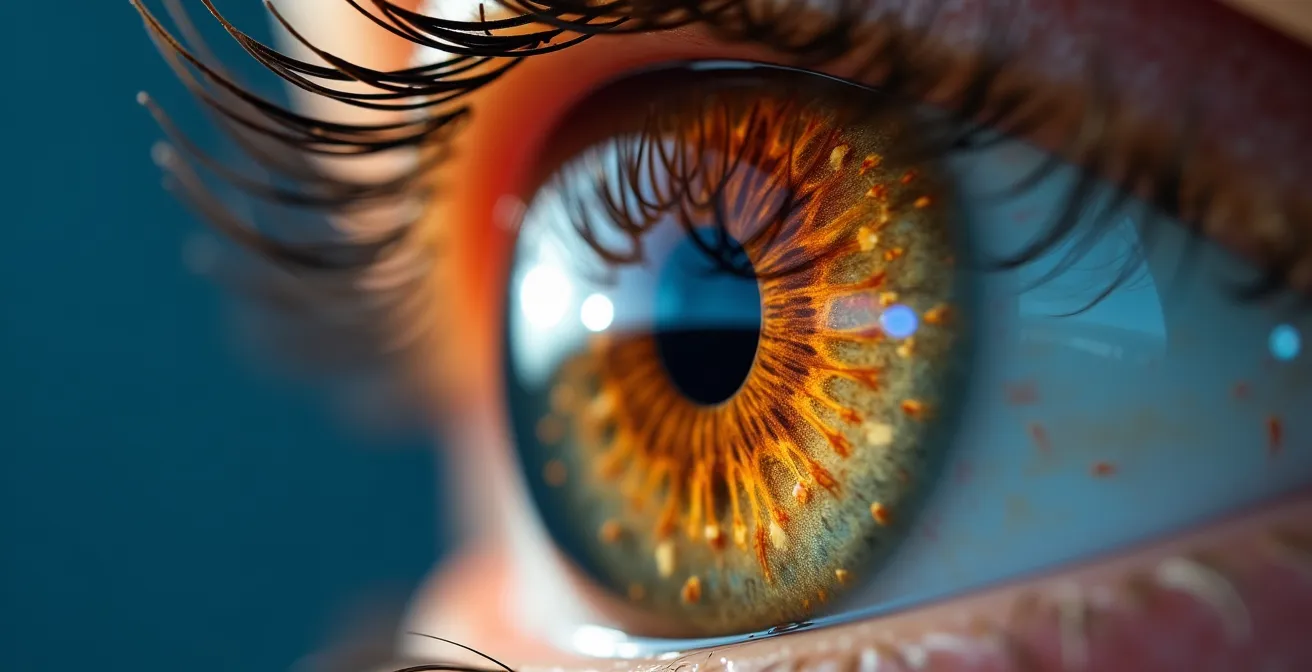
For patients concerned about the temporary side effects of dilation, such as light sensitivity and blurred near vision, modern technology offers a powerful alternative. The case for comprehensive viewing is strengthened by innovations like Optomap. This ultra-widefield retinal imaging can capture a detailed 200-degree view of the retina, often without requiring dilation drops. It provides a permanent digital record that can be compared year-over-year to track changes, addressing patient convenience while still achieving the critical goal of a complete peripheral examination.
Problem & Solution: Using Medical Insurance for Routine Eye Exams
One of the biggest hurdles for a 30-year-old with “good” vision is cost. Many people believe that if they don’t have a separate vision plan, they must pay for an eye exam entirely out-of-pocket. This is a common and costly misunderstanding. A “routine” eye exam can often be billed to your standard medical insurance if there is a medical reason for the visit. The key is understanding what constitutes a “medical complaint.”
You don’t need to have a diagnosed eye disease. Simple, common symptoms can qualify the exam as medical. Reporting issues like persistent headaches, eye strain from computer use, dry or irritated eyes, or even new floaters can shift the visit from a “vision” screening to a “medical” evaluation. Discussing a family history of glaucoma or your concerns about diabetes-related complications are also valid medical reasons. This simple shift in communication can make the difference between a significant out-of-pocket expense and a visit covered by your deductible or copay.
Framing the exam as a small investment versus a large expense is also critical. The economic impact of preventable blindness is staggering; for example, research shows glaucoma costs the U.S. economy $2.86 billion annually. The modest cost of a preventative exam is insignificant compared to the potential for life-altering vision loss and the associated long-term medical expenses. Don’t let a misunderstanding of insurance coverage become the barrier to protecting your sight.
The Silent Retinal Issue That Standard Acuity Tests Miss in 1 out of 5 Patients
Even beyond what the naked, dilated eye can see, modern technology is revealing a new layer of “silent” damage that standard tests miss. A standard acuity test measures function, but it cannot measure structure at a cellular level. This is where advanced imaging like Optical Coherence Tomography (OCT) becomes indispensable. An OCT scan is like an ultrasound for your eye, using light to create high-resolution, cross-sectional maps of your retinal layers.
This technology is revolutionary because it allows doctors to detect and quantify cellular damage from diseases like glaucoma and macular degeneration years before they impact your vision. It can measure the thickness of the nerve fiber layer with microscopic precision, spotting the earliest signs of glaucomatous thinning. This provides an objective, numerical baseline that can be tracked over time to monitor disease progression or confirm stability with unparalleled accuracy.
Early Detection with Optical Coherence Tomography (OCT)
Optical Coherence Tomography (OCT) technology provides a crucial advantage in preventative care. By creating detailed, cross-sectional maps of the retina’s layers, it can identify cellular damage from conditions like macular degeneration and glaucoma long before a patient experiences any vision loss. This allows for the precise quantification and tracking of the nerve fiber layer, turning disease management from a reactive process into a proactive, data-driven strategy.
This level of detail is critical. A 2024 JAMA Ophthalmology study found that 1.49 million U.S. adults have glaucoma that is already affecting their vision, a number that highlights the vast population of undiagnosed or undertreated individuals. Technologies like OCT are the front line of defense, shifting the paradigm from waiting for functional loss to intervening at the first sign of structural change.
Why Skipping Dilation Might Cost You Your Peripheral Vision?
The primary reason people hesitate to get a dilated exam is the inconvenience. The thought of blurry near vision and light sensitivity for several hours is a legitimate concern in a busy schedule. As the American Academy of Ophthalmology notes, “Your pupils will typically stay dilated for four to six hours. To help tolerate light sensitivity, bring sunglasses to wear after your appointment.” Some people even arrange for a driver. While this requires planning, it’s a small price to pay for a complete and thorough health check.
The risk of skipping it, however, is monumental. The peripheral retina is not just “side vision”; it is a critical component of your overall visual field. Without a dilated view, a doctor cannot rule out conditions that specifically target this area. As we’ve seen, glaucoma often starts in the periphery, and a retinal tear—a true medical emergency that can lead to detachment and permanent blindness if not treated promptly—almost always occurs there.
The global scale of this threat is growing. A comprehensive meta-analysis projects that 111.8 million people worldwide will have glaucoma by 2040. This staggering number underscores the urgency of adopting preventative screening as a public health priority. Choosing convenience over a complete exam is a bet against your own long-term health, a gamble where the potential loss is your irreplaceable sight.
Key Takeaways
- 20/20 vision is not a measure of eye health; it only tests distance clarity and misses silent diseases like glaucoma.
- A comprehensive, dilated eye exam is the only way to inspect the entire retina and optic nerve for early signs of irreversible damage.
- Your eyes act as a window to your systemic health, revealing early indicators of diabetes, high blood pressure, and other conditions.
Glaucoma or Hypertension: Which Silent Killer Strikes the Eyes First?
Perhaps the most compelling argument for a comprehensive eye exam has nothing to do with vision correction. The eye is the only place in the human body where blood vessels and a central nervous system component (the optic nerve) can be observed directly and non-invasively. This makes the eye exam an incredibly powerful screening tool for your overall systemic health. Your optometrist might be the first health professional to detect signs of high blood pressure or diabetes.
Hypertension, for example, can cause specific changes in the retinal blood vessels, such as narrowing or “nicking,” which are clearly visible during a dilated exam. Similarly, diabetic retinopathy presents with tiny hemorrhages or leaky blood vessels. Spotting these signs can lead to an earlier diagnosis and management of these systemic conditions, potentially preventing a heart attack, stroke, or other life-threatening complications. In this context, the eye exam is not just about the eyes; it’s a frontline defense for your entire body.
Both glaucoma and hypertension are silent killers, but they often reveal themselves in the eye first. As the BrightFocus Foundation warns, “As many as half of people living with glaucoma may not be aware they have the disease. That’s why glaucoma is sometimes called the ‘sneak thief of sight,’ and why regular screening and early detection are so important.” With IHME research estimating that 4.22 million U.S. adults have glaucoma, the need for this ocular window is more critical than ever.
Stop gambling with your health. The belief that perfect sight equals perfect health is an illusion that leaves you vulnerable to silent, irreversible disease. Your next step is to move beyond the eye chart and schedule a comprehensive, dilated eye exam to get a true picture of your ocular and systemic well-being.