The inability to purchase contact lenses over-the-counter in the United States stems from a strict federal regulatory framework, not arbitrary retail policy. The FDA classifies contact lenses as medical devices that require a precise, medically-determined fit to prevent serious health risks. This guide deconstructs the legal and medical rationale behind the prescription mandate, explaining why your eyes have unique needs that cannot be met by a generic, one-size-fits-all product.
For any traveler or new resident in the United States, the experience can be jarring. You know your prescription, you see the contact lens boxes on a shelf behind the counter, yet a simple purchase is blocked by a single demand: a valid, unexpired prescription from a licensed provider. This often feels like an unnecessary hurdle, especially when compared to the ease of buying eyeglasses or other goods. The frustration is understandable, but the barrier isn’t a retail choice; it’s a matter of federal law rooted in a complex medical and safety framework.
The common understanding is that “it’s for your safety,” but this explanation is often too vague to be satisfying. It fails to address the core questions: Why are contact lenses treated so differently from glasses? Why can’t a previous prescription suffice if your vision hasn’t changed? The North American soft contact lens market is substantial, and as an analysis estimates its size at USD 3.6 billion in 2024, the regulations governing it are correspondingly robust and specific.
The true key to understanding this requirement is to shift perspective. Instead of viewing a contact lens as a simple vision-correcting commodity, the law sees it as a custom-fitted medical prosthetic that sits directly on the living tissue of your cornea. This article will deconstruct the regulatory framework governing contact lenses. We will not just state the rules; we will explore the specific medical principles and legal classifications that form their foundation. From material science to the physics of light refraction, you will learn the precise reasons why a prescription is non-negotiable and how this system is designed to protect you from risks you may not even see.
This guide will walk you through the critical distinctions between different prescription types, the data you need to understand on your lens packaging, the real risks of unregulated lenses, and practical strategies for managing your prescriptions within the U.S. system. By the end, you will not only understand the rule but also the comprehensive reasoning that supports it.
Summary: Deconstructing the US Contact Lens Prescription Mandate
- Why “Generic” Contact Lenses Don’t Exist Like Generic Drugs?
- How to Identify Base Curve and Diameter on Your Lens Box?
- Glasses Rx vs. Contact Rx: Why the Powers Are Never the Same?
- The Infection Risk of Buying “Halloween” Lenses From a Costume Shop
- Problem & Solution: Aligning Your Rx Expiration With Your Insurance Benefits
- How to Verify if Your Optician Is Licensed in Your State or Province?
- Telehealth Vision Test or Slit Lamp Exam: Which Detects Micro-Abrasions?
- How to Read Your Eyeglass Prescription Before Ordering Online?
Why “Generic” Contact Lenses Don’t Exist Like Generic Drugs?
The concept of a “generic” is common in pharmaceuticals, where a drug’s efficacy is based on its active chemical compound. Once a patent expires, other manufacturers can replicate that compound to create a cheaper, chemically identical alternative. However, this model is fundamentally incompatible with contact lenses due to their classification and function. In the United States, prescription contact lenses are regulated by the FDA as Class II or sometimes Class III medical devices, placing them in the same risk categories as infusion pumps and surgical sutures. This is because a lens’s performance is not just about its refractive power; it’s about its physical and chemical interaction with your eye.
Unlike a pill, a contact lens is defined by more than one active component. Its safety and effectiveness depend on a combination of proprietary factors: the specific material used, its oxygen permeability (biocompatibility), its water content, its edge design, and its overall shape. For example, the oxygen permeability (Dk value) of two different silicone hydrogel materials like Lotrafilcon B and Comfilcon A can be 110 and 128, respectively. These values are significantly different and determine how much oxygen reaches your cornea, a critical factor for long-term corneal health.
Because these characteristics are unique to each brand and manufacturer, they are not interchangeable. Substituting a prescribed brand for a “similar” one would be like replacing a custom-molded prosthetic with an off-the-shelf approximation. It might seem to work, but it ignores the precise material science and fit determined by your eye care professional to be safest and most effective for your specific corneal topography and tear chemistry. Therefore, a prescription for “Acuvue Oasys” is for that exact product, not for any lens with the same power.
How to Identify Base Curve and Diameter on Your Lens Box?
Your contact lens prescription is a set of precise measurements that ensures the lens fits the unique shape of your eye. These parameters are printed on every box of contact lenses and are critical for a safe and comfortable fit. Understanding them demystifies why a prescription is so detailed. The two most fundamental measurements are the Base Curve and Diameter.
To locate these on your lens packaging, look for the following key abbreviations:

The primary parameters to identify are:
- BC (Base Curve): This is the curvature of the back surface of the contact lens. Measured in millimeters, it typically ranges from 8.0 to 10.0. The BC must match the curvature of your cornea to ensure the lens sits stably on your eye without being too tight (which can starve the cornea of oxygen) or too loose (which can cause irritation and unstable vision).
- DIA (Diameter): This is the width of the contact lens from edge to edge, also in millimeters. It determines how the lens covers your cornea and where its edges rest. An incorrect diameter can lead to discomfort or inadequate corneal coverage.
- PWR/SPH (Power/Sphere): This indicates the lens’s refractive power in diopters to correct nearsightedness (-) or farsightedness (+).
- CYL & Axis (for Astigmatism): If you have astigmatism, your prescription will include Cylinder (CYL) power and an Axis measurement (from 0 to 180 degrees) to correct the irregular shape of your cornea.
Finally, the brand name itself—such as Acuvue, Biofinity, or Dailies—is a non-negotiable part of the prescription, as it dictates the specific material and design your doctor has approved for your eyes.
Glasses Rx vs. Contact Rx: Why the Powers Are Never the Same?
A common point of confusion is why a perfectly good eyeglass prescription cannot be used to purchase contact lenses. While both correct vision, they do so from different distances, a critical factor that changes the required power. The scientific principle behind this is known as vertex distance: the space between the back of the eyeglass lens and the front surface of your cornea. Eyeglasses sit approximately 12mm away from your eyes, while contact lenses sit directly on the cornea (a vertex distance of 0).
This distance alters how light is focused onto your retina. For prescriptions stronger than +/- 4.00 diopters, the effect is significant enough to require a mathematical conversion. An optometrist uses a formula to calculate the “effective power” needed for a contact lens to produce the same visual correction as your glasses. Simply using your glasses’ power for a contact lens would result in under-correction or over-correction and, consequently, blurry vision.
Furthermore, a contact lens prescription contains multiple parameters that are completely absent from a glasses prescription. These are essential for a safe fit and are determined during a contact lens fitting exam.
| Parameter | Glasses Prescription | Contact Lens Prescription |
|---|---|---|
| Power (SPH) | Standard diopter measurement | Adjusted for vertex distance |
| Base Curve (BC) | Not included | Essential (8-10mm typical) |
| Diameter (DIA) | Not included | Required (14-14.5mm typical) |
| Brand Specification | Not required | Mandatory – specific brand only |
| Expiration Period | Typically 2 years | Minimum 1 year by federal law |
These differences underscore that a contact lens is not just a different form of vision correction; it is a distinct medical device requiring its own specific and detailed prescription to ensure both clear vision and ocular health.
The Infection Risk of Buying “Halloween” Lenses From a Costume Shop
Perhaps the most compelling argument for strict prescription laws comes from the well-documented dangers of illegally sold, over-the-counter decorative or “Halloween” lenses. These products, often found in costume shops, beauty salons, or online marketplaces, are frequently sold without a prescription, in direct violation of U.S. federal law. The risk they pose is not hypothetical; it is severe and can lead to permanent eye damage.
The primary danger is a serious corneal infection called keratitis. An ill-fitting lens, which is almost guaranteed with a one-size-fits-all product, can cause tiny scratches on the cornea, creating an entry point for bacteria, viruses, and amoebas. Eye health research indicates that using non-prescription contacts can heighten the risk of developing keratitis by up to 16 times. This condition can be excruciatingly painful and, in worst-case scenarios, can lead to corneal ulcers, scarring, and even blindness.
The problem is compounded by the quality of the lenses themselves. As a leading eye health authority explains, these lenses are often not manufactured to the same safety standards as their FDA-approved counterparts.
These cosmetic lenses typically do not meet the same safety standards as prescribed lenses and may not be FDA-approved for wear in the U.S. They may be poorly manufactured, unsterilized, or lack the proper fit.
– ACUVUE Eye Health, Contact Lens Safety Guidelines
This lack of regulatory oversight means consumers have no way of knowing if the lens material is safe for the eye, if the colored dyes might leak, or if the packaging is sterile. The FDA’s mandate that all contact lenses, including decorative ones, require a prescription is a direct response to these tangible and devastating health risks. It ensures that any lens placed on the eye has been professionally fitted and meets stringent manufacturing and safety standards.
Problem & Solution: Aligning Your Rx Expiration With Your Insurance Benefits
One of the most practical frustrations of the U.S. prescription system is the potential misalignment between your contact lens prescription’s expiration date and the renewal of your vision insurance benefits. Under the FTC’s Contact Lens Rule, a prescription is valid for a minimum of one year, unless a specific medical reason justifies a shorter period. Many insurance plans also operate on a one-year cycle, creating a tight window where you must get an exam and purchase your supply before one or the other expires.
This can lead to a scenario where your prescription expires a month before your insurance benefits become available, forcing you to either pay for an exam out-of-pocket or go without lenses. However, with strategic planning, you can create a buffer and optimize your purchasing power. Proactive scheduling is key. Instead of waiting until your prescription is about to expire, schedule your annual eye exam 10 to 11 months after your last one. This ensures your new one-year prescription is active well before your old one and your insurance benefits are set to expire.

This proactive approach allows you to use your current benefits on a new prescription, or use leftover FSA/HSA funds before they expire at the end of the year. Some states have laws extending prescription validity to two years, which provides even more flexibility. It’s crucial to request a physical or digital copy of your prescription immediately after your fitting is complete, as you are legally entitled to it.
Your Action Plan: Auditing Your Prescription and Benefit Cycle
- Points of Contact: List your eye doctor’s office, your insurance provider’s portal, and your FSA/HSA administrator. Note the key dates for each: prescription expiration, benefit renewal, and fund expiration.
- Collect Existing Elements: Gather your current contact lens prescription (check the expiration date), your vision insurance summary of benefits (note the allowance for contacts/fittings), and your current FSA/HSA balance.
- Check for Coherence: Compare the dates. Is there a gap where your prescription expires before your benefits renew? Your goal is for the prescription to be valid during the window you plan to make a purchase.
- Identify Opportunities: Does your state law allow a 2-year prescription? Could you schedule your next exam a month earlier to reset the cycle in your favor? Is there enough in your FSA to buy a 6-month supply now?
- Create an Integration Plan: Set a calendar reminder 10 months after your last exam to schedule the next one. Pre-book your appointment to secure a convenient time before your benefits or prescription expires.
By actively managing your exam schedule and understanding the rules, you can transform the rigid one-year cycle from a constraint into a predictable and manageable part of your healthcare routine.
How to Verify if Your Optician Is Licensed in Your State or Province?
The integrity of the prescription system relies on the qualifications of the professionals writing and fitting them. In the U.S., eye care is provided by three types of professionals, often called “the three O’s,” and their roles are distinct. Understanding who does what is the first step in ensuring you are receiving legitimate care.
First, there are Ophthalmologists (MDs), who are medical doctors that specialize in eye and vision care. They are trained to perform eye exams, diagnose and treat disease, prescribe medications, and perform eye surgery. Second, there are Optometrists (ODs), who are Doctors of Optometry. They are the primary healthcare providers for the eye. ODs conduct eye exams, diagnose and manage eye diseases, and prescribe eyeglasses and contact lenses. Both ophthalmologists and optometrists are licensed to write valid contact lens prescriptions.
The third group is Opticians. Opticians are technicians trained to design, verify, and fit eyeglass lenses and frames, but they are not doctors. In most states, they cannot perform eye exams or write prescriptions. However, in some states, opticians can undergo additional certification to become certified contact lens fitters, but they still cannot write the initial prescription. Throughout the U.S., you can be fitted for contact lenses by an optometrist or ophthalmologist, and in some states, by a certified optician under an OD or MD’s supervision.
To ensure your provider is legitimate, verification is crucial. The most reliable method is to check with your state’s licensing board for optometry or ophthalmology. For a centralized resource, the Association of Regulatory Boards of Optometry (ARBO) provides a license lookup tool on their website, allowing you to verify the credentials of most optometrists in the country. This confirms that the person prescribing your medical device is qualified and legally authorized to do so, protecting you from unlicensed sellers who might substitute brands or fill expired prescriptions.
Telehealth Vision Test or Slit Lamp Exam: Which Detects Micro-Abrasions?
The rise of telehealth has introduced online vision tests that offer the convenience of renewing a prescription from home. While these services can accurately measure your refractive error (your “power”), they have a significant and dangerous limitation: they cannot assess the physical health of your eye. This is the primary reason why an in-person exam remains the gold standard and a legal requirement for a new contact lens prescription.
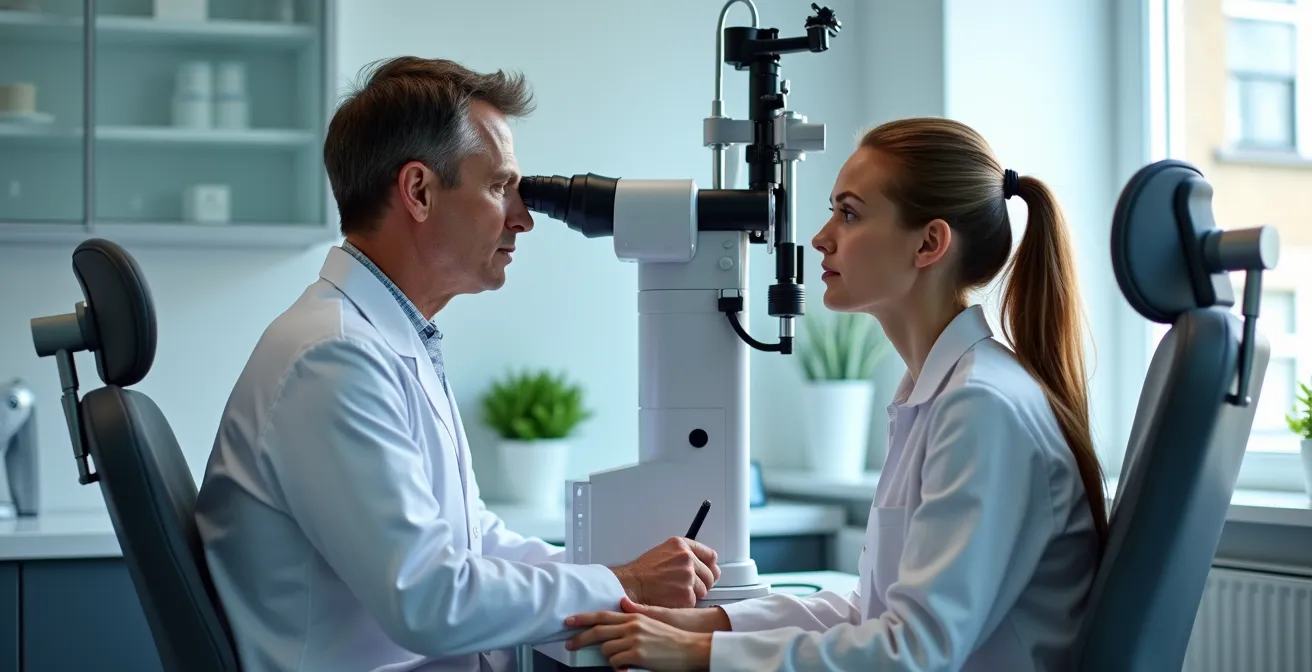
A comprehensive in-person eye exam involves a slit lamp examination. This is a high-magnification microscope that gives your optometrist a detailed, three-dimensional view of the structures of your eye, including the cornea, lens, and tear film. By using this instrument, often with a yellow fluorescein dye, your doctor can detect microscopic problems that are invisible to the naked eye and cause no symptoms. These can include tiny scratches (micro-abrasions) from an ill-fitting lens, signs of oxygen deprivation (neovascularization), deposits, or the early stages of an infection or other eye diseases.
As one ophthalmologist notes, these findings are common and crucial for preventative care.
You may be having microscopic problems that can be seen only with a slit lamp. About 10% of the time when he sees a patient during a follow-up visit, he notices something that could become a problem if not taken care of immediately.
– Dr. Charles Slonim, M.D., Ophthalmologist, Tampa, Florida
A telehealth test, which typically uses a smartphone and computer screen, has no way of performing this critical health assessment. The difference in diagnostic capability is stark.
| Examination Capability | Telehealth Vision Test | Slit Lamp Exam |
|---|---|---|
| Refractive Error Measurement | Yes | Yes |
| Micro-Abrasion Detection | No | Yes (with fluorescein dye) |
| Corneal Health Assessment | Limited | Comprehensive |
| Early Cataract Detection | No | Yes |
| Tear Film Evaluation | No | Yes |
| Contact Lens Fit Assessment | No | Yes |
This is why a prescription cannot be renewed indefinitely online. The law requires periodic in-person evaluation to ensure the medical device you are wearing is not silently damaging the delicate surface of your eye.
Key Takeaways
- Contact lenses are regulated by the FDA as Class II/III medical devices, not cosmetics, due to direct contact with the cornea.
- A contact lens prescription includes brand, base curve, and diameter—parameters not found on a glasses Rx—to ensure a safe, custom fit.
- The power of a contact lens prescription is different from a glasses prescription due to vertex distance, the physical space between glasses and the eye.
How to Read Your Eyeglass Prescription Before Ordering Online?
While this article focuses on contact lenses, understanding your eyeglass prescription is equally empowering, especially when ordering online. An eyeglass prescription is simpler than a contact lens Rx, but it contains specific terminology and numbers that must be interpreted correctly to avoid costly mistakes. Misreading a single sign or number can render a new pair of glasses unusable.
The first terms to know are Latin abbreviations for your eyes: OD (Oculus Dexter) refers to your right eye, and OS (Oculus Sinister) refers to your left eye. Sometimes you may see OU (Oculus Uterque), which means both eyes. Your prescription values will be listed in columns or rows corresponding to OD and OS.
Here are the critical elements to check:
- PWR/SPH (Power/Sphere): This is the main strength of your lens. Critically, check the sign in front of the number. A negative sign (-) indicates nearsightedness (myopia), while a positive sign (+) indicates farsightedness (hyperopia).
- CYL & Axis: These values are present if you have astigmatism. Like with contacts, CYL is the power to correct the astigmatism, and Axis is its orientation in degrees.
- ADD (Addition): This value appears on prescriptions for bifocal or progressive lenses. It represents the additional power needed for reading and near-vision tasks. A high ‘ADD’ power often requires professional measurement and fitting.
- PD (Pupillary Distance): This is the distance in millimeters between the centers of your pupils. It is absolutely critical for ordering glasses online, as it ensures the optical center of the lenses aligns with your eyes. This measurement is not always written on your prescription, and you may need to ask for it or measure it yourself.
- Prism: This is a less common value used to correct for eye alignment issues. If your prescription includes ‘Prism’, it’s often best to have your glasses fitted by a professional optician.
Triple-checking these elements, especially the positive/negative signs and the PD measurement, is the most important step you can take to ensure a successful online glasses purchase.
Ultimately, navigating the American healthcare system requires understanding that it is built on a foundation of professional licensure and regulatory oversight. The prescription is the central document in this system, acting as a legal and medical directive from a licensed practitioner to a dispenser. It certifies that a medical professional has assessed your unique anatomy and health status and has determined that a specific medical device—the contact lens—is safe and appropriate for you. Viewing the prescription not as a barrier, but as documented proof of personalized medical care, is the key to managing your eye health effectively and safely within this protective framework.
Frequently Asked Questions on Why Can’t You Buy Contact Lenses Without a Valid Prescription in the US?
Who can legally write a contact lens prescription?
In the United States, only a licensed optometrist (OD) or an ophthalmologist (MD) can legally examine a patient’s eyes, fit them for contact lenses, and write a valid prescription. These are medical professionals with the training to assess both vision correction needs and overall eye health.
What are red flags of unlicensed sellers?
Red flags for an unlicensed or illegitimate seller include a willingness to sell lenses without requesting a prescription, filling a prescription that is clearly expired, or substituting the prescribed brand for another without doctor approval. Any vendor that does not require prescription verification is operating illegally in the U.S.
How can I verify my eye care provider’s credentials?
You can verify an eye care provider’s license by checking with your state’s board of optometry or ophthalmology. A more centralized option is using the Association of Regulatory Boards of Optometry (ARBO)’s online license lookup tool, which can confirm the credentials and standing of most optometrists across the country.