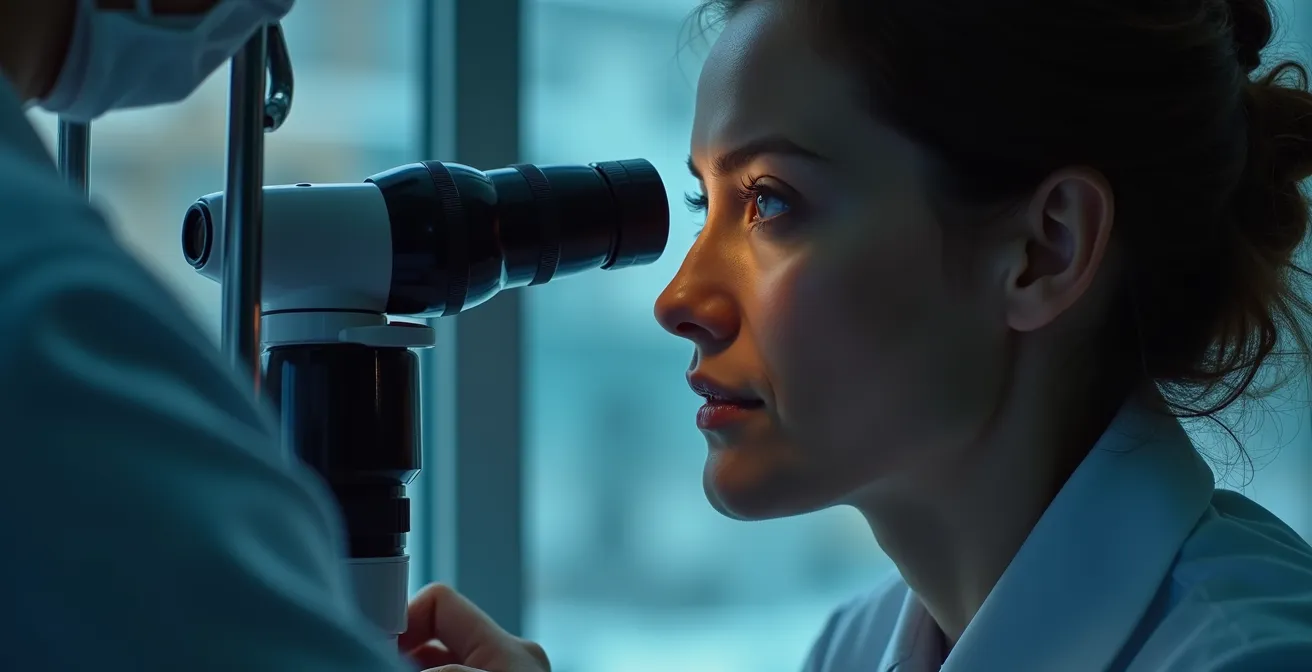
The ‘expired prescription’ notice isn’t a sales tactic; it’s a critical safety alert that your contact lenses—a class II medical device—require an essential inspection of the living tissue they sit on.
- Your eyes undergo microscopic changes in shape and chemistry over time, altering how a lens fits and depriving the cornea of oxygen, even if your vision feels sharp.
- Online vision tests cannot perform a slit lamp exam, which is the only way to detect silent, vision-threatening conditions like micro-abrasions, corneal ulcers, or giant papillary conjunctivitis.
Recommendation: View your annual exam not as a bureaucratic hurdle, but as indispensable medical device management to prevent irreversible harm to your long-term vision.
The notification arrives with predictable, frustrating timing: “Your contact lens prescription has expired. Please see your eye doctor to renew.” For the frugal and discerning patient, the reaction is often one of skepticism. If your vision is still clear and the lenses feel fine, why is this recurring, seemingly bureaucratic checkup necessary? It feels less like healthcare and more like a mandatory toll on the road to clear sight. This perspective, while understandable, overlooks a fundamental and non-negotiable medical principle.
The common wisdom states that prescriptions expire because “your eyes can change.” While true, this simplifies a far more critical reality. A contact lens is not a passive accessory like a pair of glasses; it is an active medical device that rests directly on the delicate, living tissue of your cornea. The annual exam is not primarily about re-testing your 20/20 vision. It is a medical inspection to manage the physiological impact of this device on your ocular health—an impact that is often silent, gradual, and completely invisible to you until it becomes a serious problem.
This is not a matter of convenience, but of clinical necessity. The core issue is the potential for silent pathologies and subtle changes to the eye’s micro-environment. This article will deconstruct the specific, evidence-based reasons why professional oversight is mandated. We will explore the microscopic changes your eyes undergo, the diagnostic tools an optometrist uses that telehealth cannot replicate, and the serious risks you unknowingly run when you skip these vital inspections. The goal is to reframe the annual exam from a perceived inconvenience into what it truly is: essential preventative maintenance for one of your most precious assets.
To understand the full scope of this medical necessity, this guide examines the critical health checks that occur during an in-person exam, the limitations of digital alternatives, and the practical steps you can take to manage your prescription and benefits effectively.
Summary: Why Your Contact Lens is a Medical Device Requiring Regular Inspection
- Why Your Contact Lens Fit Might Tighten After 5 Years of Wear?
- How Optometrists Grade Papillae Under Your Eyelid During Exams?
- Telehealth Vision Test or Slit Lamp Exam: Which Detects Micro-Abrasions?
- The Silent Ulcer: What Happens When You Skip Exams Because “It Feels Fine”
- When to Book Your Contact Lens Exam to Avoid Running Out of Supply
- The Danger of Relying on App-Based Vision Tests for Prescription Renewals
- Problem & Solution: Aligning Your Rx Expiration With Your Insurance Benefits
- Why 20/20 Vision Is Not a Clean Bill of Health?
Why your contact lens fit might tighten after 5 years of wear?
Over years of wear, a contact lens prescription that was once perfect can become problematic, even if the power remains correct. This isn’t about vision; it’s about the physical interaction between the lens and your eye. The cornea, the clear front surface of the eye, is a living tissue that requires a constant supply of oxygen directly from the atmosphere. A contact lens, by its nature, acts as a barrier to this oxygen. While modern lenses are highly permeable, long-term wear can still induce subtle, chronic changes.
This low-grade, long-term oxygen deprivation can cause the shape of the cornea to change slightly. It may steepen or flatten in ways that are imperceptible to you. A lens that once had an ideal fit, allowing for proper movement and tear exchange, may now be too “tight.” A tight-fitting lens doesn’t move enough, trapping debris and metabolic byproducts underneath it and further restricting oxygen. This creates a dangerous feedback loop that can lead to inflammation, infection, and corneal neovascularization—the growth of new blood vessels into the cornea as it desperately tries to get oxygen, which can threaten vision.
An optometrist assesses this fit by observing the lens’s movement on your eye during the exam. They check for adequate centration, lag, and movement on blink. These are not metrics you can self-assess. Continuing to wear a lens with a compromised fit, even if you see well, is a primary example of a silent pathology. You are unknowingly damaging your corneal integrity, which is why a periodic, professional refitting is a cornerstone of safe medical device management.
How optometrists grade papillae under your eyelid during exams?
One of the most critical parts of a contact lens exam involves a procedure you can’t see: the optometrist everts, or flips, your upper eyelid. They are looking for a specific physiological response to contact lens wear known as Giant Papillary Conjunctivitis (GPC). The inner surface of your eyelid, the palpebral conjunctiva, is lined with tiny bumps called papillae. In response to the chronic presence of a foreign body (the contact lens) and the proteins that build up on its surface, these papillae can become inflamed and enlarged.
This is a classic immune response. Optometrists use a grading scale (typically 1 to 4) to classify the size and severity of these papillae. Grade 1 might be a normal response, while Grades 3 and 4 indicate significant inflammation that requires immediate intervention. A patient with advanced GPC may notice symptoms like itching, lens intolerance, or a ropy mucus discharge, but in its early stages, it is completely asymptomatic. You would have no idea it’s developing.
Clinical Insight: The Progression of Giant Papillary Conjunctivitis (GPC)
According to clinical findings, the development of a thick, ropy mucus coating on contact lenses is a tell-tale sign of Giant Papillary Conjunctivitis. This condition is an immune response triggered by protein deposits and allergens on the lens surface. If left unchecked, the papillae under the eyelid can grow significantly, causing lens discomfort, poor fit, and blurred vision. Early detection during an in-person exam, where the eyelid is everted and inspected, is critical to managing GPC before it becomes a chronic condition that could force a wearer to cease using contacts altogether.
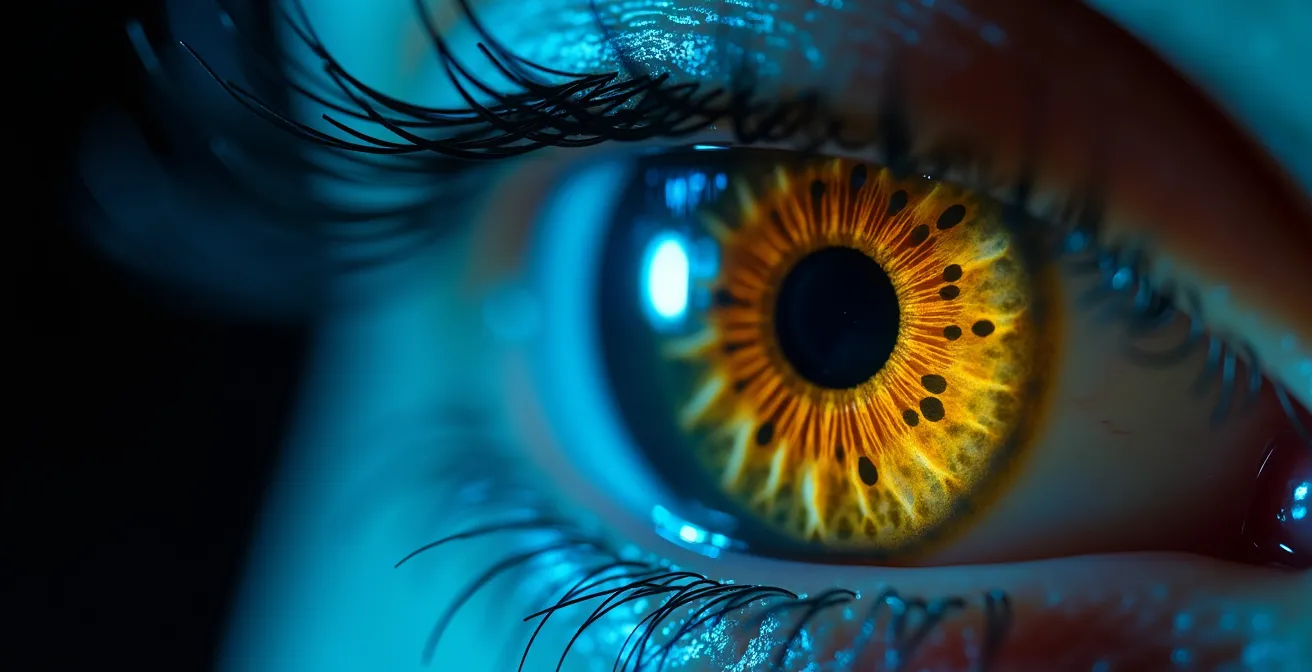
The image below shows a diagnostic procedure using fluorescein dye under cobalt blue light. This technique highlights any surface irregularities on the cornea, but the same principle of microscopic examination is used to inspect the tissues under the eyelid. Catching GPC early allows an optometrist to recommend a change in lens material, a switch to daily disposables to reduce protein buildup, or a temporary break from lens wear. Ignoring it allows a manageable issue to become a chronic, vision-impacting problem.
Telehealth vision test or slit lamp exam: which detects micro-abrasions?
The rise of telehealth has offered convenience, but for contact lens wearers, it introduces a critical diagnostic gap. An online vision test can effectively determine your refractive error—the numbers for nearsightedness or farsightedness. However, it is functionally blind to the health of your eye’s surface. The single most important tool for a contact lens exam is the slit lamp biomicroscope, something that simply cannot be replicated through a webcam.
The slit lamp is a high-powered, binocular microscope that gives the optometrist a highly magnified, stereoscopic view of your eye. By using a narrow “slit” of light, they can examine the cornea, conjunctiva, and lens in cross-section, layer by layer. This is how they detect corneal micro-abrasions, tiny scratches caused by a poorly fitting lens or debris trapped underneath it. They can also identify corneal infiltrates, which are early signs of an inflammatory response that can precede an infection. A recent study confirmed that remote digital tests cannot detect critical eye health indicators like these, nor can they measure intraocular pressure or spot early cataracts.
The following table, based on information from the American Academy of Ophthalmology, clearly illustrates the diagnostic chasm between an in-person exam and a remote test. This isn’t about one being “better”; it’s about one being a comprehensive medical evaluation and the other being a limited refraction test.
| Examination Aspect | Slit Lamp Exam | Online Vision Test |
|---|---|---|
| Magnification Level | 10-40x microscopic view | No magnification |
| Corneal Surface Detection | Can detect micro-abrasions, infiltrates, erosions | Cannot detect surface irregularities |
| Fluorescein Dye Testing | Available for highlighting epithelial defects | Not possible remotely |
| Tear Film Analysis | Direct visualization possible | Cannot assess tear quality |
| Contact Lens Fit Assessment | Can observe lens movement and positioning | Cannot evaluate physical fit |
The silent ulcer: what happens when you skip exams because “it feels fine”
The single greatest danger of forgoing regular contact lens exams is the risk of a corneal ulcer, a serious infection of the cornea that can lead to scarring and permanent vision loss. The “it feels fine” rationale is particularly dangerous here because many of the preconditions for an ulcer, and even the ulcer itself in its earliest stages, can be asymptomatic. A tiny, unfelt micro-abrasion on the cornea’s surface becomes an open door for common bacteria to invade.
This condition, known as microbial keratitis, is a medical emergency. While risk factors like sleeping in lenses or poor hygiene are well-known, even compliant wearers are at risk if their lens fit is suboptimal or their ocular surface is compromised. Without a slit lamp exam, these precursor conditions go undetected. You may be walking around with a compromised corneal defense system and have no idea. The consequences can be devastating. Data from medical device reports reveals a stark reality: approximately 20% of reported contact lens-related corneal infections resulted in eye damage, including central corneal scarring that permanently impairs vision or requires a corneal transplant.
This is the ultimate expression of a silent pathology. The transition from a seemingly healthy eye to one with a vision-threatening infection can be shockingly rapid. An optometrist is trained to spot the subtle warning signs—a small epithelial defect, a faint infiltrate, a change in tear film quality—long before you would ever feel pain or notice redness. The annual exam is your only line of defense against this silent but aggressive threat. Viewing the renewal process as a mere financial transaction ignores the profound medical risk it is designed to mitigate.
When to book your contact lens exam to avoid running out of supply
While the medical necessity of annual exams is clear, the practical frustration of running out of lenses is real. The key to avoiding this “prescription gap” is not to circumvent the system, but to manage it proactively. Aligning your exam schedule with your supply ensures a seamless transition and eliminates the stress of being on your last pair with an expired prescription.
The most common mistake is waiting until you are out of lenses to try and book an appointment. Optometry offices can be booked weeks in advance, creating an unavoidable gap. Instead, you must think of scheduling your exam as part of your supply chain. When you open your second-to-last box of contacts, that is your non-negotiable trigger to book your appointment. This simple habit creates a buffer of several weeks or even months, accommodating any scheduling difficulties.
Furthermore, it’s critical to know that contact lens prescriptions generally expire in one or two years, a timeframe often determined by state law and your individual risk profile. Do not assume you have two years. Verify the expiration date on your current prescription and plan accordingly. The following checklist provides a simple, strategic framework for never running out of contacts again.
Your action plan: strategically timing your contact lens exam
- Set Your Trigger: Book your appointment the moment you open your second-to-last box of contacts. This is your primary buffer.
- Schedule Ahead: Immediately after completing your current exam, schedule next year’s appointment while still in the office. It’s easier to reschedule than to book last-minute.
- Align with Benefits: If possible, time your exam for Q4 (October-November) to maximize the use of any expiring annual insurance benefits or FSA/HSA funds.
- Request a Bridge: Ask for a one or two-week supply of trial lenses at your exam to bridge the gap until your full order arrives.
- Use Digital Reminders: Set a calendar reminder for yourself two months before your prescription’s official expiration date as a final backstop.
The danger of relying on app-based vision tests for prescription renewals
In the quest for convenience, app-based vision tests present themselves as an easy solution to an expired prescription. They promise a quick, cheap renewal from the comfort of your home. However, these services operate with significant and publicly stated limitations that make them inappropriate and dangerous for contact lens wearers. The core issue is that they conflate a “vision test” with an “eye health exam,” and for a medical device like a contact lens, this is a critical failure.
Professional bodies like the American Academy of Ophthalmology are clear on this point. They state that online vision testing should be strictly limited to healthy young adults with no risk factors or symptoms of eye disease, primarily for renewing glasses prescriptions. For contact lenses, the equation is different. An app cannot measure the base curve and diameter required for a proper fit. A poorly fitting lens, even with the correct power, will not center properly on the cornea. This can cause not only blurry and fluctuating vision but also physical symptoms like headaches, nausea, and eye pain as your eyes strain to compensate.
This is medical device mismanagement in its purest form. You are obtaining a prescription number without any of the corresponding safety measurements that ensure the device works correctly and safely on your body. It is equivalent to getting a prescription for a blood pressure medication without ever having your blood pressure checked. The convenience is not worth the risk of chronic discomfort or, worse, inducing a corneal problem from an ill-fitting lens. The “prescription” you receive is incomplete and lacks the most critical data points for a contact lens wearer.
Problem & solution: aligning your rx expiration with your insurance benefits
For the frugal patient, a primary source of frustration is the out-of-pocket cost. Many do not realize that vision insurance often distinguishes between a standard eye exam and a contact lens fitting, with the latter incurring an additional fee. Understanding and planning for this can significantly reduce financial friction.
Before your appointment, call your optometrist’s billing department. Your first question should be about your specific vision plan’s coverage for a “contact lens evaluation,” which is often billed under the code CPT 92310. This is separate from the routine exam (refraction, code 92015). Ask what your copay is for this specific fitting fee. Knowing this cost upfront eliminates surprises and allows for proper budgeting.
The second strategy is to align your exam timing with your benefit calendar. Many patients have Flexible Spending Accounts (FSA) or Health Savings Accounts (HSA) with funds that expire on December 31st. Scheduling your exam in Q4 (October or November) is an excellent way to use these “use-it-or-lose-it” funds for your fitting fee, copays, and contact lens supply. You can even purchase a partial supply (e.g., 6 months) with your current year’s benefits and the remainder after your benefits reset on January 1st. This proactive financial planning transforms an unexpected expense into a predictable, manageable part of your annual healthcare budget.
Key takeaways
- A contact lens is a medical device requiring a health inspection, not just a vision test. An expired prescription is a safety flag, not a sales tactic.
- Silent pathologies like Giant Papillary Conjunctivitis (GPC) and micro-abrasions are undetectable without a professional slit lamp examination. Feeling “fine” is not a reliable indicator of eye health.
- Online tests cannot assess lens fit or ocular health, making them dangerously incomplete for renewing a contact lens prescription and risking long-term corneal damage.
Why 20/20 vision is not a clean bill of health?
The ultimate misconception that drives the desire to skip exams is the belief that clear vision equals healthy eyes. Having 20/20 acuity is simply a measure of your eye’s ability to see a certain size letter at a certain distance. It says absolutely nothing about your eye pressure, the health of your retina, the integrity of your cornea, or your tear film quality. It is one single data point in a complex medical assessment.
Relying on it as your sole metric for eye health is profoundly risky. As the American Optometric Association states, this is a foundational principle of preventative care.
Periodic eye and vision examinations are an important part of preventive health care. Many eye and vision problems have no obvious signs or symptoms, so you might not know a problem exists.
– American Optometric Association, Guidelines on Comprehensive Eye Exams
The scale of this issue is significant. CDC surveillance data shows that in the U.S. alone, there are nearly one million health care visits for keratitis or contact lens complications annually. A substantial portion of these cases could have been prevented with proper medical device management and routine examinations. These are not just statistics; they represent individuals who may have experienced pain, financial cost, and in some cases, permanent vision loss, all stemming from complications that were once silent and detectable.
The annual contact lens exam is the mechanism that stands between a manageable issue and a medical crisis. It is the only way to ensure the medical device you wear every day is not silently compromising the health of your eyes. The prescription expiration date is the system’s way of enforcing this critical safety check, protecting you from the very risks you cannot see or feel.
Therefore, the next time you receive that expiration notice, view it not as an obstacle, but as a vital and necessary step in the responsible management of your long-term health. To ensure your eyes receive the comprehensive care they require, scheduling a full, in-person examination with an optometrist is the only medically sound course of action.