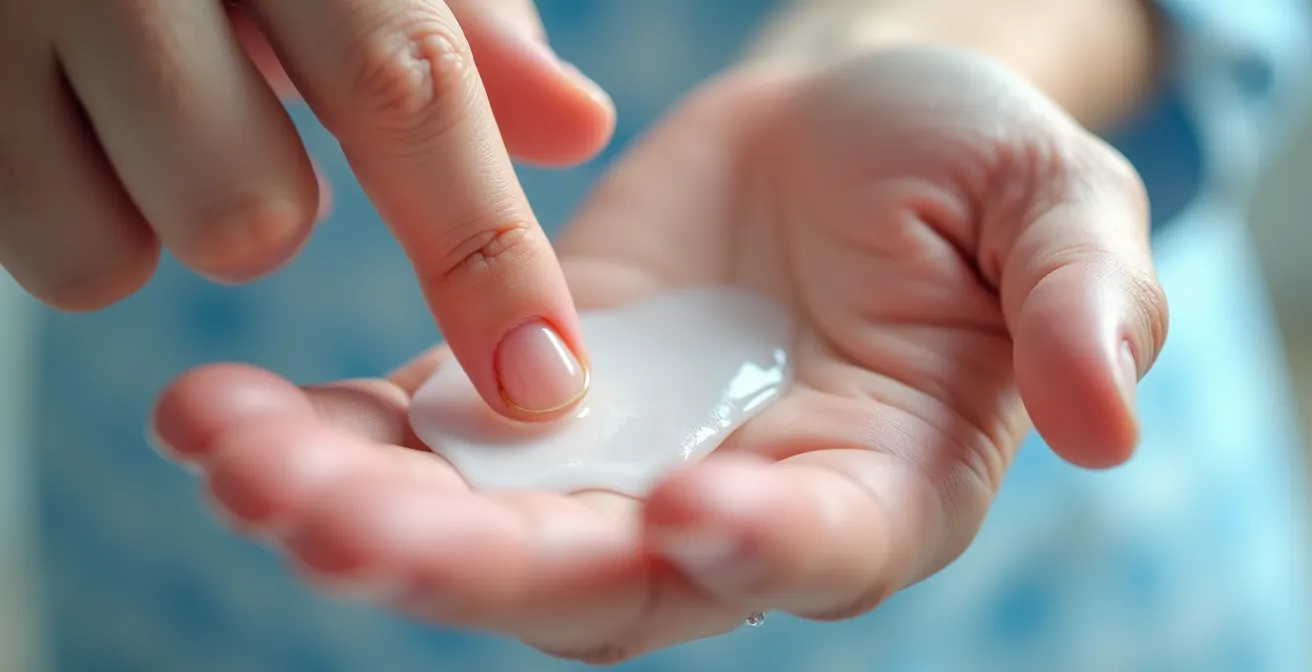
Despite “no-rub” marketing, mechanical rubbing is a non-negotiable step for complete contact lens safety because soaking alone cannot break down bacterial biofilm.
- Passive soaking disinfects but does not physically clean the lens surface from stubborn, glue-like deposits.
- Only the active friction from rubbing can dislodge lipids, proteins, and the protective matrix where bacteria hide, drastically reducing infection risk.
Recommendation: Always mechanically rub your lenses with solution for 10-20 seconds upon removal to ensure they are truly clean and safe to wear.
You bought the “no-rub” contact lens solution, followed the instructions, and yet your eyes feel gritty or your lenses seem cloudy by the end of the day. It’s a common frustration that leads many to question if they’re doing something wrong. The term “no-rub” is one of the most successful—and potentially dangerous—marketing ploys in the field of eye care. It promises convenience, but it overlooks a fundamental principle of microbiology that can put your eye health at risk.
While multipurpose solutions are excellent at disinfecting—killing free-floating bacteria and viruses in the liquid—they are often ineffective against the root cause of lens contamination: bacterial biofilm. This isn’t just loose debris; it’s a structured, sticky community of microorganisms that attaches firmly to the lens surface. Simply soaking a lens is like trying to clean a dinner plate caked with dried food just by letting it sit in soapy water. It might soften some of it, but it won’t remove the stubborn residue.
The truth is, the physical act of cleaning cannot be skipped. This article will dismantle the “no-rub” myth by explaining the science behind why rubbing is essential. We will explore what biofilm is, how to rub your lenses safely without damaging them, and why the timing of your cleaning routine is just as critical as the technique itself. The goal is not to complicate your life, but to empower you with the knowledge to protect your vision, ensuring that convenience never comes at the cost of safety.
This guide breaks down the critical reasons and techniques for proper lens care, moving beyond marketing claims to focus on the scientific realities of eye health. Explore the sections below to understand each crucial aspect of a truly safe cleaning regimen.
Summary: The Undeniable Need for Rubbing in Contact Lens Care
- Why Soaking Alone Fails to Remove Stubborn Bacterial Biofilms?
- How to Rub High-Water Content Lenses Without Ripping the Edge?
- Manual Rubbing or Ultrasonic Machines: Which Cleans Deeper?
- The Stinging Sensation Caused by Rinsing for Only 2 Seconds
- When to Clean: Why Rubbing Upon Removal Is Better Than Before Insertion
- How to Perform the “Palm Rub” Technique Without Tearing the Lens?
- Weekly Enzyme Tablets or Daily Rubbing: Which Removes Lipids Best?
- Multipurpose or Saline: Which Actually Kills Bacteria?
Why Soaking Alone Fails to Remove Stubborn Bacterial Biofilms?
The core failure of a “soak-only” approach lies in a misunderstanding of what truly contaminates your lenses. It’s not just loose dust or a few stray germs; it’s a highly organized, protective structure called biofilm. Think of biofilm as a microscopic city built by bacteria on your lens surface. The bacteria secrete a glue-like substance that creates a shield, protecting them from threats—including the disinfectants in your contact lens solution.
When you simply soak your lenses, the solution can kill bacteria floating around in the case, but it struggles to penetrate this protective matrix. The biofilm remains largely intact, ready to grow and cause irritation or, in worst-case scenarios, a serious eye infection like a corneal ulcer. This is where mechanical friction becomes essential. Rubbing the lens physically breaks apart the biofilm’s structure, scrubbing the bacteria and their protective slime off the surface. Once dislodged, the disinfectant in the solution can effectively neutralize them.
The science is clear on this. While soaking may reduce some microbial load, it is nowhere near as effective as a proper rub-and-rinse regimen. In fact, dedicated research shows that proper rubbing technique can achieve a 4 to 6 log CFU reduction in biofilm, meaning it can remove over 99.99% of the colony. Soaking alone doesn’t even come close, leaving a dangerous amount of organized bacteria on the lens you are about to put back in your eye.
How to Rub High-Water Content Lenses Without Ripping the Edge?
A common fear, especially for users of soft lenses with high water content, is that rubbing will tear the delicate material. These lenses are indeed more fragile, but a proper technique not only prevents damage but is crucial for cleaning them. The key is to use a gentle, controlled motion and avoid common mistakes like using your fingernails or applying too much pressure.
The goal is to create a “hydroplaning” effect, where your finger glides over a cushion of solution, providing enough friction to dislodge deposits without stressing the lens material. One effective and safe method is the “Clock Face” technique. After placing the lens in your clean palm with a few drops of solution, imagine it’s a clock. Use the pad of your index finger to gently rub from the center to the 12 o’clock position and back. Repeat this for the 3, 6, and 9 o’clock positions. This ensures you cover the entire surface with lateral (back-and-forth) motions rather than circular ones, which can twist and stretch the lens.
The image below demonstrates the correct finger positioning, ensuring you are using the soft pad of your finger, not the tip or nail, to apply gentle pressure within a pool of cleaning solution.
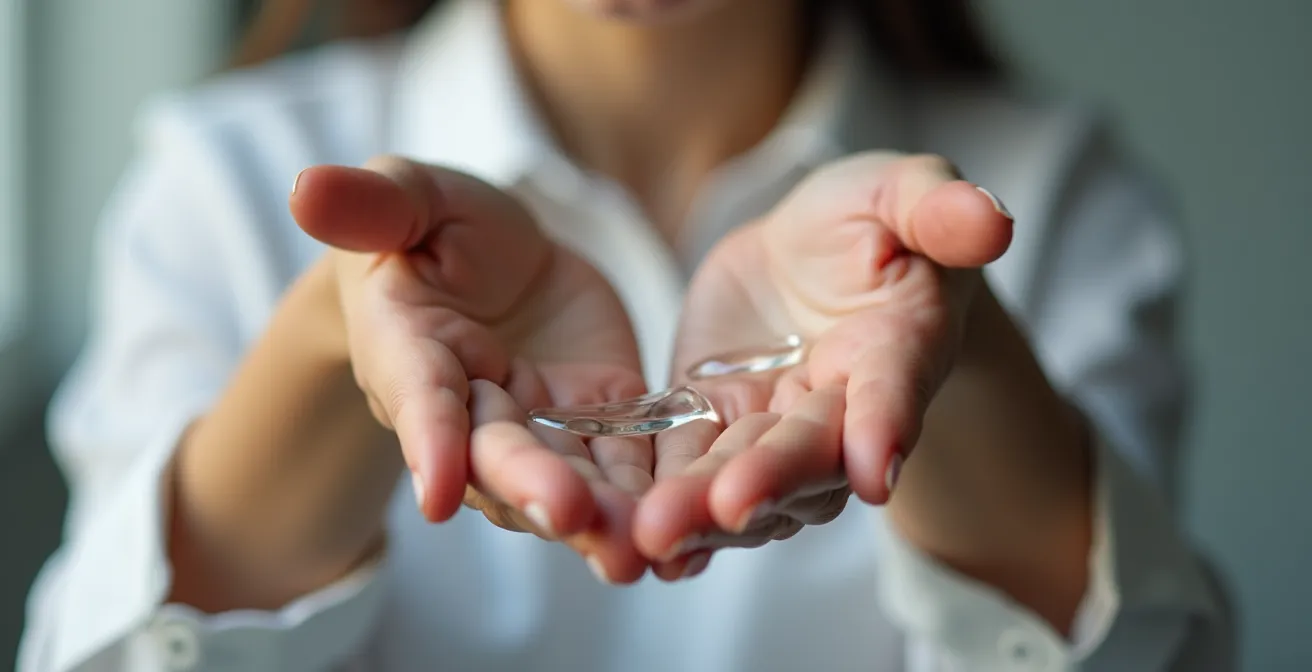
By using the soft pad and ensuring there is always a pool of solution, you create a safe, low-friction environment. This allows you to apply enough mechanical force to break up biofilms and protein deposits without ever putting the lens edge at risk of tearing. It’s about being deliberate and gentle, not aggressive.
Manual Rubbing or Ultrasonic Machines: Which Cleans Deeper?
With the rise of consumer gadgets, ultrasonic contact lens cleaners have become a popular alternative, promising a deep clean with no effort. These devices use high-frequency sound waves to create microscopic bubbles in the solution, which implode and theoretically dislodge debris. While the technology is sound for cleaning jewelry or other hard surfaces, its effectiveness on soft contact lenses is a subject of debate among eye care professionals.
The primary issue is that while ultrasonic waves can agitate the solution and shake loose some larger, non-adherent deposits, they may lack the targeted force needed to break down a well-established, sticky biofilm. The mechanical shear force applied by your finger pad is direct, controlled, and far more effective at physically scraping away the protein and lipid layers that are essentially “baked on” the lens after a full day of wear.
Many optometrists remain skeptical of a hands-off approach, emphasizing that nothing has proven more effective than the classic rub-and-rinse method. Even leading ophthalmologists advocate for the tactile approach. As a prominent eye health authority, the American Academy of Ophthalmology, highlights the consensus view. Dr. W. Barry Lee, a respected ophthalmologist, offers this direct advice:
Dr. W. Barry Lee still recommends rubbing the lenses for 10 seconds with your fingers. ‘This will ensure that any remaining debris is removed.’
– Dr. W. Barry Lee, American Academy of Ophthalmology
Ultimately, while an ultrasonic machine might feel futuristic, it can’t replace the proven effectiveness of manual cleaning. The direct, physical friction is simply superior at ensuring every part of the lens, especially the central optic zone you look through, is free of vision-impairing and infection-causing biofilm.
The Stinging Sensation Caused by Rinsing for Only 2 Seconds
You’ve diligently rubbed your lenses, but when you put them in, you feel an immediate stinging or burning sensation. The likely culprit isn’t the solution itself but an insufficient rinse. After you rub your lenses, you’ve successfully loosened a cocktail of debris: proteins, lipids, dust, and the now-broken-up biofilm. If you only give the lens a quick, two-second rinse, you’re not washing all of that material away.
What’s left on the lens is a concentrated mix of debris and disinfectant. When this touches your cornea, it can cause significant irritation and stinging. The rinse step is not just about washing off the solution; it’s about flushing away the dislodged contaminants. A short rinse simply redistributes them across the lens surface, where they can re-adhere during storage or cause immediate discomfort upon insertion.
To avoid this, a thorough rinse is non-negotiable. Optometry guidelines are specific about this: you must rinse the lens generously to ensure it is completely clean. The American Optometric Association and other eye care bodies recommend rinsing each side for at least 10 seconds with a steady stream of fresh multipurpose solution. This duration ensures that all loosened particles and excess disinfectants are completely washed away, leaving a pristine surface that won’t irritate your eye.
When to Clean: Why Rubbing Upon Removal Is Better Than Before Insertion
The timing of your cleaning routine is just as important as the technique. Many users believe cleaning their lenses in the morning, right before insertion, is sufficient. This is a critical mistake. The ideal time to perform the rub-and-rinse step is immediately upon removing the lenses at the end of the day. The reason is simple: you want to remove deposits before they have time to set and form a mature biofilm.
When you take your lenses out, they are covered in a fresh layer of proteins, lipids, and microorganisms from your tears and the environment. If you place them directly into the case to soak overnight, you are giving that biofilm a 6-to-8-hour, undisturbed incubation window to establish itself. During this time, the deposits can bind more tightly to the lens surface, making them much harder to remove in the morning. This hardened, established biofilm is what causes chronic discomfort and increases infection risk.
The following visual metaphor illustrates the difference. Cleaning upon removal deals with fresh, soft deposits, like morning dew. Cleaning in the morning means tackling a hardened, crystallized structure.

By cleaning the lenses thoroughly upon removal, you place a pristine lens into the disinfecting solution. The solution can then do its job effectively overnight, killing any residual microbes on a clean surface. Studies on biofilm formation in lens cases confirm this, demonstrating that cleaning lenses before storage significantly reduces overnight biofilm growth. Cleaning at night is proactive; cleaning in the morning is reactive and far less effective.
How to Perform the “Palm Rub” Technique Without Tearing the Lens?
The “palm rub” is the gold-standard technique recommended by optometrists for its effectiveness and safety. When done correctly, the risk of tearing a lens is virtually zero. The method relies on creating a lubricated surface in your palm and using the softest part of your finger to apply gentle, consistent pressure. It is the most reliable way to ensure you’ve broken down biofilms without damaging the lens.
The entire process is methodical. You are not just randomly rubbing; you are systematically cleaning the entire lens surface. According to the American Optometric Association, this simple act is the single most important factor in preventing lens-related complications. The evidence conclusively shows that a rub-and-rinse routine provides the safest lens-wearing experience. Forget the “no-rub” shortcut and embrace this simple, vision-saving habit.
Follow these steps precisely to ensure a safe and thorough clean every time. This checklist removes all guesswork and turns a critical safety task into a simple, repeatable routine.
Your Action Plan: The Perfect Palm Rub Technique
- Place at least 3 drops of multipurpose solution on each side of the lens surface to fully lubricate it.
- Cup your non-dominant palm slightly to create a “solution well” that will hold the lens and solution.
- Place the lens in the center of your palm, ensuring it is floating in the small pool of solution.
- Use the soft pad of your index finger from your dominant hand—never the fingertip or nail—to make contact with the lens.
- Gently rub the lens back and forth in straight lines for at least 20 seconds, ensuring you cover the entire surface.
After rubbing, the final, crucial step is to thoroughly rinse each side of the lens for at least 5-10 seconds with fresh solution to wash away all the dislodged debris before placing it in your clean case with new solution.
Weekly Enzyme Tablets or Daily Rubbing: Which Removes Lipids Best?
For wearers who experience heavy protein and lipid buildup, weekly enzymatic protein remover tablets have long been an option. These tablets are dissolved in saline solution to create a bath that breaks down stubborn protein deposits that daily cleaning might miss. However, they are not a substitute for daily mechanical rubbing, especially when it comes to lipids (oily deposits).
Enzyme tablets are specifically designed to target proteins. They are less effective against lipids, which require a surfactant—a detergent-like agent found in multipurpose solutions—combined with mechanical friction to be properly removed. Rubbing the lens with a multipurpose solution acts like washing a greasy dish: the surfactant helps lift the oil, and the physical scrubbing removes it. Relying only on a weekly enzyme soak leaves these lipid films on the lens, leading to a hazy, uncomfortable wearing experience.
Furthermore, the “no-rub” marketing trend has created a dangerous sense of complacency. Wearers may believe that since their daily solution is “no-rub,” an occasional enzyme clean is all the extra care they need. This overlooks the daily accumulation of biofilm. The reality is that compliance with complex, multi-step cleaning routines is notoriously low. In fact, studies show a noncompliance rate as high as 79% among contact lens wearers, even with simpler regimens. A consistent, daily rub-and-rinse habit is far safer and more effective than a weekly deep clean that is often forgotten or done improperly.
Key Takeaways
- “No-rub” is a marketing term; mechanical friction is a physical necessity to break down bacterial biofilm.
- Clean lenses immediately upon removal to prevent an overnight incubation window where deposits harden.
- Use a “palm rub” technique with back-and-forth motions for 10-20 seconds, followed by a thorough 10-second rinse on each side.
Multipurpose or Saline: Which Actually Kills Bacteria?
A final, critical point of confusion for many users is the difference between multipurpose solution (MPS), saline solution, and hydrogen peroxide systems. Using the wrong one for the wrong task can render your entire cleaning routine useless and even dangerous. The most important distinction to understand is that saline solution does not disinfect.
Saline is simply a pH-balanced saltwater solution. Its only job is to rinse. It contains no cleaning agents and no disinfectants. Never use it to clean, disinfect, or store your lenses. Storing lenses in saline is like leaving them in a petri dish of stagnant water—it becomes a breeding ground for bacteria. Multipurpose solutions, on the other hand, are the all-in-one workhorses. They contain surfactants to clean and active disinfectants to kill microorganisms.
Hydrogen peroxide solutions offer the most powerful level of disinfection but require a crucial neutralization step. The peroxide is extremely effective at killing germs but will cause severe stinging and burning if it comes into contact with the eye. These systems always come with a special case containing a catalytic disc that neutralizes the peroxide into simple saline over 4-6 hours. This system is excellent for those with sensitivities to the preservatives in MPS, but the rules must be followed precisely. The following table clarifies the role of each solution.
| Solution Type | Disinfecting Power | Primary Function | Key Warning |
|---|---|---|---|
| Multipurpose (MPS) | Contains active disinfectants | Clean, rinse, disinfect, store | Never mix old with new solution (“topping off”). |
| Saline | NO disinfecting power | Rinse only | Never use for storage—becomes a bacterial breeding ground. |
| Hydrogen Peroxide | Powerful disinfection | Deep clean & disinfect | Must be neutralized for 4-6 hours in its special case before use. |
Choosing the right solution is fundamental to eye health, but as this comparative analysis from the CDC shows, knowing its specific purpose is even more critical. Using a product for a function it was not designed for is one of the fastest routes to an eye infection.
Frequently Asked Questions About Contact Lens Cleaning
Why does my lens sting even after rinsing?
A stinging sensation is most often caused by an insufficient rinse. A quick, 2-second rinse is not enough to remove the mixture of loosened debris and concentrated disinfectants left after rubbing. This residue irritates the eye upon insertion. A thorough rinse of at least 10 seconds per side is necessary to completely flush the lens surface.
What happens if I skip the rinse step?
Skipping the rinse leaves all the dirt, proteins, and lipids you just loosened on the lens. These deposits can re-adhere to the surface during overnight storage, making the lens uncomfortable and significantly increasing your risk of infection, as the disinfectant’s effectiveness is compromised.
Should I rinse before and after soaking?
Yes. The primary rub and rinse should happen upon removal at night. However, it is also best practice in the morning, after washing and drying your hands, to give your lenses another quick rub and rinse with fresh solution before putting them in. This removes any airborne particles that may have settled in the case overnight.
Can I use saline solution to store my contacts overnight?
Absolutely not. Saline solution has zero disinfecting properties and should never be used for cleaning or storing lenses. It is only for rinsing lenses *after* they have been cleaned and disinfected with a proper system like a multipurpose or hydrogen peroxide solution. Storing lenses in saline is a major risk factor for severe eye infections.
What is ‘topping off’ and why is it dangerous?
“Topping off” is the practice of adding a bit of fresh solution to the old solution already in your contact lens case. This is extremely dangerous because it dilutes the concentration of the disinfectant, rendering it ineffective at killing bacteria. Always discard all old solution, rinse the case with fresh solution, and fill it with new solution every single time.
Why does hydrogen peroxide solution require special cases?
Hydrogen peroxide is a powerful disinfectant but is highly caustic and will cause severe stinging and burning if it touches your eye directly. The special cases included with these systems contain a platinum-coated disc that acts as a catalyst, neutralizing the hydrogen peroxide into harmless, pH-balanced saline over a period of 4 to 6 hours. This step is mandatory before the lens is safe to wear.